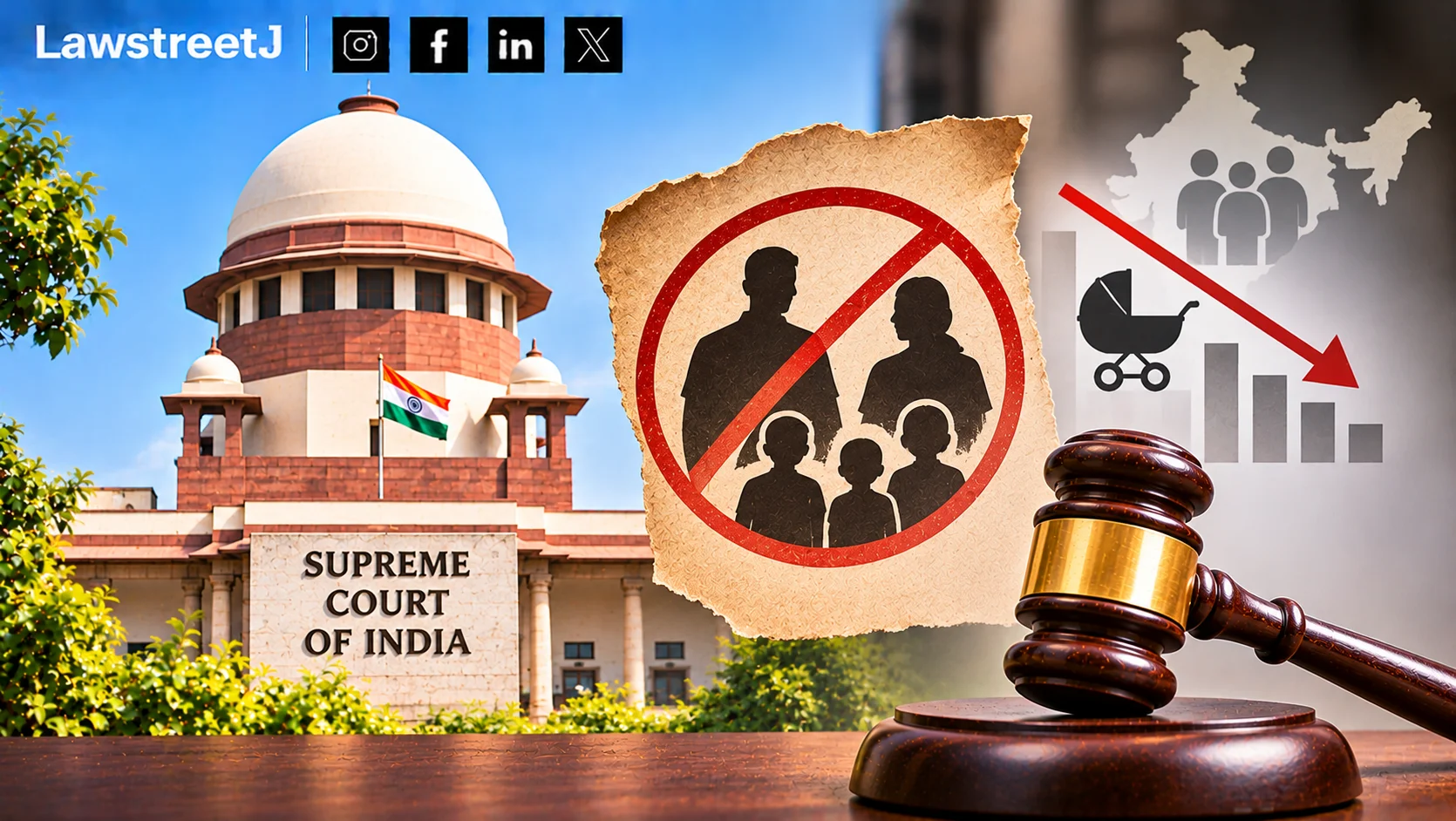
New Delhi: The Supreme Court has referred to a larger Bench for reconsideration its 2003 ruling in Javed v. State of Haryana, which upheld disqualification of persons having more than two children from panchayat elections, saying that laws penalising having more than two children “have lost their relevance” as the fear of overpopulation on which they rested has crumbled due to demographic changes.
A Bench of Justice Pamidighantam Sri Narasimha and Justice Alok Aradhe delivered the judgment on 4 November 2026 (2026 INSC 1193) and directed the Registry to place it before the Chief Justice of India to constitute an appropriate Bench.
The Court was hearing the appeal of Mangala Bhimrao Ingle, whose election as Sarpanch of Kakoda Gram Panchayat was set aside on the ground that she was disqualified under Section 14(1)(j-1) of the Maharashtra Village Panchayats Act, 1959 for having more than two children. According to the judgment, she gave birth to a third child in 2014 but contested and won the 2022 elections. Her only argument was that there was no conclusive proof of the third child as the place of issue of the birth certificate was allegedly invalid.
The Bench said that its enquiry was not about the legality of the High Court’s application of the law, but about whether such laws remain relevant when their foundation has changed. It stated that the constitutional validity of the Maharashtra provision, and of Javed and Rajbala, was not under challenge and that it was not adjudicating on them directly, but that this did not stop it from declaring that the underlying basis of those judgments no longer holds ground.
The Court noted that Javed had relied on the then concern about a “population explosion”, the National Population Policy 2000 and the situation in China. It recorded that, according to the Sample Registration System, India’s Total Fertility Rate has fallen from about 3.0 to 1.9, below the replacement rate of 2.1, and that NFHS-6 estimates it at about 2.0. It added that the population is not yet declining because of demographic momentum, but that the share of persons aged 60 and above is projected to rise to nearly 15% by 2036.
The Bench observed that the Chinese experience, which Javed cited as an instance of successful population control, moved in the opposite direction, as China abandoned its one-child policy in 2015 and permitted three children in 2021, without the anticipated revival in births, and that Japan faces high public expenditure on its ageing population. It said that India should guard against a potentially irreversible decline in fertility, and that “we cannot ride into the future on a horse that is dead”.
On the role of constitutional courts, the Court relied on the doctrine of temporal reasonableness, drawing on Malpe Vishwanath Acharya, Satyawati Sharma and State of Maharashtra v. Super Max International, to say that a law valid at the time of enactment may become arbitrary as circumstances change. It referred to Justice Sinha’s dissent in Devans Modern Breweries on a decision ceasing to be law owing to changed conditions, and to Yash Developers on the court’s role in auditing the working of statutes. It also noted that courts cannot direct the legislature to repeal or amend a law, but can examine whether its continued operation remains constitutionally sustainable.
Turning to the Javed line of cases, the Court noted that the Haryana provisions upheld in Javed were repealed in 2006, but that the decision had influenced Rajbala v. State of Haryana, which upheld educational and other qualifications for panchayat elections. It recalled that, on the data before the Court in Rajbala, about 68% of Scheduled Caste women and 41% of Scheduled Caste men would be ineligible, and referred to the three-Judge Bench’s questioning of Rajbala in Sukanya Shantha v. Union of India.
The Court found that the two-child disqualification restricts political representation, referring to Dr. Ambedkar’s description of citizenship as a “bundle of rights” and his view on the right to hold office. It said that the norm has disproportionate effects on women, citing a 2009 study for the Ministry of Panchayati Raj that recorded instances of forced abortions, desertion of pregnant wives and denial of paternity to evade disqualification, and that son preference shapes reproductive decisions across socio-economic groups.
On reproductive autonomy, the Court held that the right to make reproductive decisions is an integral facet of Article 21, relying on Suchita Srivastava and Puttaswamy, and that the State cannot achieve indirectly, through adverse civil or political consequences, what it cannot ordinarily compel directly. It said that disqualification upon the birth of a third child places a person in the position of choosing between reproductive autonomy and participation in democratic governance.
Concluding that, even if the law was valid when made, it has become invalid as the foundation on which it rested has changed, the Bench referred the matter to a larger Bench for reconsideration of the ratio in Javed. It noted that the High Court’s judgment had been stayed when notice was issued, so the appellant continues as Sarpanch, and directed that the interim order continue until disposal of the civil appeal. It placed on record the assistance of the Amicus Curiae, Ms. Rukhmini Bobde.
Case Title: Mangala Bhimrao Ingle v. The Additional Commissioner, Amravati Division and Others, Civil Appeal arising out of Special Leave Petition (C) No. 30772 of 2025