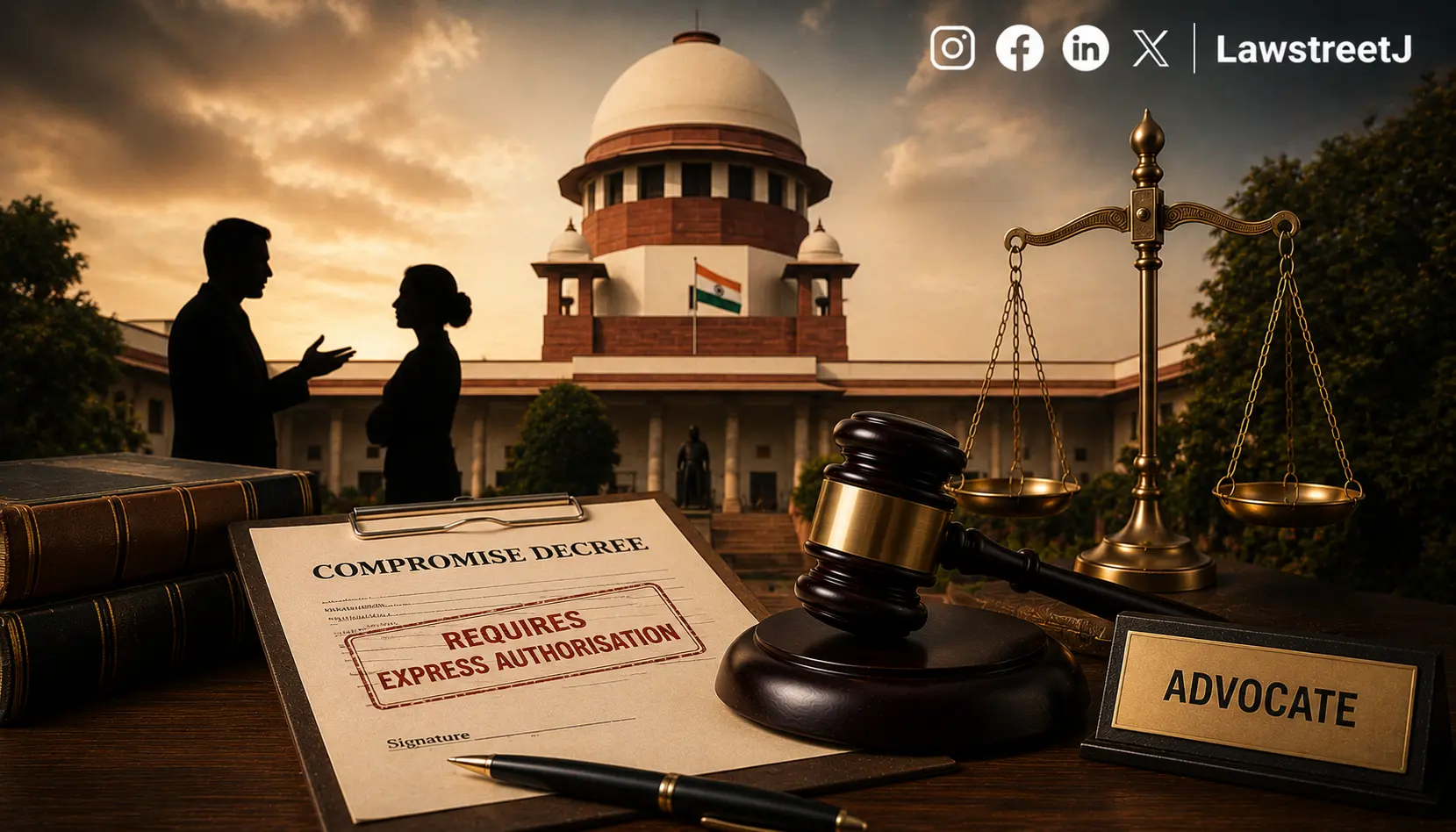
The Supreme Court has held that a compromise decree under Order XXIII Rule 3 of the Code of Civil Procedure, 1908 is invalid if it was entered into by a lawyer without the client's express authorisation, and upheld the setting aside of a 32-year-old compromise decree in a partition suit despite a 25-year delay in challenging it.
Background
A bench of Justice Sanjay Karol and Justice Nongmeikapam Kotiswar Singh was hearing an appeal against a judgment of the High Court of Judicature at Patna, which had dismissed a civil revision challenging an order of the Sub-Judge-01 (East), Muzaffarpur, setting aside a compromise decree dated 22nd February 1994 passed in a partition suit filed in 1989.
The original plaintiff had filed a partition suit seeking a one-fourth share in ancestral property, impleading, among others, one Chaturbhuj Chaudhary as defendant No. 5. During the pendency of the suit, a compromise petition was filed jointly by the plaintiffs and defendants, which was accepted by the trial court on 22nd February 1994, and a final decree followed in 1997. Nearly a quarter of a century later, in 2022, the legal representatives of defendant No. 5 moved a miscellaneous application under Section 151 of the CPC seeking to set aside the compromise decree, contending that it had been obtained by fraud and that defendant No. 5 had never signed it. The trial court allowed the application in 2024, a decision affirmed by the High Court, leading the legal heirs of the original plaintiffs to approach the Supreme Court.
Arguments
The appellants contended that defendant No. 5 had duly engaged an advocate, filed a written statement, and joined the compromise petition through counsel, whose vakalatnama was on record since 1992. It was submitted that defendant No. 5 was well acquainted with the suit and had, in fact, played an active role in securing the final decree.
The respondents, on the other hand, maintained that defendant No. 5 had never engaged the advocate in question, that his signatures on the written statement and vakalatnama were fabricated, and that he had no knowledge of the compromise proceedings at all. They further contended that the cause of action arose only in April 2022, when they were asked to vacate the suit property and, upon inspecting the record, discovered the alleged fraud for the first time.
Analysis
Examining Order XXIII Rule 3 of the CPC, the Court traced the settled position that, after the 1976 amendment, a compromise must be in writing and signed by the parties, the object being to prevent false and frivolous pleas of settlement. While a counsel or duly authorised representative may sign a compromise decree on a client's behalf, the Court reiterated, relying on Byram Pestonji Gariwala v. Union Bank of India and Himalayan Coop. Group Housing Society v. Balwan Singh, that this can only be done where there is express authorisation or an exigency of circumstance, and that a lawyer has no implied authority to surrender a client's substantial legal rights.
The Court surveyed a line of its earlier decisions on compromise decrees, noting that prior to the 1976 amendment a compromise could be oral or written and proved through general evidence, as held in Gurpreet Singh v. Chatur Bhuj Goel, but that post-amendment it must be in writing and signed by the parties, as clarified in Som Dev v. Rati Ram. It further reiterated, drawing on Banwari Lal v. Chando Devi, that while a court accepting a compromise decree essentially puts a seal of approval on it, its role is not confined to that of a mere recorder; it must apply its judicial mind to ensure that the terms are lawful and voluntarily accepted. The Court also referred to the recent decision in Prasanta Kumar Sahoo v. Charulata Sahoo, which had revived a decades-old caution from the Madras High Court that, absent express power in the vakalatnama itself, a special vakalatnama or the specific consent of the party ought to be obtained before a compromise is entered into on their behalf.
The Court observed that an advocate should not act on implied authority in the absence of exigent circumstance, and found that there was neither express authorisation from defendant No. 5 permitting his counsel to sign the compromise, nor any material on record showing exigent circumstances that justified counsel acting without such authorisation. In the absence of these elements, the Court held, the voluntariness mandated by Order XXIII Rule 3 could not be established, rendering the resulting compromise contrary to law.
On the question of the 25-year delay in challenging the decree, the Court declined to treat limitation as a bar. It held that the law of limitation, though an important facet of the legal system, cannot be used to defeat substantive rights, particularly where the basic facts underlying the compromise, including whether defendant No. 5 was even aware of the suit, remained squarely disputed between the parties. The Court noted that the challenge was set into motion only after the respondents were sought to be dispossessed in 2022, nearly two decades after defendant No. 5's death, and that permitting the delay to defeat the application would perpetuate a decree that was not in accordance with law.
Conclusion
Holding that the compromise decree had been correctly set aside and that the underlying partition suit required adjudication on a full trial, the Supreme Court dismissed the appeal, with no order as to costs, notwithstanding the acknowledged difficulty of taking a 1989 suit to trial 37 years later.
Case Title: Krishna Kumar Ojha & Ors. versus Jitendra Chaudhary & Ors., Civil Appeal (Arising out of SLP(C) No. 13671 of 2025)