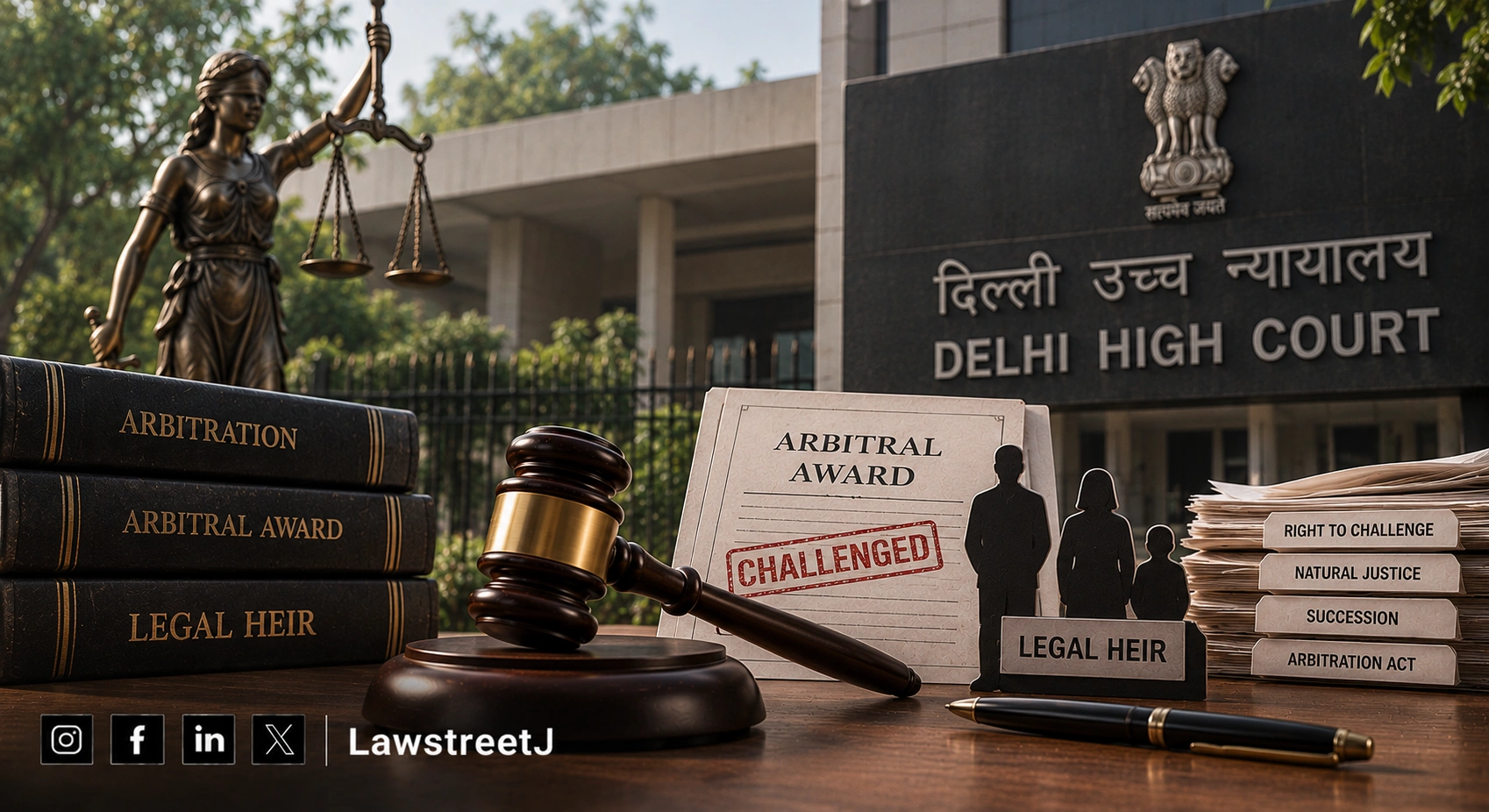
New Delhi: The Delhi High Court has dismissed a writ petition seeking intervention in arbitral proceedings on behalf of a legal heir who was not impleaded by his co-heir in a claim concerning their late father's estate, holding that the petitioner was not without a remedy, since a legal representative claiming under a deceased party can challenge the eventual arbitral award under Section 34 of the Arbitration and Conciliation Act, 1996, even without having participated in the arbitration.
Dr. Justice Swarana Kanta Sharma was hearing a petition filed by Faisal Ahmed, one of the nine legal heirs of late Sh. Sultan Ahmed, seeking a stay of further arbitral proceedings and/or pronouncement of the award, his impleadment along with the other legal heirs, an opportunity of hearing, and, if necessary, reopening of the proceedings to enable such participation.
The petitioner's case was that his late father had entered into agreements with Asian Hotels (North) Limited (AHNL) concerning a shop at the Hyatt Regency Shopping Arcade, New Delhi, disputes over which culminated in arbitral proceedings before a Sole Arbitrator. It was contended that respondent no. 2, Mr. Mujeeb Ahmed another of the nine legal heirs had instituted and pursued the arbitration as legal representative of the deceased without disclosing the existence of the other legal heirs, and that the petitioner learnt of the proceedings only after they had reached the stage of final arguments, upon which he filed an intervention application before the Arbitrator seeking a hearing and a direction that any relief be recorded as belonging to all the legal heirs jointly.
The learned Arbitrator, by order dated 07.05.2026, disposed of the intervention application, observing that respondent no. 2 represented the estate of the deceased in the proceedings and that any relief secured by him would be held in that representative capacity, but that the inter se rights of the legal heirs could not be adjudicated by the Tribunal and that the petitioner would have to pursue appropriate remedies before a forum of competent jurisdiction.
Assailing this order before the High Court, counsel for the petitioner argued that continuation of the arbitration without notice to or participation of all the legal heirs violated the principles of natural justice and Section 18 of the Act, that respondent no. 2 could not exclusively prosecute claims concerning the entire estate without the other heirs' consent, and that since the petitioner was never a party to the arbitration, no appeal lay under Section 37, leaving Articles 226 and 227 as the only available recourse at this stage; relegating him to a post-award remedy, it was submitted, would cause grave prejudice either way the arbitration was decided.
Counsel for AHNL opposed the petition, submitting that the petitioner was not without a remedy and could challenge any eventual award under Section 34, that any independent claim at this stage would in any event be time-barred given that the underlying termination letter dated 29.05.2020 pre-dated the petitioner's approach to the court by several years, and that the belated intervention, sought when the arbitration had already reached final arguments, would seriously prejudice and derail the proceedings.
Examining the scope of its jurisdiction, the court noted that while Section 5 of the Act embodies a policy of minimal judicial intervention in arbitral proceedings, this does not entirely oust the constitutional jurisdiction under Articles 226 and 227, though, per the Supreme Court's decisions in SBP & Co. v. Patel Engineering Ltd. and Bhaven Construction v. Executive Engineer, Sardar Sarovar Narmada Nigam Ltd., such interference is confined to cases of exceptional rarity where a party is left ‘remediless’ or there is ‘clear bad faith’. Relying on the Supreme Court's recent clarification in Harshbir Singh Pannu v. Jaswinder Singh, the court observed that this expression must be read against the statutory scheme, so that an order challengeable within the confines of Sections 34 and 37 would not ordinarily be amenable to writ interference.
Tracing the statutory position of a legal representative under Sections 2(1)(g), 35 and 40 of the Act, the court held that the death of a party does not bring arbitral proceedings to an end, and that the resulting rights and obligations survive to bind the legal representative, who correspondingly acquires the right to avail statutory remedies against an award affecting the estate. Relying on the Supreme Court's decision in V.K. John v. S. Mukanchand Bothra and HUF, the court noted that a legal representative claiming under a deceased party is entitled to challenge the arbitral award under Section 34, even if he had not himself participated in the arbitration, and that such a person cannot be treated as remediless merely because the proceedings continued through a co-heir.
The court further noted, relying on Daya Ram v. Shyam Sundari and subsequent decisions, that where one of several legal representatives is on record, he represents the estate, and that proceedings do not become invalid merely because all legal heirs have not been individually impleaded. It observed that the Arbitrator had already clarified that respondent no. 2 represented the estate of the deceased in a representative capacity, and did not enjoy any exclusive personal entitlement to relief a clarification the court affirmed, adding that any adverse outcome would equally bind the estate as represented in the arbitration.
Weighing these considerations against the advanced stage of the arbitration, the court held that the petitioner was not left remediless, since any grievance regarding want of notice or opportunity to participate could be raised as a ground to challenge the eventual award under Section 34 of the Act, and that the case did not fall within the narrow parameters warranting interference under Article 226 or 227 at this stage.
The petition, along with the pending application, was accordingly dismissed, with the court clarifying that it had not expressed any opinion on the inter se rights of the legal heirs in the estate or on any other substantive claim available to the petitioner, and that the observations made would not prejudice any remedy available under Section 34 of the Act or before any other competent forum.
Appearances:
For the Petitioner: Mr. Harsh Vardhan Sharma, Mr. Saksham Gupta and Mr. Neeraj Kumar, Advocates.
For Respondent No. 1 (AHNL): Ms. Akansha Kaul, Advocate. For Respondent No. 2: Mr. Deepak Dhingra, Senior Advocate, with Ms. Sneh Somani and Ms. Riya Sardana, Advocates.
Case Title: Faisal Ahmed vs. Asian Hotels North Ltd & Anr., W.P.(C) 10751/2026 & CM APPL. 49847/2026


![Delhi High Court Sets Aside Arbitral Tribunal's Award Against NHAI in Highway Project Delay Case [Read Judgment]](/secure/uploads/2023/07/lj_9605_23374c2e-392c-4491-a2fe-f2f12fc5272f.jpg)
![Delhi Court Rejects Stay Request in Defamation Case Against Rajasthan CM Ashok Gehlot [Read Order]](/secure/uploads/2023/08/lj_5208_80de1ddc-d76a-4f7f-b180-408e3ae14fb4.jpg)