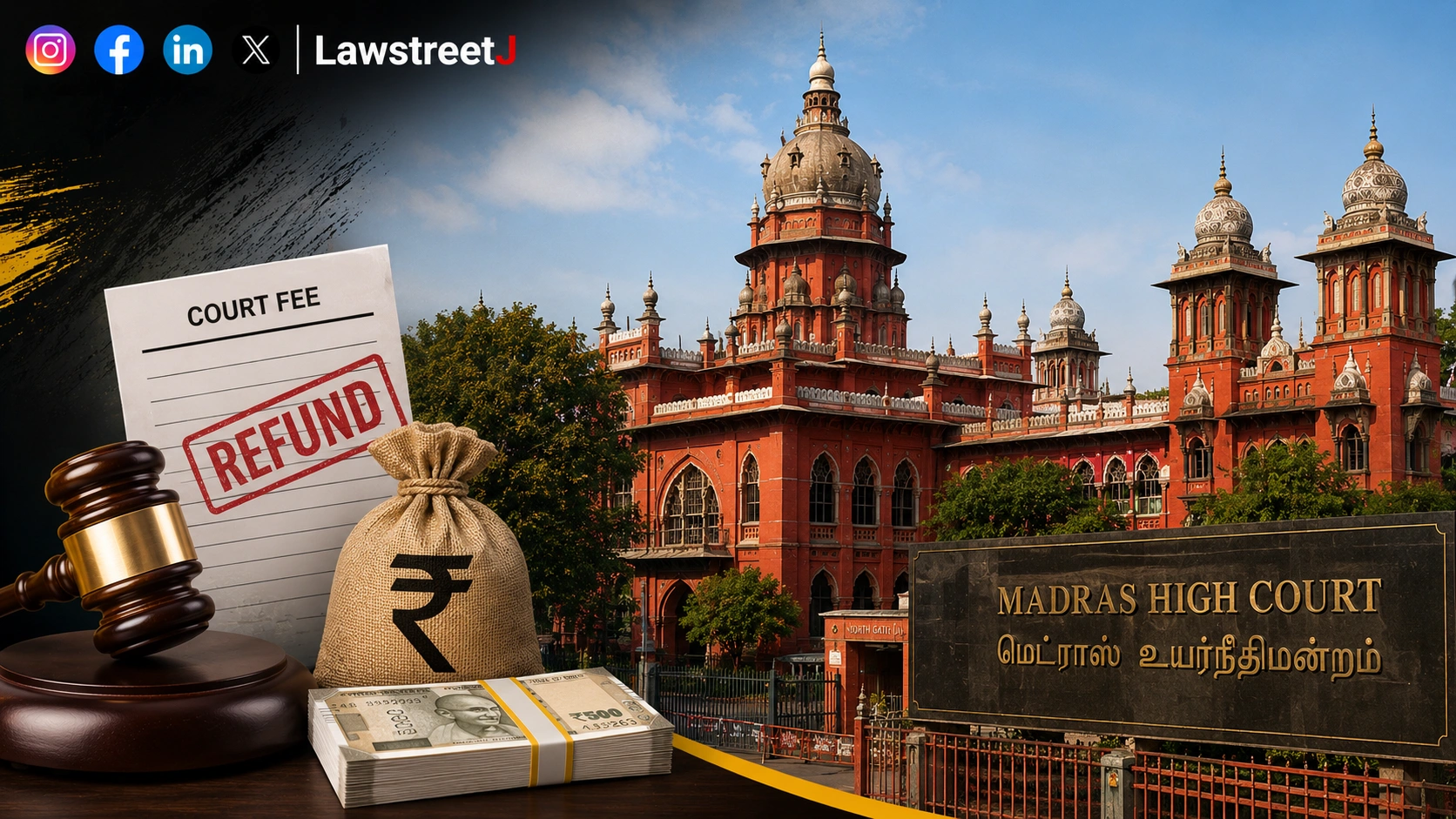
Madurai: The Madurai Bench of the Madras High Court has held that a litigant whose appeal is closed as not maintainable is entitled to a refund of the court fee paid, holding that filing such an appeal amounts to "inadvertence" within the meaning of Section 70 of the Tamil Nadu Court-Fees and Suits Valuation Act, 1955, and that retaining the fee would result in unjust enrichment of the State.
A Division Bench of Justice G.R. Swaminathan and Justice K.K. Ramakrishnan was hearing an arbitration appeal filed under Section 37(2) of the Arbitration and Conciliation Act, 1996, seeking to set aside an arbitral award dated 24.10.2024. The Court noted at the outset that Section 37 of the Act only catalogues specific appealable orders, and a final arbitral award is not among them; it can only be challenged through a petition under Section 34. Observing that the appeal had, unfortunately, not only been filed but also numbered, the Court held it was ex-facie not maintainable and closed it, granting the appellant liberty to pursue his remedy in the manner known to law.
Counsel for the appellant then requested that the court fee paid be refunded. Section 70 of the Tamil Nadu Court-Fees and Suits Valuation Act, 1955 mandates that a fee paid by "mistake or inadvertence" shall be refunded, and the Court observed that the use of the word "shall" casts a duty on the court to order refund once that threshold is met. Examining precedent, it noted that in K.S. Venkatraman & Co. v. State of Madras, refund was refused where the fee had been paid deliberately for obtaining relief, while in Zahoorunnissa Begum Sahiba v. T. Mohammed Ali Sahib and later in Indian Bank v. Godfrey W. Noble, courts held that mistakes of procedure, including filing in the wrong forum, also fell within Section 70's protection.
The Bench recorded that it would not have hesitated to grant the refund but for a Full Bench ruling in The Official Receiver, Coimbatore v. S.A. Ramaswamy, which had refused a refund on facts where counsel had conceded that the fee was not paid by mistake or inadvertence, holding that the specific statutory remedy under Section 70 excluded resort to the inherent power under Section 151 CPC. Tracing the subsequent history of that ruling, the Bench noted that Justice V. Ratnam, who was part of that very Full Bench, had in a later decision, N. Rangaswamy Naidu v. Narayanan Naicker, ordered refund of court fee paid in a suit mistakenly filed against a person who had already died, relying on dictionary definitions of "inadvertence" as an unintentional act arising from carelessness or want of attention.
Choosing to "take the bull by the horns" rather than skirt the issue as the earlier decision had done, the Bench held that the scope of Section 70 itself had never actually been argued or decided by the Full Bench in Official Receiver, since counsel there had conceded the point, and that the ruling therefore posed no impediment to ordering a refund in the present case. It held that filing the present appeal without properly appreciating the scope of Section 37 of the Arbitration and Conciliation Act squarely amounted to inadvertence.
The Bench went on to examine the issue from a constitutional and equitable standpoint as well. Relying on the Full Bench of the Bombay High Court in Prabhakarbhat v. Vishwambhar Pandit, followed by the Delhi High Court in Amit Jain v. Mahavir International, and the Supreme Court's ruling in The High Court of Judicature at Madras v. M.C. Subramaniam holding that court-fee statutes must be construed liberally in favour of the litigant, the Bench observed that a court fee paid for an appeal that could never lie before the Court was collected without the authority of law, invoking the spirit of Article 265 of the Constitution, and that failing to refund it would amount to unjust enrichment of the State.
Invoking the theory of unjust enrichment and citing jurist Upendra Baxi's description of “litigants as consumers of justice,” the Bench held that where a matter could not be taken up for adjudication at all for want of maintainability, the litigant received no service in return for the fee paid, amounting to a failure of consideration that entitled him to a refund. It observed that retaining such fee would result in “unjust enrichment for the State.”
Accordingly, the Court closed the appeal as not maintainable, directed the Registry to refund the court fee paid by the appellant forthwith and without delay, and granted him liberty to pursue his remedy in the manner known to law, clarifying that the time spent in prosecuting this appeal would be excluded while computing limitation. No costs were awarded.
Case Title: J. Murugavel vs. Pichai, Proprietor, Vel Murugan Traders, Arb. Appeal (MD) No. 63 of 2026



![Madras High Court Directs Tamil Nadu Government to Ensure Quota for Transgenders in Local Body Elections [Read Order]](/secure/uploads/2023/08/lj_2507_7a03d113-08b1-4670-b6fb-9058aee481d0.jpg)