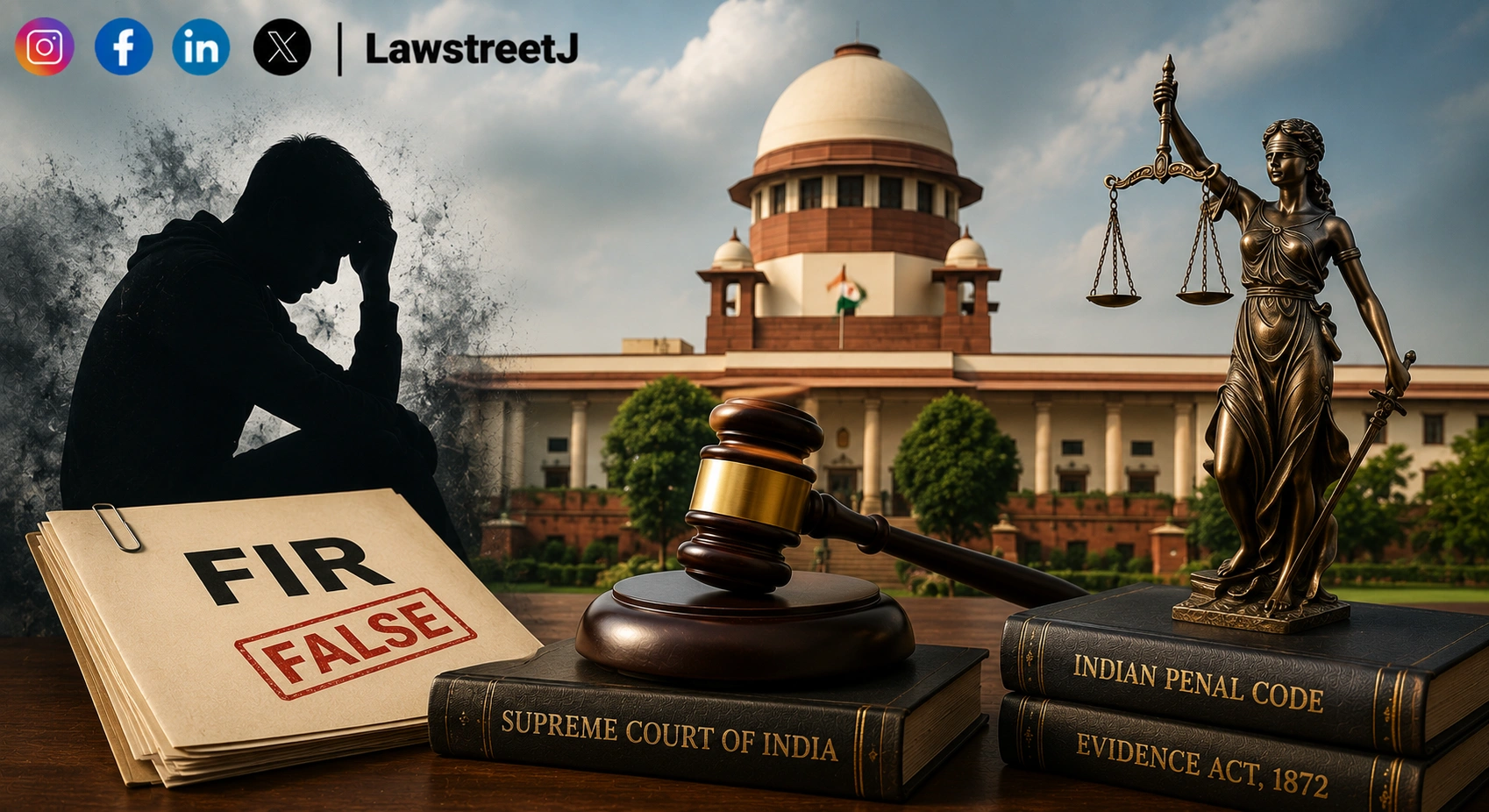
New Delhi: The Supreme Court has quashed an FIR alleging abetment of suicide against the in-laws of a deceased man, holding that lodging an FIR or seeking maintenance, even if the proceedings are later found to be false, does not by itself amount to instigating a person to commit suicide, and that the ingredients of abetment must appear from the material on record rather than being inferred from a spouse's decision to leave the matrimonial home.
A Bench of Justice Manoj Misra and Justice Vijay Bishnoi set aside an order dated 16th September 2025 passed by the Gujarat High Court, which had dismissed the appellants' petition under Section 482 of the CrPC seeking quashing of an FIR registered against them under Sections 306 and 114 of the IPC.
The appellants, the mother-in-law, father-in-law and brother-in-law of the deceased, had been named in an FIR lodged by the deceased's brother alleging that they had harassed the deceased because they wanted him and his wife to reside with them, that a false FIR had been registered against the deceased, and that a notice for maintenance had been served upon him, driving him to commit suicide. The deceased's wife had earlier lodged a separate FIR against the deceased under Sections 498A and 323 of the IPC, alleging that he had assaulted her, following which she had left the matrimonial home and later served him with a notice seeking maintenance.
Counsel for the appellants submitted that lodging an FIR and seeking maintenance are a person's legal rights, and that if the accused or notice recipient commits suicide out of fear of facing proceedings, this cannot amount to abetment by the person who initiated those proceedings. It was submitted that the deceased had, on the material on record, taken his own life on account of his own frustrations rather than any instigation by the appellants.
The Court examined the deceased's suicide note, which was addressed to his relatives including his wife and in-laws, and which indicated that the deceased believed his married life had been ruined by the appellants, though he held no grudge against his wife. Noting that the State, on instructions, confirmed there was no evidence of a homicidal death, the Court proceeded to examine whether the FIR and suicide note, read together, disclosed a prima facie case of abetment.
Referring to Section 107 of the IPC, which defines abetment as instigation, engaging in a conspiracy, or intentionally aiding the doing of a thing, the Court held that the necessary ingredients of abetment were completely lacking in both the FIR and the suicide note. “Lodging an FIR, even if it is false, against a person, per se, does not amount to instigating that person to commit suicide,” the Court held, observing that every individual has a right to take recourse to legal proceedings to protect their rights, and that a person who sets the criminal justice system in motion cannot be held liable for abetment merely because the person against whom proceedings were initiated later commits suicide.
The Court further noted that the appellants were admittedly residing separately from the deceased and could not be said to have had such an overbearing influence over him as to instigate or drive him to end his life. It held that while assessing a prima facie case of abetment, courts must look beyond the bare allegations in a suicide note to the surrounding facts, and consider whether the accused's conduct, in ordinary circumstances, would have driven an ordinary person not an oversensitive one to take such a drastic step. The Court observed that in matrimonial relationships, differences between spouses and the institution of proceedings against each other cannot by themselves be treated as instigation to commit suicide, since it is for courts to determine whether such proceedings are bona fide or mala fide.
Holding that the suicide note and the FIR did not disclose the necessary ingredients to constitute abetment, and that the High Court ought not to have refrained from examining the matter in some depth when the reasons for the suicide were spelt out in both documents, the Court allowed the appeal, set aside the High Court's order, and quashed the FIR along with all consequential proceedings.
Appearances:
For the Appellants: Ms. Pyoli, Advocate; Mr. Somesh Chandra Jha, AOR; Mr. Brijesh Raj, Advocate; Mr. Animesh Rajoriya, Advocate.
For the Respondents: Ms. Deepanwita Priyanka, Advocate; Ms. Swati Ghildiyal, AOR; Mr. Nimesh Bhatt, Advocate.
Case Title: Patel Joshnaben Pravinkumar Patel & Ors. vs. State of Gujarat & Anr., Criminal Appeal (Arising out of SLP (Crl.) No. 18705 of 2025)