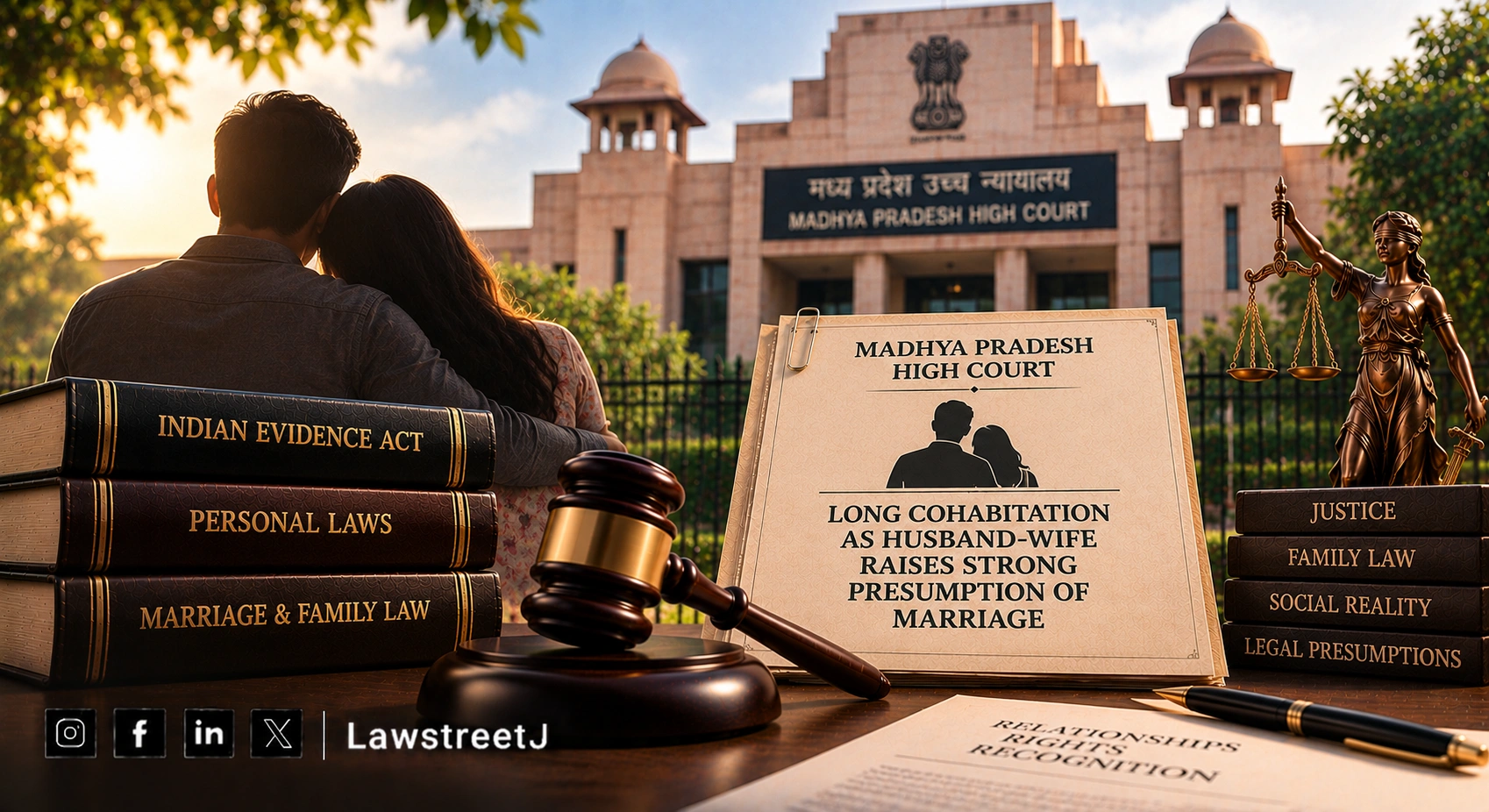
Jabalpur: The Madhya Pradesh High Court at Jabalpur has dismissed a second appeal challenging a first appellate court's finding that the plaintiffs, born of a long-standing cohabitation between their parents, were entitled to a 2/5th share in the suit property, holding that long and continuous cohabitation as husband and wife raises a strong presumption of a valid marriage.
Justice Pranay Verma was hearing a second appeal under Section 100 of the Code of Civil Procedure, preferred by defendant no. 2, against the judgment and decree dated 06.07.1999 passed by the Second Additional District Judge, Sagar, Camp Khurai, which had set aside the trial court's decree and held that the plaintiffs had a 2/5th share in the lands and house of defendant no. 1.
As per the plaintiffs, they were sons of Dhunna (defendant no. 1) through his second wife Rajiyabai (defendant no. 3), married as per the Kari system after the death of his first wife Nimiya, from whom defendant no. 2 (the appellant) was born. The plaintiffs claimed a 2/3rd share in the suit property, contending that a compromise decree earlier entered into between defendant no. 1 and defendant no. 2 under which the latter received 1.50 acres of land and a 1/3rd share in the suit house was not binding on them as they had not been impleaded as parties. Defendant no. 2 contested the claim, asserting that Rajiyabai was not the legally wedded wife of defendant no. 1 and that the plaintiffs were illegitimate children, so that the earlier compromise, entered into by defendant no. 1 as Karta of the joint family, bound the plaintiffs as well.
While the trial court had only partly decreed the plaintiffs' claim after deducting defendant no. 2's share under the earlier compromise, the first appellate court set aside that decree and granted the plaintiffs a 2/5th share, holding that the compromise, to which they were not parties, could not bind them.
The appeal was admitted on three substantial questions of law concerning the validity of the presumption drawn in favour of the Kari marriage, the effect of the plaintiffs' failure to prove the Kari form of marriage on the presumption arising from long cohabitation, and whether the compromise entered into by defendant no. 1 as Karta bound the plaintiffs as coparceners absent proof of fraud.
The High Court held that although the plaintiffs had not proved the Kari form of marriage strictly, the evidence including testimony that defendant nos. 1 and 3 had cohabited as husband and wife for a long period, were recognized as such in the village, and that even defendant no. 2 himself had acknowledged this in his statement established long and continuous cohabitation. Relying on the Supreme Court's decision in Chowdamma (dead) v. Venkatappa, which reiterated earlier authorities including Badri Prasad v. Dy. Director of Consolidation, the Court reaffirmed that “a strong presumption arises in favour of wedlock where the partners have lived together for a long spell as husband and wife”, rebuttable only by unimpeachable evidence, with the burden lying heavily on the party seeking to displace it. The Court distinguished Raja Gounder v. M. Sengodan, relied upon by the appellant, on the ground that it concerned the legitimacy of children born of an invalid marriage rather than the legitimacy of the marriage itself.
The Court further held that since the plaintiffs were not parties to the earlier compromise suit between defendant nos. 1 and 2, and there was no case set up that the suit property was joint Hindu family property in which defendant no. 1 acted as Karta, the compromise decree was not binding on the plaintiffs and had no bearing on the merits of the present case.
Answering the substantial questions of law against the appellant and in favour of respondent nos. 1 and 2, the Court affirmed the judgment and decree of the first appellate court.
The appeal was accordingly dismissed, with no order as to costs.
Case Title: Fulla vs. Munna & Ors., Second Appeal No. 1018 of 1999



![High Court Prohibits Compulsion of Hijab and Islamic Texts on Students of Different Faiths at Ganga Jamuna School [Watch Video]](/secure/uploads/2023/09/lj_5754_f71da9b5-c632-4d0b-94b8-6f36245eb157.jpg)
.jpeg)