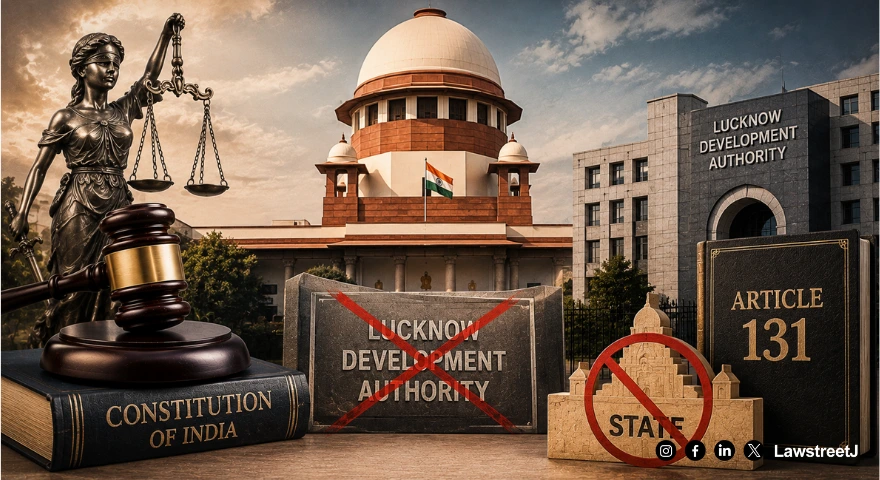
New Delhi: The Supreme Court has set aside an order of the Allahabad High Court, Lucknow Bench, which had dismissed a nearly two-and-a-half-decade-old writ petition filed by the Lucknow Development Authority, holding that the High Court had committed a gross error in treating the dispute as one between the State of Uttar Pradesh and the Union of India, and in relegating the appellant to proceedings under Article 131 of the Constitution.
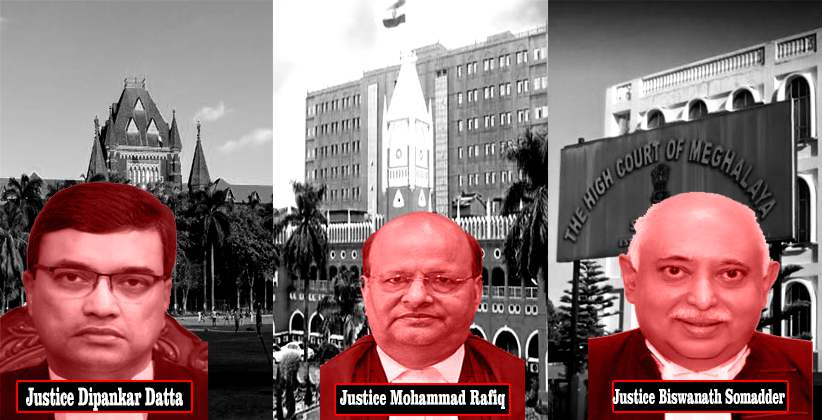
The bench of Justice Dipankar Datta and Justice Sheel Nagu was hearing a civil appeal filed by the Lucknow Development Authority against the High Court's order dated 19th September, 2023, which had dismissed its writ petition, originally instituted in 1999, seeking relief against the Union of India through the Secretary, Ministry of Defence, the GOC-in-C, Central Command, and the Station Commander, Sub-Area, Cantonment, Lucknow. Swarg Ashram Shakari Awas Samiti Limited and the State of Uttar Pradesh were subsequently impleaded as respondents.
The appellant's case was that although it had developed a colony and allotted plots and flats to allottees, officers of the Union of India and the defence establishments were interfering with the allottees' physical possession, claiming that the land belonged to them.
Recording that the High Court had made all possible efforts by requiring officers of the appellant, the State and the Union to resolve the dispute, and that these efforts had proved abortive, the impugned order dismissed the writ petition on the ground that the dispute between the State and the Union could not be decided by the High Court, granting liberty to the parties to initiate proceedings under Article 131 of the Constitution.
The Supreme Court held that the High Court had committed a gross error in viewing the dispute as one between the State of Uttar Pradesh and the Union of India, since it was the appellant, and not the State, which had invoked the writ jurisdiction. The Court noted that the appellant, being a body corporate constituted under Section 4 of the Uttar Pradesh Urban Planning and Development Act, 1973, for the planned development of the development area under its jurisdiction, could not be equated with the State of Uttar Pradesh.
Explaining the scope of Article 131, the Court held that its original jurisdiction is confined to disputes between the Government of India and one or more States enlisted in the First Schedule of the Constitution, and that the expression 'State' in that context is distinct from a ‘State’ as defined under Article 12. While the appellant could fall within Article 12 as an instrumentality of the State, the Court held that it was not a State for the purposes of Article 131, and that this jurisdiction could be invoked only by the States specified in the First Schedule, and not by any authority or instrumentality covered by Article 12.
On this basis, the Court held that it is not open to the appellant to approach this Court in its original jurisdiction, a position that was not disputed by the Additional Solicitor General appearing for the Union of India.
Terming the impugned order 'wholly wrong', the Supreme Court set it aside and allowed the civil appeal, remitting the writ petition to the High Court for a fresh decision.
Noting the substantial time that had lapsed since the institution of the writ petition, the Court requested the High Court to decide the matter in accordance with law and expeditiously. Pending applications, if any, were directed to stand closed.
Appearances:
For the Appellant: Not specified in the order.
For the Union of India: Mr. K.M. Nataraj, Additional Solicitor General.
Case Title: Lucknow Development Authority vs. Union of India & Ors., Civil Appeal No. 11201/2026 (Special Leave Petition (C) No. 29619/2026) @ Diary No. 17816/2026