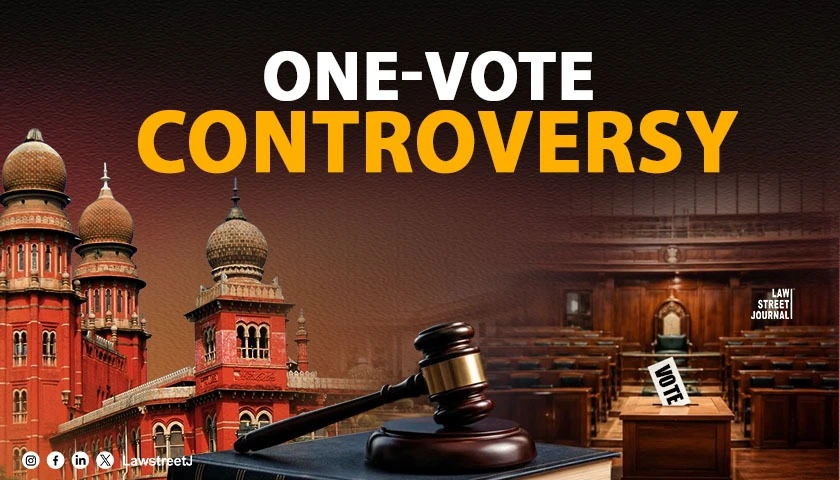
Chennai: The High Court of Judicature at Madras has restrained R. Seenivasa Sethupathi, the returned candidate from No. 185 Tiruppattur Assembly Constituency in the General Elections to the 17th Tamil Nadu Legislative Assembly held on 23 April 2026, from voting or otherwise participating in any floor test, confidence motion, no-confidence motion, trust vote, or any other proceeding in the Tamil Nadu Legislative Assembly, until further orders.
The Division Bench of Justice L. Victoria Gowri and Justice N. Senthilkumar passed the interim direction while hearing a writ petition filed by the unsuccessful candidate, who alleged serious irregularities in the counting and accounting of votes in the said constituency.
The backdrop to the writ petition is a razor-thin electoral result. The returned candidate won by a margin of only one vote. The petitioner raised three specific grievances: first, that a postal ballot indisputably belonging to No. 185 Tiruppattur Assembly Constituency in Sivagangai District was wrongly transmitted to No. 50 Tiruppattur Assembly Constituency in Tiruppattur District and was rejected there, not on account of any invalidity, impersonation, defective marking, or statutory disqualification, but solely because it was found in a different constituency; second, that there exists a discrepancy of 18 EVM votes between the consolidated counting abstract and the figures published on the official website of the Election Commission of India; and third, that the writ petition sought preservation of all electoral records and videographic material to ensure that foundational evidence is not lost before the appropriate remedy could be invoked.
On the question of maintainability, the Court acknowledged the well-established constitutional bar engrafted under Article 329(b) of the Constitution read with Sections 80 and 100 of the Representation of the People Act, 1951, which ordinarily requires all election disputes to be channelled exclusively through the election petition route. The Court also took note of the consistent line of Supreme Court judgments cautioning constitutional courts against interdicting the electoral process under Article 226 of the Constitution.
Relying on Election Commission of India v. Ashok Kumar (2000) 8 SCC 216, the Court reiterated that judicial remedy must ordinarily be postponed until completion of the election, but that judicial intervention remains available to correct the electoral process, remove obstacles, or preserve vital evidence that may otherwise be lost. It also referred to Mohinder Singh Gill v. Chief Election Commissioner (1978) 1 SCC 405 for the proposition that free and fair elections form the heart of democracy and must be protected from arbitrariness, illegality, and procedural unfairness.
The Court held that the present case stands on an altogether exceptional and unprecedented factual footing that was never within the legislative contemplation while enacting Section 100 of the Representation of the People Act, 1951. The grievance was not a routine challenge to counting, recounting, or acceptance or rejection of votes. Rather, it disclosed a peculiar constitutional anomaly where a postal ballot admittedly relatable to a live and concluded election in one constituency was allegedly diverted to another constituency bearing a similar nomenclature and was rejected there without any corrective mechanism being invoked.
The Court observed that such a situation, involving a vote extinguished in the wrong constituency without any remedial action, is not one expressly contemplated under the grounds enumerated in Section 100 of the Act.
Significantly, the Court took note of the affidavit filed by the official respondents, which candidly admitted that no statutory provision exists enabling the transfer of a postal ballot from one Returning Officer to another, and that such transfer is neither contemplated nor permitted under the existing statutory framework. The Court treated this admission as itself revealing a procedural vacuum in the electoral framework.
It observed that election officials are not mere passive custodians of forms and procedures, but constitutional functionaries obligated to ensure that every valid vote cast by a citizen reaches its lawful destination.
Once the Returning Officer of No. 50 Tiruppattur Assembly Constituency noticed that the disputed postal ballot did not pertain to that constituency, the least that was expected was prompt transmission of the ballot to the competent Returning Officer of No. 185 Tiruppattur Assembly Constituency rather than its mechanical rejection. The failure to take such elementary corrective measures, particularly in an election decided by a margin of one vote, was characterised by the Court as a serious dereliction in preserving the sanctity and reliability of the electoral process.
On the question of interim relief, the Court addressed the specific constitutional concern arising from the possibility of a floor test. It held that the principle that election disputes must await an election petition cannot be converted into a rule of absolute judicial silence even when the issue is not merely the validity of an election, but the immediate use of a disputed electoral mandate to decide the fate of a Government.
The Court observed that a floor test is not an ordinary legislative sitting; participation in it may determine the survival or fall of a Government. If the returned candidate were to participate and his vote proved decisive, the consequence would travel far beyond the constituency and affect the constitutional governance of the State. The injury in such a case would be incapable of effective correction.
The Court was at pains to clarify the scope and nature of the interim order. It expressly stated that it was not, at that stage, declaring the election of the returned candidate void, nor was it seating the petitioner in his place. The limited question before it was whether, pending a prima facie scrutiny of serious electoral anomalies in a one-vote result, the returned candidate should be permitted to participate in a proceeding where his vote may alter the balance of power in the House.
The Court held that the balance of convenience, in the peculiar facts of the case, lies in preserving constitutional neutrality. No irreversible prejudice would be caused to the returned candidate by a temporary restraint pending production of records and filing of counter affidavits. On the other hand, if he participated and his vote became decisive, any subsequent correction would be rendered meaningless.
Accordingly, by way of interim direction, the Court passed an injunction restraining the returned candidate from voting or otherwise taking part in any floor test or proceeding in the Tamil Nadu Legislative Assembly where the numerical strength of the House is tested, until further orders.
The official respondents were also directed to forthwith secure and preserve all records relating to the counting of votes in No. 185 Tiruppattur Assembly Constituency held on 4 May 2026, including the consolidated counting abstract, statutory forms, round-wise counting sheets, EVM vote account records, postal ballot records, rejected postal ballot covers and papers, declarations, envelopes, proceedings relating to reverification of rejected postal ballots, and all connected materials.
The videographic footage relating to counting, postal ballot scrutiny, and reverification was directed to be preserved in its original electronic form along with back-up copies. The respondents were prohibited from destroying, overwriting, altering, transferring, or parting with custody of any such material except in accordance with law and subject to further orders of the Court.
The Court made clear that the interim order does not amount to a direction for recounting, fresh tabulation of votes, reopening of ballot papers, validation of any rejected postal ballot, or interference with the declaration of result already made.
The rights and contentions of all parties, including as to the availability of remedy under the Representation of the People Act, 1951, were expressly left open. All respondents were directed to file their counter affidavits on or before 19 June 2026, and the writ petition was posted for further hearing on that date.
Case Title: KR. Periakaruppan v. Chief Election Officer and Others, WP No. 19287 of 2026



![TN Medical Council declares change of gender identity of LGBTQIA+ as misconduct [Read Notification]](/secure/uploads/2022/12/lj_5268_5cebb05a-97fb-40fb-8045-25cdf8f4207a.jpg)
![Madras High Court Directs Tamil Nadu Government to Ensure Quota for Transgenders in Local Body Elections [Read Order]](/secure/uploads/2023/08/lj_2507_7a03d113-08b1-4670-b6fb-9058aee481d0.jpg)
![Anti Corruption sleuths acted like "puppets in The Muppet Show", HC notice to ex TN CM in disproportionate assets case [Read Order]](/secure/uploads/2023/09/lj_8675_7b37fc02-1b2d-4f4a-9816-3df20545b37e.jpg)