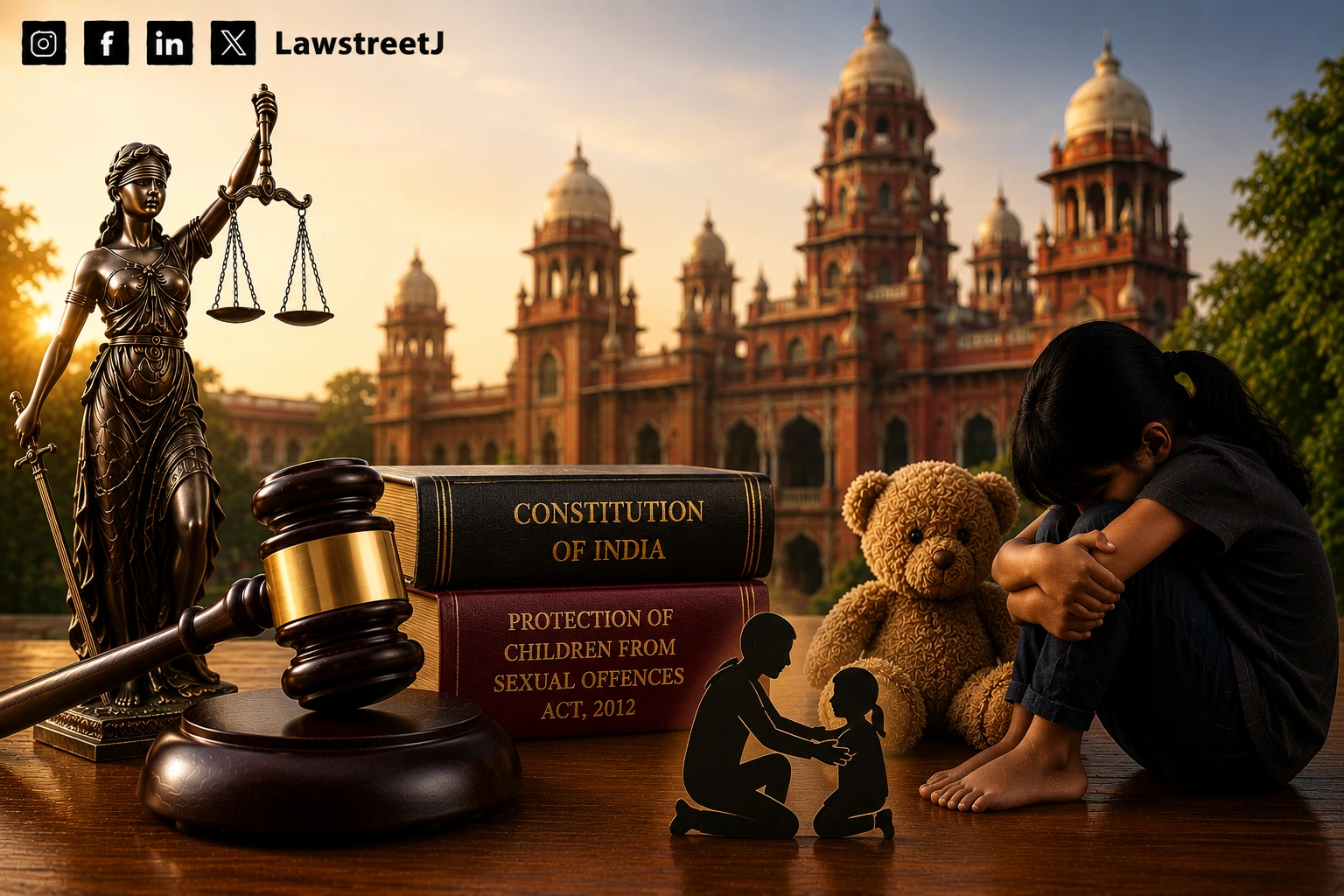
Madras: The Madras High Court has observed that a child victim in a case under the Protection of Children from Sexual Offences Act, 2012 (POCSO) cannot be called to court repeatedly and made to relive the trauma, holding that a plea to recall such a witness for cross-examination cannot be allowed merely because the accused's counsel had earlier been absent or has since been changed.
Justice D. Bharatha Chakravarthy was hearing a Criminal Original Petition filed under Section 528 of the Bharatiya Nagarik Suraksha Sanhita, 2023, seeking to set aside an order dated 05.05.2026 passed by the Sessions Judge, Special Court for the exclusive trial of cases under the POCSO Act, Villupuram, refusing to recall the victim girl, examined as PW-1, for cross-examination.
As per the prosecution case, the victim children were rearing goats when the accused, who was present nearby with his cattle, called them close to him. While the elder child managed to wriggle free and run away, the accused caught hold of the younger child, aged about 10 years, and sexually assaulted her before she pushed him away and escaped. Her statement had been recorded under Section 164 of the Cr.P.C., and after the commencement of trial, she was examined-in-chief on 05.01.2026. Although the accused was present on that day, he was not cross-examined.
Counsel for the petitioner submitted that the counsel earlier engaged by the accused had failed to appear before the Trial Court on the date of examination, and that this default on the part of counsel should not deprive the accused of his valuable right to cross-examine the crucial witness. It was submitted that the accused had since changed counsel and that the trial was being conducted properly.
The High Court noted that the examination of the elder child, who had escaped the accused's hold, was still pending and could be cross-examined, and that the accused could also cross-examine the remaining witnesses, including on the alleged property dispute between the parties. The Court held that the enactment of the POCSO Act was meant to protect children from sexual abuse, and that the implementation of the law itself should not become a further source of trauma to the child, observing that:
"The child cannot be made to relive the said incident over and again. It is not about granting an opportunity to the accused alone. But, it is about the right to life of the child itself."
The Court observed that a child witness undergoes the ordeal of reliving trauma at multiple stages — when the incident is first disclosed to family, when interviewed by the Child Welfare Committee, when examined by medical experts, when the statement is recorded by the investigating officer, when produced before the Magistrate under Section 164 Cr.P.C., and finally when examined before the trial court — and that this, by itself, was sufficient to cause trauma to the child.
Referring to Section 33(5) of the POCSO Act, which casts a duty on the Special Court to ensure that a child is not called repeatedly to testify, the Court held that recalling child victims for cross-examination on routine grounds such as the absence of counsel would amount to secondary victimisation and could not be permitted. The Court also relied on the Supreme Court's decision in Shankar Kisanrao Khade v. State of Maharashtra, (2013) 5 SCC 546, which emphasised that the best interest of the child, rather than the interest of the perpetrator, must guide the court's approach in cases of child abuse.
Holding that the approach in such cases has to be victim-centric and in the best interest of the child, and that the accused could not be permitted to recall and once again cross-examine the victim child, the Court found that the Trial Court had rightly rejected the recall petition. It accordingly dismissed the Criminal Original Petition, leaving the petitioner free to establish his case by cross-examining the other witnesses in the trial.
Appearances:
For the Petitioner: Mr. T. Maha Vishnu, Advocate.
For the Respondent: Mr. M. Mohamed Riyaz, Government Advocate (Criminal Side).
Case Title: Ramesh vs. The State of Tamil Nadu, CRL OP No. 16742 of 2026


![Madras High Court Directs Tamil Nadu Government to Ensure Quota for Transgenders in Local Body Elections [Read Order]](/secure/uploads/2023/08/lj_2507_7a03d113-08b1-4670-b6fb-9058aee481d0.jpg)