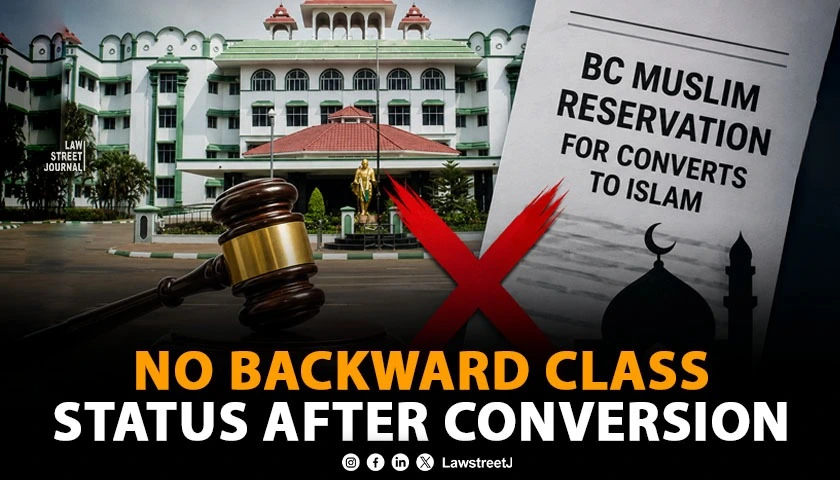
The Madurai Bench of the Madras High Court struck down a Tamil Nadu government order permitting persons from Backward Classes, Most Backward Classes, Denotified Communities and Scheduled Castes to retain reservation benefits as Backward Class Muslims upon converting to Islam, holding it unconstitutional and contrary to a seven-decade-old precedent that a convert to Islam becomes “just a Mussalman” and cannot be slotted into any caste-based community by virtue of conversion alone.
A Division Bench of Justices G.R. Swaminathan and P.B. Balaji disposed of a writ petition challenging rejection of his application for a community certificate as “Muslim Lebbai”, declaring Government Order (Ms) No.31, BC, MBC and Minorities Welfare Department dated 09.03.2024, unconstitutional in the course of the adjudication.
The Bench held that a convert to Islam cannot claim Backward Class Muslim status and is “only a Muslim and that’s all there is to it”.
Background
The petitioner was born to a Hindu couple, however a certificate issued by the Sunnath Jamath, Kayathar, stated that he had embraced Islam and changed his name to Sameer Ahamed. He married one Vahitha as per Islamic rites and two children were born from the marriage. He applied for a community certificate identifying him as “Muslim Lebbai”, which was rejected by the Tahsildar, Kayathar, prompting him to approach the High Court under Article 226.
The petitioner conceded that his claim rested solely on G.O. (Ms) No. 31 dated March 9, 2024. On examining the Government Order, the Bench doubted its constitutional validity and suo motu impleaded the Tamil Nadu government. The G.O. had been issued after the Tamil Nadu Backward Classes Commission recommended allowing persons from Backward Classes, Most Backward Classes, Denotified Communities and Scheduled Castes to retain reservation benefits as Backward Class Muslims upon converting to Islam. The recommendation followed an earlier case in which the High Court had upheld the TNPSC's decision that a Most Backward Class person who converted to Islam could not claim reservation under the Backward Class (Muslim) category.
Arguments
When the matter was taken up for final disposal, the learned Additional Advocate General filed a detailed counter affidavit along with the relevant Government Orders. The petitioner’s counsel, however, informed the Court that he had been given a change of vakalat. The Bench observed that since the matter had been heard at length and posted for orders solely to test the G.O’s validity, the petitioner was not being fair to the Court, though no fault lay with counsel, and declined to adjourn the matter.
The learned Additional Advocate General submitted that the Backward Classes Commission’s recommendation was binding on the Government and followed detailed deliberation with stakeholders. A convert from a forward community, he argued, would not acquire the Backward Class Muslim tag, and only those already enjoying reservation benefits would retain them upon conversion, leaving the social balance unaffected. It was for the Jamath concerned to accept a convertee into a sect, he submitted, and revenue authorities, or the Court, could not question a Jamath certificate, pointing out that the G.O had been acted upon in Division Bench rulings including W.A. No.2813 of 2021.
Analysis
The Bench noted that while the Constitution prohibits discrimination on grounds of religion, the State is empowered to make special provision for backward classes, and Tamil Nadu had accordingly notified only seven sects of Muslims as Backward Class Muslims under Section 3(a) of the Tamil Nadu Act 45 of 1994: Ansar, Dekkani Muslims, Dubekula, Labbais including Rowthar and Marakayar, Mapilla, Sheik and Syed. A Muslim outside these seven sects cannot be classified as a Backward Class Muslim.
Tracing the position to G. Michael v. S. Venkateswaran (1952) 1 MLJ 239, which held that a Hindu converting to Islam becomes “just a Mussalman” whose place in Muslim society is not determined by pre-conversion caste, the Bench noted this view was approved by the Supreme Court in Kailash Sonkar v. Maya Devi (1984) 2 SCC 91, K.P. Manu v. Scrutiny Committee (2015) 4 SCC 1, and C. Selvarani v. Special Secretary cum District Collector (2024) 16 SCC 537, decided after the impugned G.O. The Court held this is also consistent with Islamic theology, citing the Quranic principle of equality and the Prophet’s farewell sermon declaring no person superior to another except by piety and good deeds, and found it disingenuous to claim a parallel hierarchy within Islam given that missionary activity has historically stressed the absence of caste. The Bench nonetheless noted that Islamic society in India is also stratified, and that one becomes a Rowther, Marakkayar, or Deccani Muslim by birth alone, just as caste is determined by birth, making it untenable to suggest a person could be converted into any of these notified communities.
Invoking separation of powers, the Bench held that a final judgment cannot be undone by executive action, relying on State of T.N. v. State of Kerala (2014) 12 SCC 696, P. Sambamurthy v. State of A.P. (1987) 1 SCC 362, and UOI v. K.N. Shankarappa (2001) 1 SCC 582, for the proposition that the executive cannot override or revise a judicial decision. Since G. Michael had settled that a convert becomes just a Mussalman, the impugned G.O could not undo that position by permitting conversion into any of the seven notified sects.
The Bench further found the G.O arbitrary for placing Scheduled Caste convertees on par with Backward Class convertees within the same seven slots, despite the Supreme Court having repeatedly held that OBCs and SCs form distinct categories. It rejected the submission that the G.O had been acted upon elsewhere, holding, on the strength of Bharathidhasan University v. AICTE (2001) 8 SCC 676, that an order made outside executive competence does not gain validity merely because it went unchallenged in those matters. The Court also noted that the Madras Census Report of 1901 and Edgar Thurston’s catalogue of South Indian castes had historically treated Labbais and Deccanis as castes, reinforcing that sect membership arises only from birth.
Conclusion
The Bench declared G.O (Ms) No.31, BC, MBC and MWD dated 09.03.2024 unconstitutional and sustained the order rejecting the petitioner’s application for a community certificate as Muslim Lebbai. The writ petition was disposed of accordingly, with no order as to costs, and the connected miscellaneous petition was closed. The Court held that a convert to Islam cannot claim the status of Backward Class Muslim, observing that such a person is “only a Muslim and that’s all there is to it”.
Case Title: Sameer Ahamed N v. The District Collector, Thoothukudi District and Others (WP(MD) No. 7127 of 2022)



![TN Medical Council declares change of gender identity of LGBTQIA+ as misconduct [Read Notification]](/secure/uploads/2022/12/lj_5268_5cebb05a-97fb-40fb-8045-25cdf8f4207a.jpg)
![Madras High Court Directs Tamil Nadu Government to Ensure Quota for Transgenders in Local Body Elections [Read Order]](/secure/uploads/2023/08/lj_2507_7a03d113-08b1-4670-b6fb-9058aee481d0.jpg)
![Anti Corruption sleuths acted like "puppets in The Muppet Show", HC notice to ex TN CM in disproportionate assets case [Read Order]](/secure/uploads/2023/09/lj_8675_7b37fc02-1b2d-4f4a-9816-3df20545b37e.jpg)