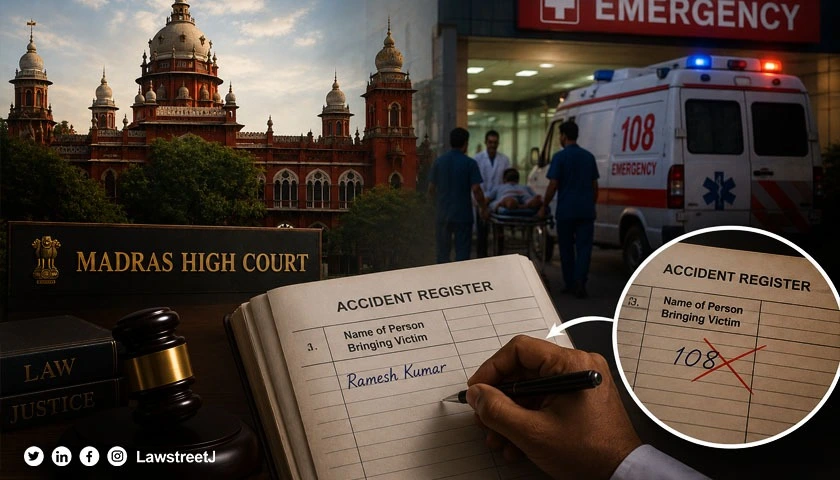
Madras: The Madurai Bench of the Madras High Court, while dismissing a criminal appeal arising out of a murder conviction, has directed the Tamil Nadu Health and Family Welfare Department and the Directorate of Medical Education and Research to ensure that Accident Registers maintained by government hospitals record the actual name and particulars of the person who brought an injured or deceased patient to hospital, instead of the attending doctor merely noting the entry ‘108’, which only indicates the ambulance service used for transportation.
A Division Bench of Justice N. Anand Venkatesh and Justice K.K. Ramakrishnan was hearing a criminal appeal filed under Section 374(2) Cr.P.C. by two accused convicted for the murder of a Village Administrative Officer (VAO) who had lodged complaints against them over illegal mining activities. The trial court had convicted the appellants under Sections 449, 302 and 506(ii) IPC, sentencing them to imprisonment for life along with rigorous imprisonment terms.
According to the prosecution, the accused trespassed into the deceased’s office and attacked him with a billhook and an iron rod in the presence of his son and the Village Assistant, who were examined as P.W.1 and P.W.2 respectively. The injured VAO was rushed to the Tirunelveli Medical College Hospital through the 108 Ambulance Service but succumbed to his injuries. The defence contended that the Accident Register did not name P.Ws.1 and 2 as having brought the victim, and argued that this, along with an alleged unrecorded earlier complaint, discarded call detail record evidence, and infirmities in the fingerprint and Test Identification Parade process, cast serious doubt on the presence of the eyewitnesses and the credibility of the prosecution case.
Rejecting these contentions, the Court held that the ocular testimony of P.Ws.1 and 2 was cogent, consistent and fully corroborated by medical evidence, and that their presence at the scene was natural since P.W.1 was the deceased’s son and P.W.2 his official assistant. Relying on the Supreme Court’s decision in Rajesh Yadav v. State of Uttar Pradesh, the Bench reiterated the principle governing ‘chance witnesses’:
“A chance witness is the one who happens to be at the place of occurrence of an offence by chance, and therefore, not as a matter of course… Merely because a witness happens to see an occurrence by chance, his testimony cannot be eschewed though a little more scrutiny may be required at times.”
The Court also rejected the argument that the deceased’s clothes and the fingerprint and recovery evidence were unreliable, holding that the fingerprint expert’s opinion, the recoveries made pursuant to the disclosure statements of the accused, and the medical evidence collectively formed a complete and consistent chain pointing to the guilt of the accused. The Bench accordingly upheld the conviction and sentence in their entirety, finding no infirmity in the trial court’s appreciation of evidence.
Turning to the Accident Register controversy, the Court observed that in a considerable number of criminal cases, attending doctors merely record the entry ‘108’ in the column meant for the name of the person who brought the injured to hospital, a practice that defence counsel routinely exploit to cast doubt on the presence of eyewitnesses. Holding that correctly recording this detail is part of the medical officer’s ethical and medico-legal duty, the Bench issued the following direction:
“…this Court deems it appropriate to issue a direction to the Principal Secretary to Government, Health and Family Welfare Department, Government of Tamil Nadu, and the Director of Medical Education and Research, Tamil Nadu, to circulate suitable instructions to all Government medical officers and hospitals dealing with medico-legal cases that, in the Accident Register, the column shall contain the name and particulars of the person who actually brought or accompanied the injured/deceased to the hospital, and not merely the entry ‘108’ or any other mode of transportation.”
The Bench further placed on record its appreciation for the expeditious manner in which the investigation and trial were concluded within less than five months of the occurrence and directed the Chief Secretary of Tamil Nadu to deliberate with the Director General of Police and the Prosecution Department to issue a circular prescribing a structured timeline for prompt investigation and expeditious trial in similar serious offences.
In the result, the criminal appeal was dismissed, and the conviction and sentence passed by the Principal Sessions Judge, Thoothukudi District, in S.C.No.285 of 2023 was confirmed.
Appearances:
For Appellants: Mr. M. Jegadeesh Pandiyan
For Respondent: Mr. C. Christopher, Government Advocate (Criminal Side)
Case Title: Ramasubramanian @ Ramasubbu & Anr. v. The State of Tamil Nadu, CRL.A.(MD).No.1021 of 2023



![Madras High Court Directs Tamil Nadu Government to Ensure Quota for Transgenders in Local Body Elections [Read Order]](/secure/uploads/2023/08/lj_2507_7a03d113-08b1-4670-b6fb-9058aee481d0.jpg)