Madurai: The Madurai Bench of the Madras High Court has quashed criminal proceedings arising under the Scheduled Castes and Scheduled Tribes (Prevention of Atrocities) Act, 1989, against two accused persons who had desecrated a poster of Dr. B.R. Ambedkar—but only after subjecting them to a rigorous programme of reformative compliance. This included the purchase and distribution of 101 books each on his life history, an oral examination conducted in camera by the Court itself, and payment of costs to the Adyar Cancer Institute.
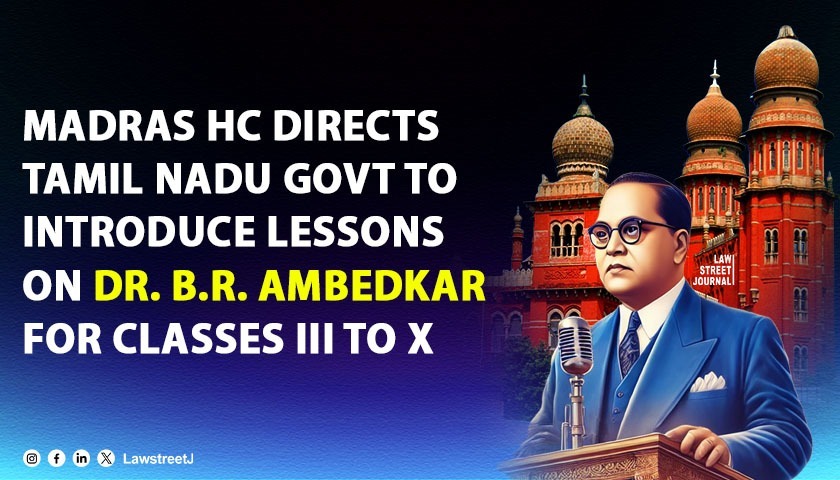
Simultaneously, the Court issued a sweeping direction to the Chief Secretary and Principal Secretary, School Education Department, State of Tamil Nadu, to introduce appropriate lessons on Dr. Ambedkar’s life and constitutional contributions in the Social Science curriculum for students from Class III to Class X, to take effect from the academic year 2027–2028.
Justice L. Victoria Gowri of the Madurai Bench delivered the judgment on April 30, 2026.
The prosecution case, as disclosed in the FIR, was that while posters bearing the photograph of Dr. Ambedkar had been displayed at Pulikuthi Bus Stand in connection with the commemoration of his birthday, the first petitioner tore one such poster and urinated upon it, while the second petitioner videographed the act and circulated the video in a WhatsApp group named “Nallava Boys Group.” The complaint was lodged by the Town Secretary of Viduthalai Siruthai Katchi, Devakottai. After completion of the investigation, a final report was filed, leading to trial before the Special Court.
The petitioners sought quashment on the basis of a Joint Compromise Memo dated November 17, 2025, recording that elders had intervened, both sides had settled the matter amicably, and the de facto complainant had no objection to the proceedings being quashed. The Court, however, declined to mechanically accept the compromise. It noted that the offence arose under a special statute enacted for the protection of vulnerable communities from indignity and oppression, and that a prosecution of this nature could not be treated on par with an ordinary private quarrel. More significantly, when the Court enquired whether the petitioners knew who Dr. Ambedkar was, their response revealed that, though vaguely aware that he was a legal luminary, they had no real understanding of his scholarship, his role in drafting the Constitution, or his contribution to the liberation of the oppressed.
By order dated December 19, 2025, the Court directed each petitioner to purchase 101 books in Tamil on the life history of Dr. Ambedkar; read one copy themselves and retain it; distribute the remaining 100 copies to students of Classes XI and XII at Murugappa Government Higher Secondary School, T. Kallupatti; obtain acknowledgment from the Headmaster; remain prepared for an oral test before the Court to demonstrate genuine understanding of Dr. Ambedkar’s life and thought; and pay costs of ₹5,000 each to the Adyar Cancer Institute. The Court also directed the de facto complainant to return the statutory compensation of ₹50,000 already paid by the Government under the SC/ST Act, by way of a demand draft in favour of the Adi Dravida Welfare, District Collectorate, Sivagangai.
On January 23, 2026, both petitioners appeared in person and produced documentary proof of compliance. The Court did not stop at receipts and acknowledgments. It conducted an oral test in camera, putting as many as thirty questions each to both petitioners on the life and work of Dr. Ambedkar. The Court recorded that they answered satisfactorily, demonstrated that they had genuinely read the material rather than treating the exercise as ritualistic, and displayed visible shame and remorse. Their demeanour was penitential and not defiant. The Court was satisfied that their repentance was real and their transformation evident.
The Court applied the principles governing quashment on the basis of compromise laid down by the Supreme Court in Gian Singh v. State of Punjab, (2012) 10 SCC 303; Parbatbhai Aahir v. State of Gujarat, (2017) 9 SCC 641; and State of Madhya Pradesh v. Laxmi Narayan, (2019) 5 SCC 688. It held that while offences under the SC/ST Act cannot be treated lightly, and while a Court exercising inherent jurisdiction cannot permit the solemnity of the statute to be diluted by routine acceptance of compromise, the present case had moved beyond mere compromise into demonstrable repentance and measurable reformation. The corrective purpose of law had been substantially achieved. The possibility of conviction had, in the circumstances, become remote and bleak, and the continuance of trial would no longer meaningfully advance the cause of justice.
Before concluding, the Court made a series of observations of broad constitutional significance. It noted the tragedy of a towering national figure being reduced to the cramped confines of caste-based perception, observing that Dr. Ambedkar belongs equally to every classroom, every court, every institution of public learning, and every citizen who values dignity under law. The Court observed that ignorance breeds prejudice, prejudice normalises indignity, and indignity, if left unchecked, corrodes the foundations of fraternity that alone can sustain constitutional democracy. Constitutional literacy, it held, is not an ornamental aspiration but part of the State’s social responsibility.
Accordingly, the Court suo motu impleaded the Chief Secretary, State of Tamil Nadu, and the Principal Secretary, School Education Department, as Respondents 4 and 5, and directed them to take necessary policy steps to introduce appropriate lessons in the Social Science curriculum for students from Class III to Class X. These lessons are to cover Dr. Ambedkar’s role as Chairman of the Drafting Committee, his constitutional vision of justice, liberty, equality, and fraternity, his contribution to the freedom movement and democratic nation-building, and his scholarly achievements in economics, law, and social thought. The State was directed to endeavour to implement this curricular inclusion from the academic year 2027–2028 and to file an elaborate compliance report before the Court on January 21, 2027.
The proceedings in Spl. S.C. No. 8 of 2020 were quashed, and the Joint Compromise Memo dated November 17, 2025, together with the compliance already recorded, was incorporated into the final order.
Case Title: G. Rajesh alias Rajeshkumar and Another v. State of Tamil Nadu and Others, Crl.O.P. (MD) No. 22813 of 2025



![TN Medical Council declares change of gender identity of LGBTQIA+ as misconduct [Read Notification]](/secure/uploads/2022/12/lj_5268_5cebb05a-97fb-40fb-8045-25cdf8f4207a.jpg)
![Madras High Court Directs Tamil Nadu Government to Ensure Quota for Transgenders in Local Body Elections [Read Order]](/secure/uploads/2023/08/lj_2507_7a03d113-08b1-4670-b6fb-9058aee481d0.jpg)
![Anti Corruption sleuths acted like "puppets in The Muppet Show", HC notice to ex TN CM in disproportionate assets case [Read Order]](/secure/uploads/2023/09/lj_8675_7b37fc02-1b2d-4f4a-9816-3df20545b37e.jpg)