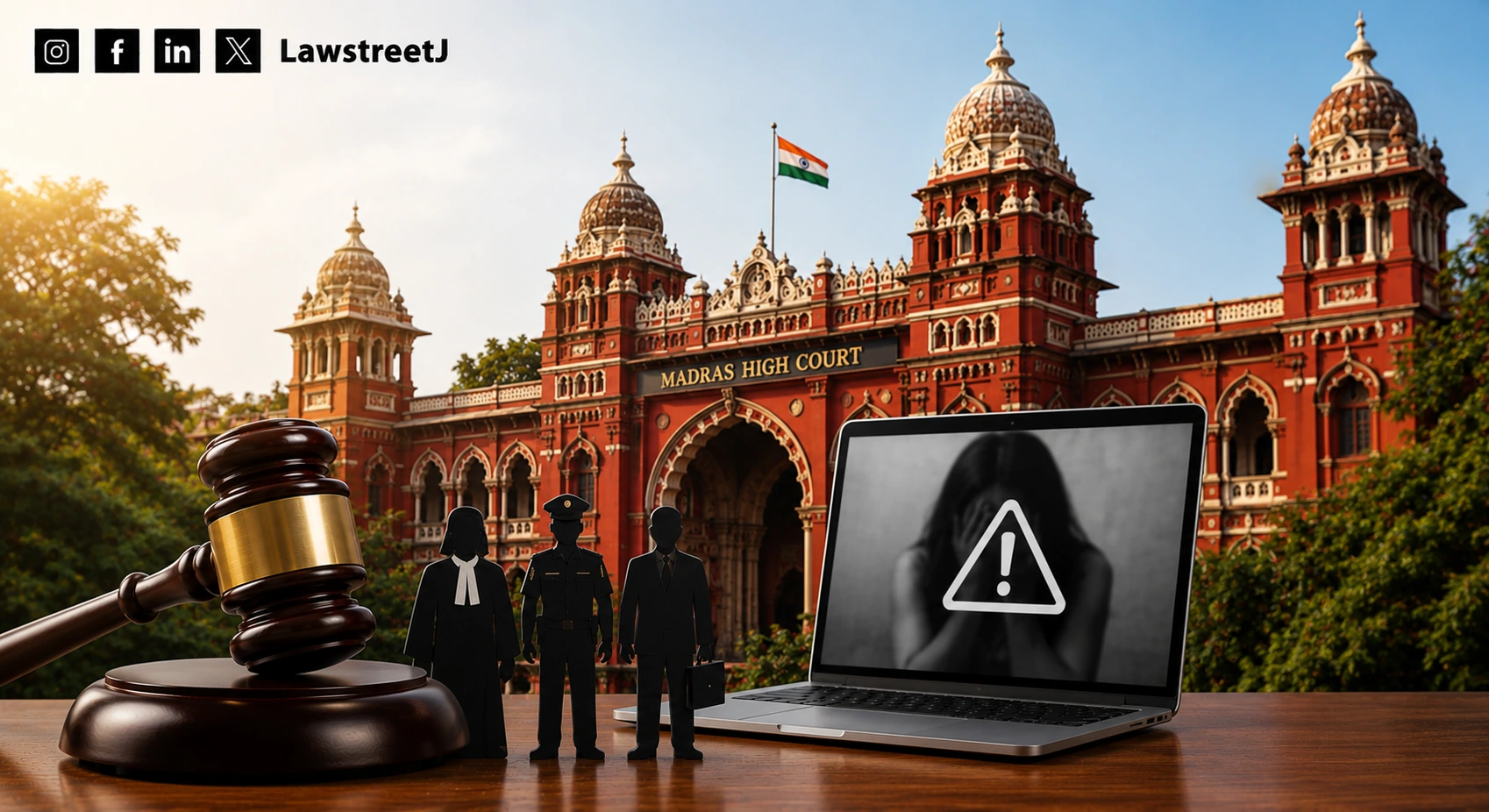
Madurai: The Madurai Bench of the Madras High Court, comprising Justice N. Anand Venkatesh and Justice K.K. Ramakrishnan, dismissed a criminal appeal against a conviction for rape and criminal intimidation through blackmail, and used the occasion to flag the psychological toll on judges, lawyers and investigators who are routinely required to sift through sexually explicit material while adjudicating such cases.
The appeal was filed against a judgment of the Fast Track Mahila Court, Nagercoil, which had convicted the appellant under Sections 376(2)(n), 417, 354(A), 294(b) and 354(c) of the IPC and Section 66E of the Information Technology Act, and sentenced him to imprisonment for the remainder of his natural life along with a fine.
The prosecution's case was that the accused had initiated contact with the victim, then in search of employment, through social media, and gradually gained her confidence through false assurances of marriage and employment. He forcibly took her to his father's godown and factory premises and committed sexual intercourse against her wishes, clandestinely recording the acts on video. He then used the recordings as an instrument of blackmail, threatening to circulate them on social media, and coerced her into repeated submission out of fear and intimidation.
Rejecting the appellant's contention that the victim's testimony was inconsistent and unreliable, the Court held that the prosecution had established, beyond reasonable doubt, that the accused had repeatedly committed rape without the victim's free and voluntary consent, such submission having been procured by deception, fear and criminal intimidation.
The bench invoked the principle that exaggerated devotion to the rule of benefit of doubt must not be allowed to destroy social defence, relying on the Supreme Court's ruling in Devender Pal Singh v. State (NCT of Delhi). It also drew on the Supreme Court's observations in State of Punjab v. Gurmit Singh on the need for courts to remain alive to the fact that no self-respecting woman would fabricate a charge of rape, and that minor discrepancies in a prosecutrix's statement should not defeat an otherwise reliable case.
Finding no explanation from the accused under Section 106 of the Evidence Act for the incriminating material recovered from his laptop, and no material to rebut the presumption under Section 114(A), the Court confirmed both the conviction and the life sentence, holding that the calculated and deceptive design of the accused and the enduring nature of the offending material justified the punishment awarded by the trial court.
In a postscript to the judgment, Justice Anand Venkatesh addressed what he described as an unacknowledged occupational hazard of the digital age the psychological harm suffered by those who must repeatedly view graphic evidence in cases of sexual violence. He noted that in the present case, a lady investigating officer had to sit through nearly sixty files of explicit material to locate the item relevant to the victim, and that prosecutors, defence counsel and judges at every level thereafter face the same material. Drawing on neuroscience, the judge observed that the human brain cannot fully distinguish between a traumatic event occurring in real life and a high-definition recording of it, and that repeated exposure to such material can cause vicarious trauma, with consequences including hypervigilance, cognitive fatigue and emotional numbing.
“The machinery of justice cannot treat its human beings like unfeeling computers. If we continue to ignore the mental and neurological toll of this digital age, we will end up with burnt-out, traumatized, and emotionally numbed investigators, lawyers, and judges.”
The judge called upon the judiciary and institutional leaders to build structural safeguards, including mandatory psychological screening, regular counselling, decompression protocols after exposure to graphic material, rotation of personnel assigned to such material, training to recognise vicarious trauma, and secure procedures to minimise unnecessary exposure. He stressed that while the law had developed detailed safeguards under the Evidence Act to verify the authenticity of digital material, it had not engaged with how the same material affects the human minds required to evaluate it.
“The law must continue to refine the technical rules for digital evidence. It must also, with equal seriousness, safeguard the minds entrusted to apply it.”
The Court also made a broader appeal to young persons, particularly girls and women, urging caution in online and technologically facilitated relationships and warning against sharing intimate images or videos through electronic means, noting that such material, once shared, can be misused with irreversible consequences for a victim's privacy and dignity.
Given the wider public importance of the issue, this portion of the judgment was delivered in English, Tamil and Hindi. With these observations, the Court dismissed the appeal and confirmed the conviction and sentence passed by the Fast Track Mahila Court, Nagercoil, in S.C. No. 41 of 2021.
Appearances:
For Appellant: Mr. V. Kathirvelu, Senior Counsel
For Respondent: Mr. G. Karuppasamy Pandian, Counsel for State of Tamil Nadu (Crl. Side)
Case Title: Suji @ Kasi vs. The State rep. by the Inspector of Police, CBCID, Nagercoil, Kanyakumari District



![Madras High Court Directs Tamil Nadu Government to Ensure Quota for Transgenders in Local Body Elections [Read Order]](/secure/uploads/2023/08/lj_2507_7a03d113-08b1-4670-b6fb-9058aee481d0.jpg)