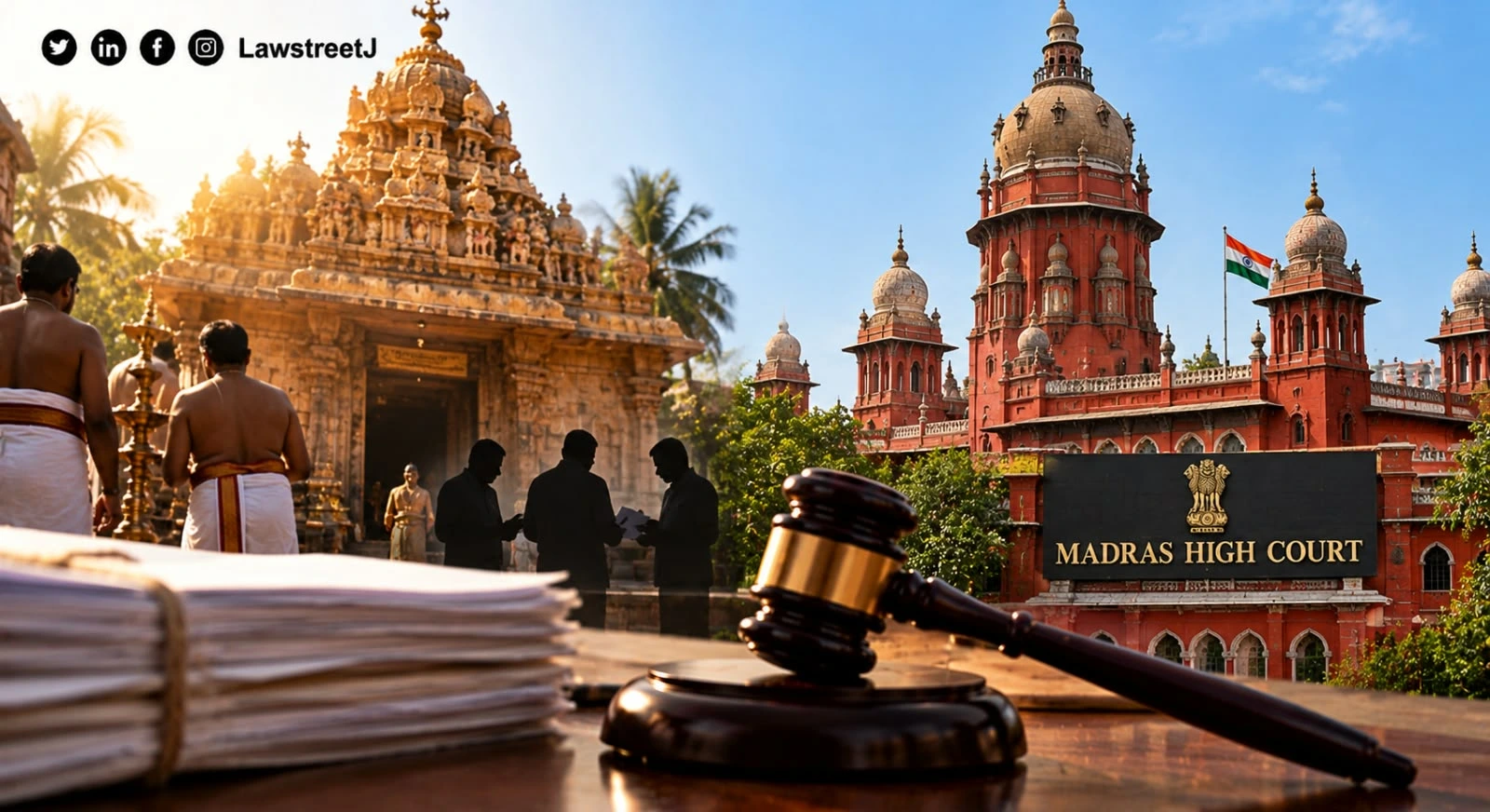
Chennai: The Madras High Court has held that G.O. (Ms) No. 115 of 17.05.2022, permitting devotees to climb the Kanagasabai and have darshan of Lord Nataraja at the Sri Sabanayagar Temple in Chidambaram, is not a colourable exercise of power that overrides the Podhu Dikshitars’ rights under Article 26 of the Constitution. Finding maladministration, damage to heritage structures and unaudited accounts, the Court constituted a Board of Management to run the temple until “the ill is cured”.
A Division Bench of Dr. Justice G. Jayachandran and Justice E. Manoharan decided three writ petitions: W.P. No. 36022 of 2023 by the temple through its Secretary, Podhu Dikshitars, and Nos. 20467 and 30365 of 2023 by T.R. Ramesh and K. Rajasekar. All challenged the Government Order, which was issued after W.P. No. 9447 of 2022 and followed the District Collector’s report recommending darshan as practised before Covid-19. Connected petitions arising from the suo motu W.P. No. 574 of 2015 on heritage preservation were tagged and heard together.
The Dikshitars argued that the Government had no authority under the HR&CE Act to issue such an order, that the Order, passed under Article 161, was an indirect takeover, and that under Dr. Subramanian Swamy v. State of Tamil Nadu (2014) 5 SCC 75 they, as a religious denomination, alone administer the temple. They said the Kanagasabai, a space of about 10 ft by 2 ft where the Spatika Lingam is worshipped during the six daily Kaala Poojas, is open to darshan between poojas. The HR&CE Department and intervenors countered that general devotees were blocked during the pandemic while others got access on payment of tokens, with no accounting of the money.
On the first issue, the Court held that the Podhu Dikshitars’ autonomy to perform ceremonies for the deities is not offended by the Government Order, and that the right under Article 26 is subject to public peace and the right of citizens to profess and practise religion. It said:
“The right conferred on the denominational institution for a group of persons cannot override the right of the public to worship in the public temple, which is equally a fundamental right under the Constitution conferred on all citizens.”
It added that the right to administer conferred on the Dikshitars is “only to administer the religious affairs in the Nataraja temple and not maladminister”. The Court noted that none of the earlier judgments, from Shirur Mutt to Subramanian Swamy, gives the Dikshitars a right to violate others’ fundamental rights or mismanage, and that Subramanian Swamy itself permits State intervention for maladministration, though only until the evil is remedied. It also observed that the Courts had always spoken of the Dikshitars administering the temple, not establishing it, and that they satisfied only one of the two conditions for a denomination.
The Court found the Dikshitars’ stand that no devotee is allowed on the Kanagasabai during Kaala Pooja to be contradicted by photographs showing devotees climbing the Panchakshara Padi after obtaining tokens for payment. It noted that the Dikshitars had resolved on 16.09.2026 to allow devotees to ascend between poojas and to raise the number from 1,500 to 3,000 a day. It also took note of a proposal giving first preference to VIPs and constitutional authorities.
On heritage, the Court relied on reports of the Heritage Committee (14.12.2023) and the Tamil Nadu Heritage Commission (inspection of 11.08.2026) listing unauthorised constructions, such as concrete mandapas, sheds, Kattalai rooms and paint on ancient pillars. It found that the heritage structure was damaged under the Dikshitars’ management, and that they offered no plausible explanation. It also noted handbills inviting donations for “Annadhanam” with menus, and use of the temple dining hall by organisers from Dikshitar families, which it said made the premises a “food court”.
On accounts, the Court opened the sealed cover of accounts for 2018 to 2020 and found only unaudited rough day-book ledgers. It said the temple owns about 1,000 acres and valuables worth crores, that registers are not updated, and that both the HR&CE Department, whose Special Tahsildars did not collect rents or enforce Kattalais, and the Dikshitars blamed each other and failed to protect the assets.
Answering the three questions, the Court held that the Government Order is not a colourable exercise (No), that the heritage structure was damaged under the Dikshitars (Yes), and that the properties were not properly accounted for and audited (No). It then constituted a Board of Management, comprising Justice V. Bharathidasan (Retd.) as Chairman, Justice R. Suresh Kumar (Retd.) as Co-Chairman, C. Rajendran, IAS (Retd.), and the Secretary of the Podhu Dikshitars and the HR&CE Secretary as ex-officio members. The Board is to ensure fair and equal darshan at the Kanagasabai in consultation with the Dikshitars, remove unauthorised constructions with the Heritage Commission, retrieve encroached properties, maintain accounts and a single-window e-payment system for donations, renovate without altering heritage structures, and inventory valuables.
The Court preserved that daily rituals and festivals remain the “exclusive prerogative” of the Podhu Dikshitars, who will keep their fixed deposits and income but must submit monthly accounts to the Board. It fixed the non-official members’ remuneration at ₹2 lakh per month each with a car, driver and security, to be met from HR&CE funds with ₹10 lakh for contingencies. The petitions were disposed of without costs.
Appearances:
For the Podhu Dikshitars (W.P. No. 36022 of 2023): Mr. K. Harishankar for Mr. G. Chandrasekaran, Advocates.
For T.R. Ramesh (W.P. No. 20467 of 2023): Party-in-person.
For K. Rajasekar (W.P. No. 30365 of 2023): Mr. Naveen Aravindhan, Advocate.
For the State and HR&CE: Mr. R. Bharanidharan, Special Government Pleader (HR&CE); for the Superintendent of Police: Mr. N. Palanivel, Government Advocate (Crl. Side).
Case Title: Sri Sabanayagar Temple vs. State of Tamil Nadu & Ors., W.P. Nos. 36022, 20467 and 30365 of 2023, 2026:MHC:4389