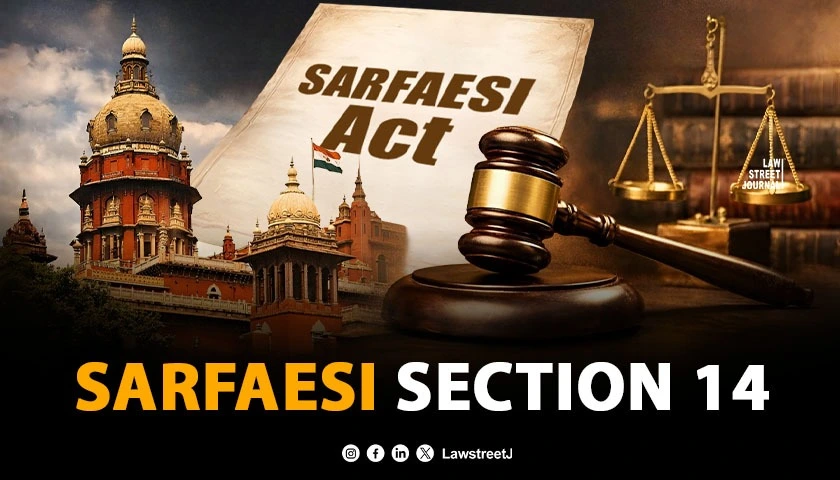
Chennai: The Madras High Court has issued a comprehensive set of statewide directions governing the processing of applications filed under Section 14 of the Securitisation and Reconstruction of Financial Assets and Enforcement of Security Interest Act, 2002 (SARFAESI Act), declaring unequivocally that the role of the designated authority under that provision is ministerial and not adjudicatory, and that unexplained delays in deciding such applications will be viewed seriously and may attract adverse comments and consequential orders.
A Division Bench of Chief Justice Sushrut Arvind Dharmadhikari and G. Arul Murugan passed the order while disposing of a writ petition filed by a successful auction purchaser of a secured asset sold by Punjab National Bank, who had been unable to obtain physical possession of the property nearly a year after the bank had issued a sale certificate in his favour.
The petitioner had purchased the property through a SARFAESI auction, paid the full sale consideration, and obtained a sale certificate on 3 June 2025. However, possession was not handed over. Punjab National Bank informed the Court that its application under Section 14 of the SARFAESI Act seeking assistance for taking possession had remained pending before the Chief Judicial Magistrate, Chengalpattu, where nearly 200 similar applications were awaiting registration and disposal.
Referring to R.D. Jain and Company v. Capital First Limited and Balkrishna Rama Tarle v. Phoenix ARC Private Ltd., the Court held that the powers exercised by the Chief Metropolitan Magistrate or District Magistrate under Section 14 of the SARFAESI Act are purely ministerial in nature. It observed that the magistrate is not required to undertake any quasi-judicial inquiry or adjudicate disputes, but only to verify the correctness of the information furnished in the application and facilitate the secured creditor’s taking of possession without delay.
The Court observed that authorities across the country, including in Tamil Nadu, often either delay deciding applications under Section 14 of the SARFAESI Act or exceed their limited jurisdiction by adjudicating disputes. Such practices, it noted, generate unnecessary litigation and undermine the very purpose of the SARFAESI Act, which was enacted to ensure the speedy recovery of secured assets and help reduce non-performing assets (NPAs) in the banking sector.
The Court also referred to Equitas Small Finance Bank Ltd. v. State of Madhya Pradesh, a case decided by the present Chief Justice while serving at the Madhya Pradesh High Court. In that case, a Chief Judicial Magistrate had refused to register a Section 14 application and instead listed it for arguments. Noting the similarity of the issue, the Court recalled that the Madhya Pradesh High Court had issued detailed guidelines and directed that Section 14 applications should preferably be disposed of within 45 days of filing.
Agreeing with the approach adopted by the Madhya Pradesh High Court, the Madras High Court issued statewide directions to all Chief Metropolitan Magistrates, Chief Judicial Magistrates, and District Magistrates exercising powers under Section 14 of the SARFAESI Act. The Court directed that every Section 14 application must be registered immediately upon filing, without any pre-registration hearing. It further clarified that the designated authority’s scrutiny is limited to verifying territorial jurisdiction, service of the Section 13(2) notice, filing of the statutory affidavit confirming compliance with the Act, and whether the matter falls within any exception under Section 31 of the SARFAESI Act.
The Court further clarified that authorities acting under Section 14 cannot adjudicate disputes between the secured creditor, borrower, guarantor, or any third party, as such issues fall exclusively within the jurisdiction of the Debts Recovery Tribunal under Section 17 of the SARFAESI Act. It also held that no notice or hearing is required before passing an order under Section 14. Once the statutory requirements are satisfied, the designated authority must pass appropriate orders within 30 days of filing, extendable up to 60 days only in exceptional cases and for recorded reasons.
The Court carved out a limited exception for genuine tenants in possession of a secured asset prior to the creation of the mortgage. Relying on Harshad Govardhan Sondagar v. International Assets Reconstruction Co. Ltd. and Vishal N. Kalsaria v. Bank of India, it held that persons claiming tenancy rights must be given notice and an opportunity of hearing. However, the inquiry is confined to verifying the genuineness of the tenancy claim and cannot extend to adjudicating broader disputes. The exercise must also be completed within the timelines prescribed under Section 14 of the SARFAESI Act.
The Bench further directed that any person aggrieved by an order under Section 14 or by any step under Section 13(4), including a tenant or occupant, has a statutory remedy before the Debts Recovery Tribunal under Section 17, and that the designated authority shall note this remedy in its order.
It also held that if a designated authority fails to act within the prescribed time limit and the secured creditor or aggrieved party approaches the High Court by way of a writ petition, the designated authority shall file a statement of reasons for the delay, and unexplained delays may attract adverse comments and consequential orders.
To ensure statewide compliance, the Registrar General was directed to forward a copy of the order to all Principal District and Sessions Judges in Tamil Nadu, with a further direction to circulate it to all Metropolitan Magistrates, Chief Judicial Magistrates, and Additional Chief Judicial Magistrates exercising jurisdiction under Section 14. The Registry was also directed to send a copy to the Chief Secretary, Government of Tamil Nadu, for circulation among all District Magistrates and Additional District Magistrates across the state.
On the facts of the present case, the Chief Judicial Magistrate, Chengalpattu, was specifically directed to take up and dispose of the bank’s pending application under Section 14 in accordance with the Court’s directions within 30 days of receipt of a copy of the order, without listing it for arguments on registration or for any inquiry extraneous to the scope of Section 14. There was no order as to costs.
For Petitioner: Mr. M.L. Ramesh, Advocate.
For Respondent: Mr. M.L. Ganesh, Standing Counsel.
Case Title: Vijayanand Srinivasan v. Punjab National Bank, WP No. 16489 of 2026.



![TN Medical Council declares change of gender identity of LGBTQIA+ as misconduct [Read Notification]](/secure/uploads/2022/12/lj_5268_5cebb05a-97fb-40fb-8045-25cdf8f4207a.jpg)
![Madras High Court Directs Tamil Nadu Government to Ensure Quota for Transgenders in Local Body Elections [Read Order]](/secure/uploads/2023/08/lj_2507_7a03d113-08b1-4670-b6fb-9058aee481d0.jpg)
![Anti Corruption sleuths acted like "puppets in The Muppet Show", HC notice to ex TN CM in disproportionate assets case [Read Order]](/secure/uploads/2023/09/lj_8675_7b37fc02-1b2d-4f4a-9816-3df20545b37e.jpg)