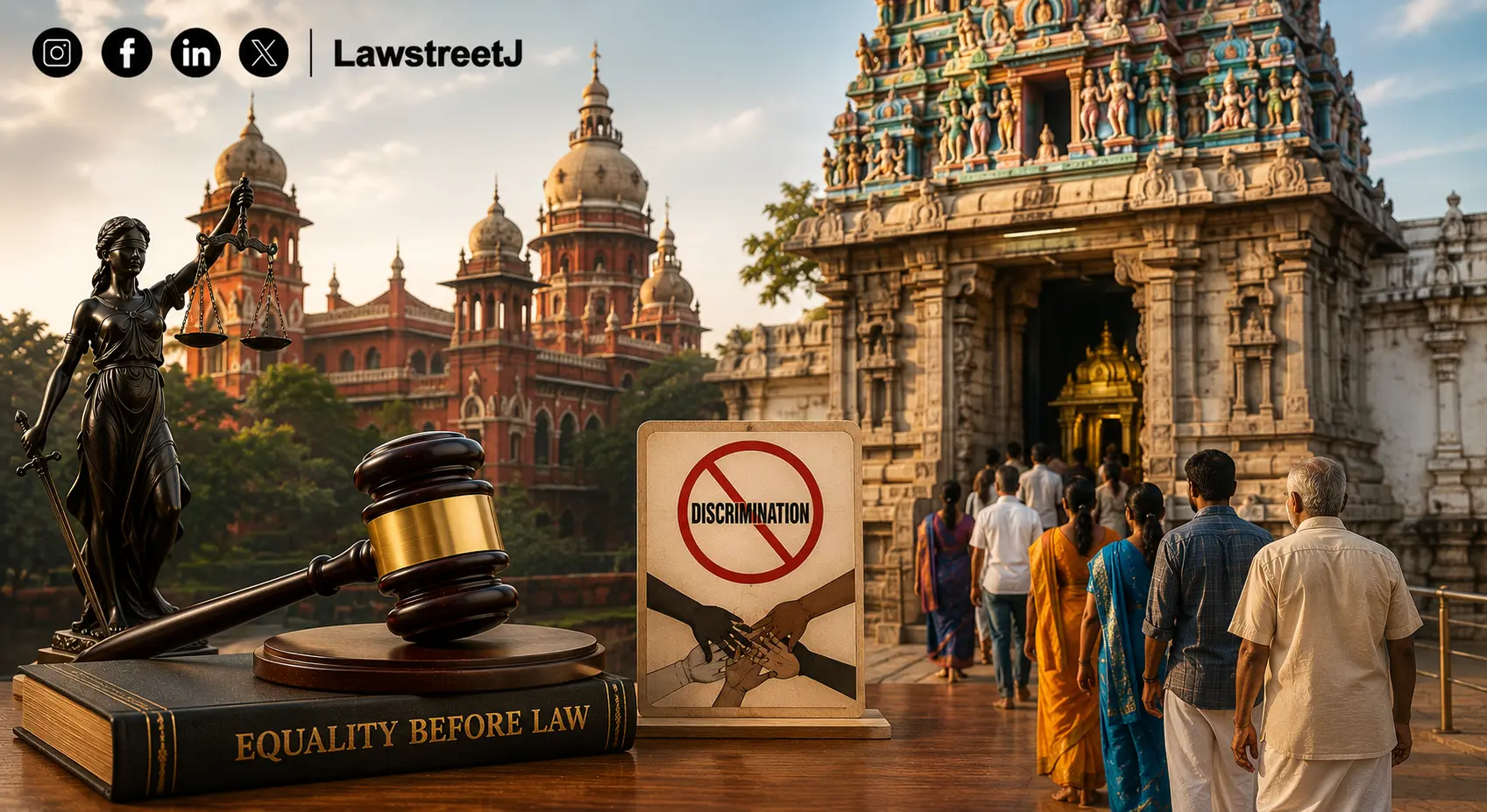
Chennai: The Madras High Court has disposed of a Public Interest Litigation alleging discrimination against non-Brahmin devotees of the Thenkalai cult at the Arulmigu Devaraja Swamigal Temple in Kanchipuram, recording an undertaking by the temple's Executive Trustee that there would be no discrimination in the distribution of Theertham, Satari and Prasadam, and that the recital of hymns and Prabandhams would remain open to all devotees.
A Division Bench of Dr. Justice G. Jayachandran and Justice E. Manoharan was hearing a writ petition filed by Madhavan Ramanuja Dasan, a Thenkalai Vaishnavite devotee of Lord Devarajaswamy and Secretary of the Thirukatchi Nambi Thirumaladiar Seva Sangam, seeking a writ of mandamus directing the authorities to prohibit discrimination against non-Brahmin devotees in the temple.
The petitioner contended that while devotees of all communities were permitted to worship at most shrines without major discrimination, the Sannathi of Manavala Munigal was an exception, non-Brahmin devotees being denied entry through the main entrance and confined to a side entrance reserved for them, while Brahmin devotees were permitted to use the main entrance. It was further contended that non-Brahmins were not permitted to recite hymns in the shrines, were made to stand outside the Sannathi to receive Prasadam and Theertham without Satari being placed on them, and that this discrimination was particularly pronounced during the ten-day birthday festival of Manavala Munigal. The petitioner relied on earlier communications from the Assistant Commissioner, HR and CE Department, in 2003 directing that there be no discrimination between Brahmins and non-Brahmins in the distribution of Theertham, Satari and Prasadam, as well as an order dated 31.10.2008 passed by the First Bench of the High Court in W.P. No. 25845 of 2008 affirming similar directions.
The Executive Trustee, in a counter affidavit, submitted that it was practically impossible to accommodate all members of the public inside the small Azhwar Acharyas sub-shrines, given that even the Adhyapaga Goshti and Adhyapak Mirasi Goshti members themselves could not be fully accommodated within, requiring devotees to be accommodated outside during service periods. The Special Government Pleader submitted on behalf of the temple authorities that there was no discrimination in the distribution of Theertham, Satari and Prasadam, and that all members of the public were treated equally, while clarifying that recital of hymns and Nalayira Dhivya Prabandhams during Sathumarai and Seva Kalams was reserved as a statutorily secured right of the Adhyapaga Mirasi holders of the Thenkalai Sect, carrying rights of remuneration and preferential honours, but that this did not prevent any other devotee from reciting the Nalayira Dhivya Prabandham in any shrine of the temple at any time for the purpose of worship. The impleaded respondents similarly denied any caste-based segregation, submitting that the sub-shrines were small structures where even service holders had to stand outside to recite Prabandhams, and that Divya Prabandham recitation was a conferred office of the Thenkalais of Kanchipuram rather than a common ritual.
Before recording its conclusions, the Court extracted Chapter 9, Verse 29 of the Bhagavad Gita, observing:
“I am equally disposed to all living beings. I am neither partial to anyone nor do I hate anyone. But those who worship Me with devotion, they are in Me and I am in them.”
The Court observed that in the eyes of God all living beings are equal, and that courts have consistently held there is no room for discrimination in a place of worship. Noting that the Special Government Pleader had offered to place the statement in the 4th respondent's counter affidavit on record as an undertaking, the Court held that this would resolve the petitioner's grievance concerning the distribution of Theertham, Satari and Prasadam. On the issue of recital of hymns and Prabandhams, the Court took on record the 4th respondent's statement, in paragraph 9 of its counter affidavit, that apart from the Adhyabaga Mirasi office secured for the Thenkalai Sect, no devotee or group would be prevented from reciting Prabandhams in any shrine of the temple for the purpose of worship, holding that this addressed the petitioner's remaining grievance regarding non-Brahmins being denied the opportunity to recite hymns.
Observing that the petitioner did not intend to disrupt any traditional ritual performed in praise of the deity, the Court held that the existing arrangement, as explained by the Special Government Pleader, preserved the petitioner's opportunity to recite hymns in the shrines without disturbing tradition, and that no discrimination arose from following the temple's customary practices. The Writ Petition was accordingly disposed of, with no order as to costs.
Case Title: Madhavan Ramanuja Dasan vs. The Commissioner, Hindu Religious and Charitable Endowment Department & Ors., W.P. No. 9273 of 2019



![Madras High Court Directs Tamil Nadu Government to Ensure Quota for Transgenders in Local Body Elections [Read Order]](/secure/uploads/2023/08/lj_2507_7a03d113-08b1-4670-b6fb-9058aee481d0.jpg)