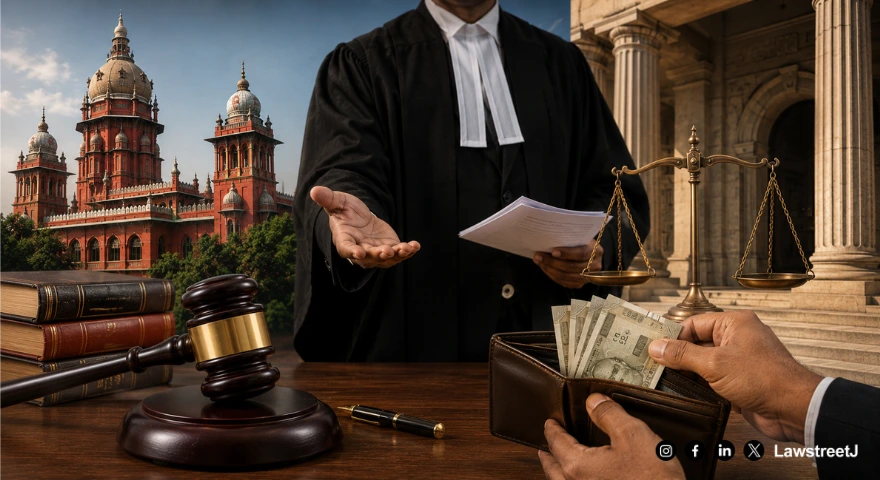
Madras: The Madras High Court has held that a claim for unpaid professional fees, even where the client is a public sector bank, cannot be enforced through a writ petition and must instead be agitated before a competent civil court.
A Division Bench of Chief Justice Sushrut Arvind Dharmadhikari and Justice G. Arul Murugan was hearing a writ appeal filed by advocate Sunit Kumar Agarwal, a former empanelled counsel for Punjab National Bank, against an order of the Single Judge dismissing his writ petition seeking payment of outstanding professional bills. The appellant, appearing in person, had claimed dues initially quantified at Rs.6,80,412/-, later enhanced to Rs.10,00,628/- on account of newly discovered bills, and contended that the delay in payment was owing to administrative malice, alleging that certain bank officials had demanded a 40 per cent commission to release his legitimate dues.
The appellant argued that the respondent bank, being an instrumentality of the State under Article 12 of the Constitution, could not act arbitrarily or in breach of trust. Counsel for the respondent bank, however, submitted that while certain undisputed bills had already been settled, other claims were seriously disputed on account of deficiencies in the legal services rendered, rendering the matter a private contractual dispute.
Framing the core question as “whether a writ petition under Article 226 of the Constitution is the appropriate remedy for enforcing a claim for professional fees arising out of an attorney-client relationship, especially where the facts are seriously disputed,” the Bench held that a writ is “an extraordinary public law remedy” designed to correct “glaring constitutional overreaches, failures of public duty, and arbitrary abuses of State power,” and is “not intended to serve as an alternate recovery mechanism for commercial or professional contracts.”
The court observed that for it to step into the realm of contract under writ jurisdiction, the appellant would have to demonstrate “an absolute, unambiguous admission of liability by the respondent, coupled with shocking arbitrariness that offends the sense of justice under Article 14 of the Constitution of India.” It noted that once the bank raises questions regarding the performance of a service, “the matter loses its public law character and enters the domain of private civil obligations.” This distinction, in the court's view, is what separates genuine cases of State arbitrariness amenable to writ jurisdiction from ordinary commercial disagreements over performance and payment, which fall to be resolved through the ordinary machinery of civil litigation rather than the extraordinary and summary process available under Article 226.
On facts, the Bench found that the claims submitted by the appellant were not admitted by the bank, which had explicitly cited deficiencies in the legal services rendered, while the appellant had countered with “grave criminal allegations of bribery and corruption.” In these circumstances, the court held that the Single Judge was right in holding that a writ petition was not the appropriate remedy to resolve the disputed contractual matter, finding “no legal infirmity in the approach adopted by the learned Single Judge that warrants our intervention in appeal.”
The Bench clarified that the dismissal of the writ petition did not leave the appellant without a remedy, observing that he had “knocked on the wrong judicial door” and that “the proper course of action is to approach a competent civil court, where both parties can file detailed pleadings, produce documents, cross-examine witnesses and establish the truth through a regular trial.”
Dismissing the appeal and affirming the order of the Single Judge, the court granted the appellant liberty to establish his claims for professional fees before a competent civil court or appropriate forum, and directed that if he chooses to file a civil suit, the time spent bona fide prosecuting the writ petition and the writ appeal shall be excluded for the purpose of computing limitation. There was no order as to costs.
Mr. Sunit Kumar Agarwal appeared in person for the appellant, while Mr. P. Raghunath, for M/s. T.S. Gopalan & Co, appeared for the respondents.
Case Title: Sunit Kumar Agarwal v. The Asst. General Manager, Punjab National Bank & Ors.



![TN Medical Council declares change of gender identity of LGBTQIA+ as misconduct [Read Notification]](/secure/uploads/2022/12/lj_5268_5cebb05a-97fb-40fb-8045-25cdf8f4207a.jpg)
![Madras High Court Directs Tamil Nadu Government to Ensure Quota for Transgenders in Local Body Elections [Read Order]](/secure/uploads/2023/08/lj_2507_7a03d113-08b1-4670-b6fb-9058aee481d0.jpg)
![Anti Corruption sleuths acted like "puppets in The Muppet Show", HC notice to ex TN CM in disproportionate assets case [Read Order]](/secure/uploads/2023/09/lj_8675_7b37fc02-1b2d-4f4a-9816-3df20545b37e.jpg)