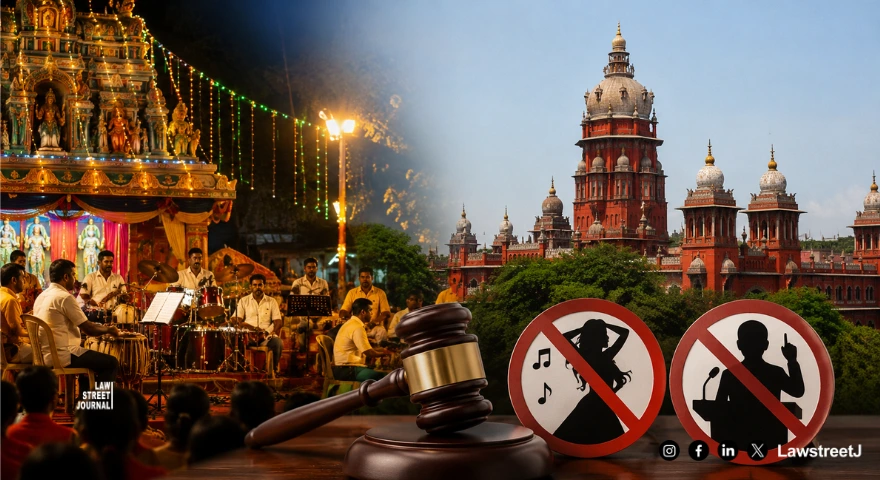
The Madurai Bench of the Madras High Court has directed the police to grant permission and protection for an Aadal Paadal orchestra program at a temple festival, while laying down an extensive set of conditions aimed at preventing obscenity, political propaganda and communal disharmony during such performances.
Justice L. Victoria Gowri was hearing a writ petition seeking a direction to the Thoothukudi police to permit and provide protection for the program scheduled to be held on 23.06.2026 in connection with the festival of Sri Aathi Parameshwari Amman Temple, Mukkani Village, Thoothukudi District, based on the petitioner's representation dated 13.06.2026.
The court noted that the Director General of Police, Tamil Nadu, had earlier issued two circulars, dated 31.10.2018 and 09.04.2019, instructing Inspectors of Police across the State on the manner of considering applications seeking permission for cultural programmes at such events.
Disposing of the writ petition, the court permitted the petitioner to conduct the cultural program on 23.06.2026 between 7.00 p.m. and 10.00 p.m., subject to a detailed list of conditions to be enforced by the organisers, who were required to be responsible members of the festival committee. Among the key conditions imposed by the court were the following:
- Only cultural programs having relevance to the temple or festival would be permitted, with no obscene display or dance.
- No women participating in the program would be portrayed in an obscene or undignified manner, whether through clothing or otherwise, and there would be no obscene dance or vulgar dialogue by any participant.
- The music played would be in sync with the sanctity of the temple precincts, and double-meaning songs were barred so as not to “spoil the minds of students and youths.”
- There would be no supply of alcohol or intoxicating material in and around the venue, and no donations, prizes, slogans, banners or flex boards in support of any political party or communal leader.
- None of the songs or dances would carry any political tone or relate to any religion, community or caste, and the function was to be conducted without affecting communal harmony or discrimination.
- Digital banners or placards were not to be erected on arterial roads, platforms or walkways.
On the specific question of attire, the court held that “the attire of the dancers performing in the said programme should be modest and should not involve exposure of the midriff, thighs, legs or chest. Any violation of this condition shall result in legal action, including the arrest of the organisers and all members of the temple committee.”
The court further prescribed a specific dress code for performers, directing that men wear a dhoti or pyjama with an upper cloth, women wear sarees, half-sarees or chudithars with an upper cloth, and children wear any fully covered dress.
Additional conditions required that the entire programme be videographed, that the police be empowered to stop the show if it exceeded the permitted time, and that the organisers bear responsibility for any untoward incident as well as the bundobust charges for police deployment. The organisers were also directed to obtain all other permissions required from the concerned authorities, and to ensure that the event did not disturb public peace and tranquility.
The court made it clear that in the event of violation of any of the conditions imposed, the concerned police officer was at liberty to take necessary action as per law, stop the performance forthwith, and report the matter to the court. It was further clarified that the authorities concerned could impose any other conditions considered necessary according to the ground reality, and that the organisers and committee members would be held responsible for any violation.
Appearances:
For the Petitioner: Mr. Joseph Zinoson J., Advocate.
For the Respondents: Mr. S. Arun Arockiasamy, Government Advocate (Criminal Side).
Case Title: Pichai Raja vs. The District Superintendent of Police, Thoothukudi & Ors.



![Madras High Court Directs Tamil Nadu Government to Ensure Quota for Transgenders in Local Body Elections [Read Order]](/secure/uploads/2023/08/lj_2507_7a03d113-08b1-4670-b6fb-9058aee481d0.jpg)