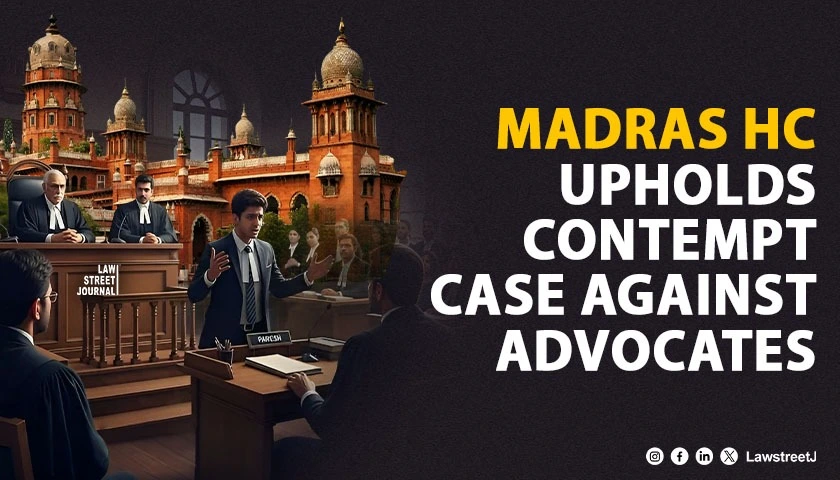
Chennai: The Madurai Bench of the Madras High Court has declined to quash contempt-in-the-face-of-court proceedings initiated by a Judicial Magistrate against a group of advocates, including office-bearers of a Bar Association, who were alleged to have collectively disrupted remand proceedings and sought to dictate the course of a judicial hearing.
The court held that any collective attempt by advocates or office-bearers of a Bar Association to overbear a presiding officer, insist upon a particular judicial order, or interrupt the course of a hearing in a manner unbecoming of officers of the court cannot be treated as protected professional conduct.
Justice L. Victoria Gowri pronounced the common order on 30 April 2026, disposing of five Criminal Original Petitions filed under Section 528 of the Bharatiya Nagarik Suraksha Sanhita, 2023, by S. Rajmohan, T. Balarathina Kumar, Mohan Kumar, A. Baskaran, and others — all practising advocates and, in four cases, office-bearers of the Madurai Bar Association.
The controversy arose from events that took place on 19 and 20 January 2026. On the evening of 19 January, Advocate T. Balarathina Kumar filed a petition under Section 100 BNSS alleging the wrongful detention of his client by the S.S. Colony Police. The Magistrate listed the matter for the following morning. When the matter was called on 20 January and no one appeared, it was passed over. Minutes later, the police produced a remand requisition in respect of the same person as Accused No. 2. At that stage, the petitioners — including the Bar President, Secretary, and Treasurer — allegedly entered the courtroom and collectively insisted that the court should not proceed with the remand.
The Bar President was alleged to have made a sarcastic remark questioning the need for a vakalath before making submissions. Repeated collective interruptions allegedly compelled the Magistrate to retire to chambers. The entire incident was captured on CCTV footage. After resuming proceedings at 6:30 p.m., the Magistrate took cognizance under Section 384 BNSS of an offence under Section 267 of the Bharatiya Nyaya Sanhita, 2023. A further order dated 11 February 2026 returned the vakalaths filed on behalf of the petitioners and directed their personal appearance.
The petitioners sought quashing of the proceedings on the grounds that the allegations were vague and omnibus; that the ingredients of Section 267 BNS were not made out in the absence of intentional insult; that cognizance had been taken after court working hours in violation of the “rising of the court” requirement under Section 384 BNSS; that the Magistrate was thereafter obligated to proceed under Section 385 BNSS before another Magistrate; and that the repeated use of the word “offenders” disclosed predetermination. The order dated 11 February 2026 was separately challenged as contrary to the right of representation through counsel.
The court rejected each of these grounds. It held that the expression “before the rising of the court on the same day” in Section 384 BNSS is not synonymous with “before the close of office hours”; rather, the legislature had consciously used language tied to the actual adjournment of the court, not clerical timings. Since the respondent’s case, supported by CCTV footage, was that the court rose only at 7:30 p.m. and cognizance was taken in open court before that time, the proceedings could not be declared void ab initio.
On Section 385, the court held that the provision is discretionary and that the argument was premature, since no punishment had yet been imposed. On the issue of predetermination, the court acknowledged that the use of stronger language at the notice stage was open to criticism, but held that it did not vitiate the proceedings beyond cure, since the petitioners retained every opportunity to contest the allegations before the Magistrate.
Regarding the vakalath order, the court declined to hold that proceedings under Section 384 BNSS always bar representation through counsel, but equally declined to recognise an absolute right to avoid personal appearance in such proceedings.
Dismissing all five petitions, the court directed the Judicial Magistrate to proceed strictly in accordance with Sections 384, 385, and 387 BNSS, uninfluenced by any observations on the factual merits, while granting liberty to the petitioners to raise all objections before her. In its epilogue, the court placed on record its appreciation of the conduct of Judicial Magistrate No. V, Ms. Lakshmi Priya, commending her principled firmness and steadfast adherence to judicial duty in the face of considerable institutional pressure.
Case Title: S. Rajmohan & Ors. v. The Judicial Magistrate No. V, Madurai [Crl.O.P.(MD) Nos. 1514, 1617, 1623, 1624, and 4711 of 2026]



![TN Medical Council declares change of gender identity of LGBTQIA+ as misconduct [Read Notification]](/secure/uploads/2022/12/lj_5268_5cebb05a-97fb-40fb-8045-25cdf8f4207a.jpg)
![Madras High Court Directs Tamil Nadu Government to Ensure Quota for Transgenders in Local Body Elections [Read Order]](/secure/uploads/2023/08/lj_2507_7a03d113-08b1-4670-b6fb-9058aee481d0.jpg)
![Anti Corruption sleuths acted like "puppets in The Muppet Show", HC notice to ex TN CM in disproportionate assets case [Read Order]](/secure/uploads/2023/09/lj_8675_7b37fc02-1b2d-4f4a-9816-3df20545b37e.jpg)