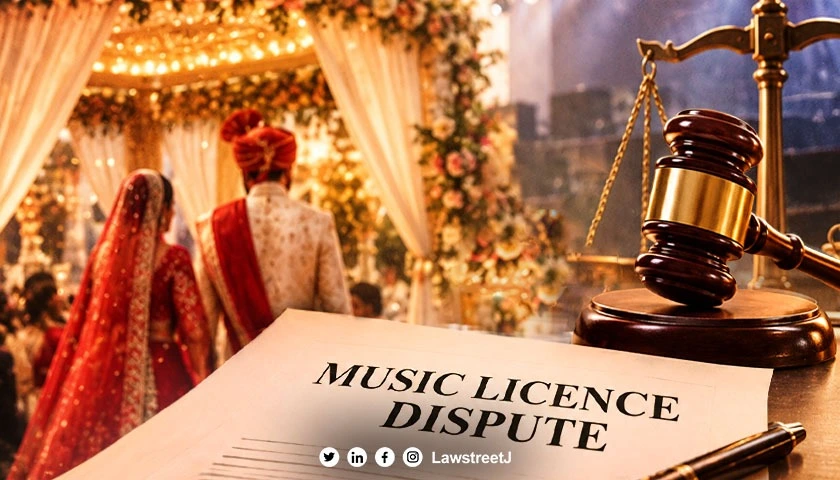
Chennai: The Madras High Court has granted an interim injunction to a couple restraining Novex Communications Pvt. Ltd. from causing any disturbance or inconvenience to them or their guests, or entering or lingering near the venue, during the cocktail event and dinner they were to host in the evening of their wedding day at the ballroom of Taj Connemara, Chennai.
The Court left open the larger question of whether a licence is required for playing sound recordings at such events.
Justice P.B. Balaji was hearing O.A. No. 1211 of 2026 in C.S. (Comm. Div.) No. 299 of 2026, filed by B. Karthiyani and V.P. Raman against Novex Communications Pvt. Ltd. (first defendant) and Taj Connemara, a part of The Indian Hotels Company Ltd. (second defendant). The suit seeks a declaration that the first defendant has issued a groundless threat of copyright infringement and a permanent injunction against its threat to make them pay and obtain a licence for sound recordings to be used at the social festivity associated with their marriage on 15.11.2026.
The applicants said that they were to marry on 15.11.2026 and, following the morning wedding ceremony, planned a cocktail event followed by dinner in the evening, with third parties engaged to play music and songs. They had obtained a No Objection Certificate from the Indian Performing Right Society (IPRS) on 20.10.2026, which, the order notes, does not charge for such consent. On 27.10.2026, however, the first defendant sent a communication to the hotel stating that playing any sound recordings would violate its rights and that its consent would have to be obtained on payment of the requisite fee, which led the applicants to file the suit.
Counsel for the applicants relied on Section 52(1)(za) of the Copyright Act, 1957, and in particular its Explanation, which provides that a ‘religious ceremony’ includes a marriage procession and other social festivities associated with a marriage. He argued that the cocktail event and dinner on the same day are associated with the morning wedding and fall within the exemption. He added that the applicants did not know what rights the first defendant held or whether the songs to be played would be licensed to it, since a third-party event manager would be engaged, and that whether they were infringing, or needed the first defendant’s consent, could be tested later.
The Court noted that the first defendant’s own notice of 27.10.2026 admitted that the position on wedding-related events is “at best, contentions and under active judicial scrutiny”, with courts “increasingly examining the misuse of Section 52(1)(za) as a blanket defence”. It held that the applicants, who were getting married on that day, “should not be put to any inconvenience, prejudice or embarrassment whatsoever”, and that:
“The larger issues can always to be decided at a later point of time and the interest of the first respondent is sufficiently protected and if at all the Court ultimately decides that the first respondent is the valid licence holder and that the applicants would have to get consent for playing music or songs licensed to them, then the first respondent can always be compensated monetarily.”
Finding a prima facie case and the balance of convenience in the applicants’ favour, the Court said that without an injunction they would suffer irreparable loss if the first defendant came to the event and created commotion before their guests. It granted the interim injunction as prayed, ordered notice returnable by 03.12.2026, permitted private notice, directed compliance with Proviso (b) to Rule 3 of Order XXXIX CPC, and listed the matter on 03.12.2026.
The order is an interim one. The Court has made no finding on whether Section 52(1)(za) covers the evening event, or on the first defendant’s licence rights, which are left for the suit.
Appearances:
For the Applicants/Plaintiffs: Mr. R. Sathish Kumar, for Mr. K. Seshasayee.
Case Title: B. Karthiyani & Anr. vs. Novex Communications Pvt. Ltd. & Anr., O.A. No. 1211 of 2026 in C.S.(Comm. Div.) No. 299 of 2026