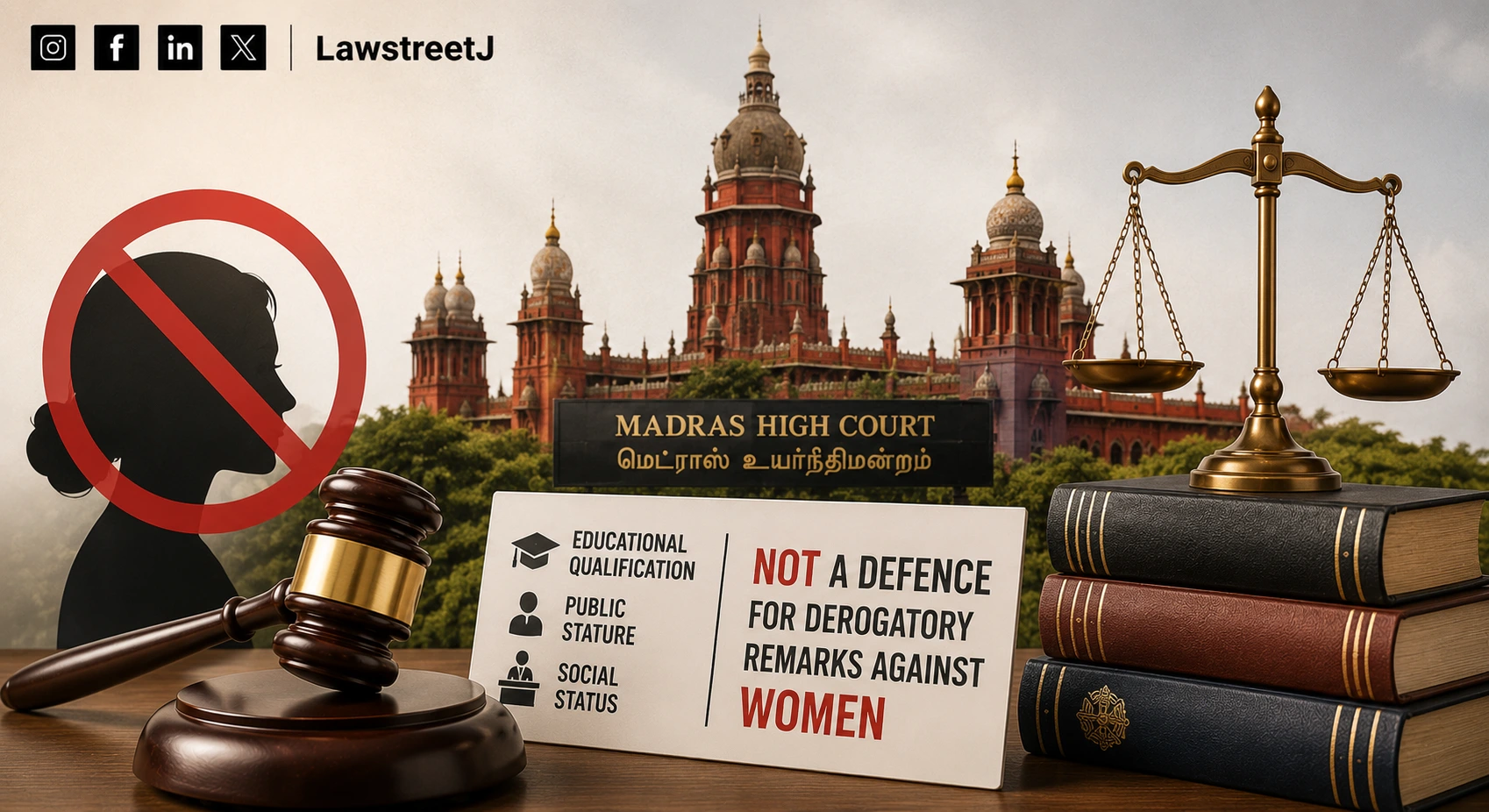
Chennai: The Madras High Court has refused to quash two FIRs registered against scientist and political commentator Dr.Ponraj over allegedly derogatory remarks made against women members of the Tamilaga Vettri Kazhagam (TVK), holding that his scientific eminence and public standing could not be pleaded as a defence to seek quashing of proceedings that, on their face, disclosed cognizable offences.
Justice G.K.Ilanthiraiyan was hearing two Criminal Original Petitions filed under Section 528 of the Bharatiya Nagarik Suraksha Sanhita, seeking to quash FIRs registered by the Cyber Crime Wing of the CCB, Chennai.
The first, in Crime No.59 of 2026, invoked Sections 79 and 296(b) of the Bharatiya Nyaya Sanhita and Section 67 of the Information Technology Act, on a complaint by Nirmal Kumar, MLA, Thiruparakundram Constituency, and Minister for Energy Resources and Law. The second, in Crime No.194 of 2026, invoked Sections 79 and 353(1)(c) of the Bharatiya Nyaya Sanhita, Section 4 of the Tamil Nadu Prohibition of Harassment of Women (Amendment) Act, 2002, and Section 67 of the IT Act, on a complaint by Raj Kumar, MLA, Cuddalore Constituency, and Minister for Housing and Urban Development. Since the allegations in both complaints were identical and the accused was the same, the court passed a common order.
The prosecution's case was that, during an interview telecast on the YouTube channel "King 360" on 18.03.2026, the petitioner made derogatory remarks against the women members of TVK, describing them as "prostitutes" and "illiterates" and thanking the party's leader for "exposing them". The complainants alleged that the remarks were intended to outrage and demean the modesty and dignity of women, and were not confined to the party's women members but were capable of insulting the dignity of women across Tamil Nadu.
Appearing for the petitioner, Senior Counsel Mr.N.R.Elango submitted that no offence was made out even if the FIR's allegations were accepted in their entirety, and that its registration amounted to an abuse of the process of law. He contended that the complaints were politically motivated, that the FIRs were registered only after the declaration of election results despite the complaints having been lodged earlier, and that the police had mechanically registered the FIRs without any preliminary enquiry.
He further submitted that the petitioner, a scientist and public policy advisor who had served as Director (Technology Interface) at the President's Secretariat under Dr.A.P.J.Abdul Kalam and as a senior scientist on the LCA-Tejas programme, was a political commentator and not a politician, and that the complainants had picked out a single word from his interview without appreciating it in its entirety. He also pointed out that the petitioner had submitted a written explanation to the Commissioner of Police and that the video had since been taken down, and relied on the Supreme Court's rulings in Imran Pratapgadhi v. State of Gujarat and S.Khushboo v. Kanniammal to argue that the complaints did not disclose any offence.
The learned Government Advocate (Crl. Side) and counsel for the second respondents opposed the petitions, submitting that the remarks were deliberate and considered, not inadvertent, and were made against an identifiable class of women, distinguishing the facts from Khushboo, where the offending material did not name or concern any identifiable individual or class.
Rejecting the petitioner's contentions, the court held that Section 79 of the Bharatiya Nyaya Sanhita does not require that the offending words be addressed to a single named woman, and that it is sufficient if the words are directed at, or concern, an identifiable and ascertainable class of women. The women cadre of TVK, the court observed, constituted such an identifiable class, being known functionaries and volunteers of a registered political party.
The court was also unpersuaded by the petitioner's professional standing being urged as a ground for quashing. It observed that a person possessing scientific eminence, educational qualifications and public accomplishments bears a greater responsibility in public discourse, and held that “such status cannot be pleaded as a defence to seek quashing of the FIR” when the allegations disclose the commission of cognizable offences. It further held that the explanation submitted to the Commissioner of Police was merely that, and that the subsequent removal of the video did not efface the alleged commission of the offences.
Reiterating that “the FIR is not an encyclopedia and it need not contain all facts”, and relying on the Supreme Court's decisions in Sau. Kamal Shivaji Pokarnekar v. State of Maharashtra and M/s.Neeharika Infrastructure Pvt. Ltd. v. State of Maharashtra, the court held that quashing of an FIR ought to be an exception rather than the rule, that criminal proceedings ought not to be scuttled at the threshold, and that at this stage the court was required only to see whether the allegations disclosed a cognizable offence, not to evaluate their merits.
Holding that the allegations, taken at face value, prima facie disclosed cognizable offences warranting investigation, the court declined to quash the FIRs. It dismissed both Criminal Original Petitions and the connected miscellaneous petitions, and directed the Inspector of Police, CCB, Cyber Crime Wing, Chennai, to complete the investigation in Crime Nos.59 and 194 of 2026 and file the final report before the jurisdictional Magistrate within twelve weeks.
Appearances:
For the Petitioner: Mr.N.R.Elango, Senior Counsel, for Mr.A.S.Ashwin Prasanna.
For Respondent No.1 (State): Mr.Arun Anbumani, Government Advocate (Crl. Side).
For Respondent No.2: Mr.Kripakaran, for M/s.M.B.Ramya.
Case Title: Dr.Ponraj vs. State rep. by Inspector of Police, CCB, Cyber Crime Wing & anr., Crl.O.P.Nos.15258 and 15446 of 2026



![Madras High Court Directs Tamil Nadu Government to Ensure Quota for Transgenders in Local Body Elections [Read Order]](/secure/uploads/2023/08/lj_2507_7a03d113-08b1-4670-b6fb-9058aee481d0.jpg)


.jpeg)