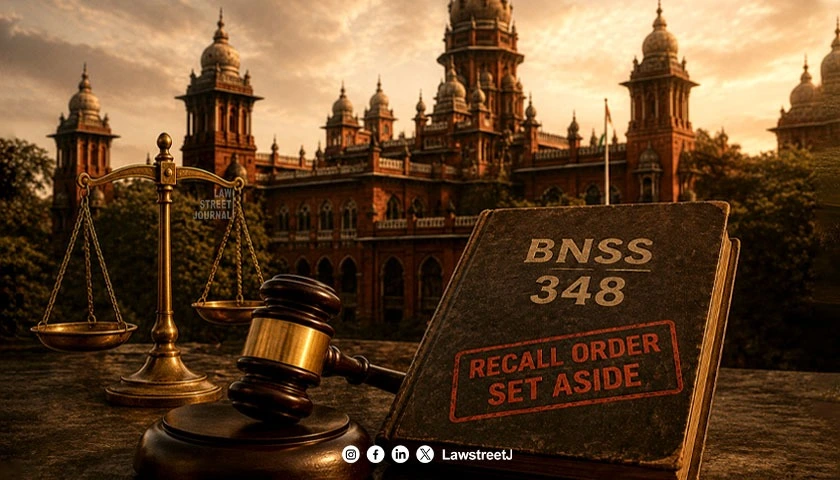
The Madurai Bench of the Madras High Court held that the power to recall a witness under Section 348 of the Bharatiya Nagarik Suraksha Sanhita, 2023 is governed by a test of essentiality, not mere relevance, and cannot be used to give the prosecution a second innings after the defence has exposed weaknesses in its case.
In a significant ruling concerning the scope of a court’s power to recall witnesses during criminal trials, the Madurai Bench of the Madras High Court has held that Section 348 of the Bharatiya Nagarik Suraksha Sanhita, 2023 cannot be invoked to provide the prosecution with an opportunity to cure weaknesses in its case after the defence has exposed them. The Court emphasized that the power to recall a witness is governed by the test of essentiality for a just decision of the case and not merely the relevance or usefulness of additional evidence.
The Court of Justice L. Victoria Gowri observed that while Section 348 BNSS grants wide powers to ensure a fair trial, such power must be exercised cautiously and cannot become a tool for filling lacunae in the prosecution’s case or causing prejudice to the accused. The ruling came while setting aside an order permitting recall of the Investigating Officer in a murder trial for introducing additional electronic and documentary evidence at the final stage of proceedings.
Background
The petitioner, Anbu, was facing trial for the alleged offence of murder under Section 302 of the Indian Penal Code, 1860 before the Additional District and Sessions Judge, Fast Track Court, Kumbakonam. The case originated from Crime No. 991 of 2021 registered at Kumbakonam Taluk Police Station.
The prosecution alleged that the deceased, Venkatesan, Regional Manager of UNILINK Company, had entrusted agricultural products worth ₹14 lakh to the accused for sale, but the accused failed to remit the sale proceeds. Following a demand for repayment, the accused allegedly took the deceased in his car and later killed him with a billhook before abandoning the body.
During the trial, after the examination of witnesses including the Investigating Officer, the matter reached the stage of defence evidence and final arguments. At this stage, the prosecution moved an application under Section 348 of the Bharatiya Nagarik Suraksha Sanhita, 2023 seeking recall of the Investigating Officer for marking additional electronic and documentary evidence, including call detail records, tower location data, IMEI details, SIM particulars, and bank transaction records.
The trial court allowed the application, observing that the additional materials were necessary for a complete adjudication of the case. Challenging the order, the accused approached the High Court.
Arguments
The petitioner contended that the trial court failed to apply the test of necessity under Section 348 of the Bharatiya Nagarik Suraksha Sanhita, 2023 before allowing recall of the Investigating Officer. It was argued that the prosecution had already examined fourteen witnesses and completed its evidence, including the full cross-examination of PW-14. According to the petitioner, the recall application was filed only after the defence highlighted gaps in the prosecution case and amounted to an attempt to fill lacunae at the final stage of trial.
The petitioner further submitted that the proposed documents, including call detail records, tower location data, and bank transactions, could not by themselves establish the ingredients of murder under Section 302 IPC. It was argued that the prosecution had also failed to recover the alleged weapon of offence and establish the complete chain of circumstances.
It was also contended that the trial court’s order was mechanical as it failed to explain how the additional documents were essential for deciding the case. Reliance was placed on decisions including State of NCT of Delhi v. Shiv Kumar Yadav, Rajaram Prasad Yadav v. State of Bihar, and Natasha Singh v. CBI.
Opposing the petition, the prosecution argued that Section 348 BNSS grants wide powers to the court to summon or recall evidence necessary for a just decision. Since the case was based on circumstantial evidence, the additional records were relevant to establish motive, last seen circumstances, and the movement of the accused and deceased. The prosecution maintained that the omission to produce the documents earlier was only an inadvertent lapse and that no prejudice would be caused as the accused would have an opportunity to cross-examine the Investigating Officer after recall.
Analysis
The Court examined whether the trial court was justified in allowing recall of PW-14 under Section 348 of the Bharatiya Nagarik Suraksha Sanhita, 2023, which corresponds to Section 311 CrPC.
The Court observed that the provision confers wide powers on courts to summon or recall witnesses where their evidence is necessary for a just decision of the case. However, such power must be exercised with caution and cannot be used to fill gaps in the prosecution case, conduct a disguised retrial, or cause prejudice to the accused.
Relying on the Supreme Court decisions in Rajaram Prasad Yadav v. State of Bihar, State of NCT of Delhi v. Shiv Kumar Yadav, and Natasha Singh v. CBI, the Court held that the necessity of additional evidence must be demonstrated through specific reasons and cannot be based on a mere assertion that recall is required for a fair trial.
The Court distinguished between an inadvertent omission and a lacuna in the prosecution case. It observed that while an accidental failure to produce material evidence may be corrected, courts must be cautious where the prosecution seeks to introduce additional material after completion of evidence and cross-examination of key witnesses.
Examining the trial court’s order, the Court found that it had not undertaken a document-wise analysis of how the proposed materials were essential for deciding the case. The Court noted that the prosecution witnesses had already spoken about the meeting between the accused and the deceased, the phone calls, and the sharing of locations. Therefore, call records, tower location data, and related electronic records were only corroborative in nature, and the trial court had failed to explain why they were indispensable.
With respect to bank transaction details, the Court held that while motive may be relevant in cases based on circumstantial evidence, such records alone could not establish the offence of murder. The requirement under Section 348 BNSS is not mere relevance but essentiality for a just decision.
The Court further held that the phrase “at any stage” in Section 348 BNSS does not mean that recall can be permitted without adequate justification. The later the stage of proceedings, the greater the judicial scrutiny required, particularly when recall is sought after closure of prosecution evidence and examination of the accused.
The Court observed that permitting recall at such a stage, after the defence had conducted its case on the basis of existing evidence, would prejudice the accused and disturb the balance of a fair trial under Article 21 of the Constitution.
Conclusion
The Court allowed the Criminal Original Petition and set aside the order passed by the Additional District and Sessions Judge, Fast Track Court, Kumbakonam. The trial court was directed to proceed with S.C. No. 187 of 2022 in accordance with law and dispose of the same as expeditiously as possible, uninfluenced by any observation made by the High Court on the merits of the main case.
The Court observed in its epilogue that Section 348 BNSS is a powerful judicial instrument meant to prevent failure of justice, not to confer a second innings upon a negligent litigant. The power to recall a witness must be exercised not merely because the evidence may be useful, but because its absence would render the decision unjust.
Case Title: Anbu v. The State of Tamil Nadu (Crl.O.P.(MD) No. 1327 of 2026)



![TN Medical Council declares change of gender identity of LGBTQIA+ as misconduct [Read Notification]](/secure/uploads/2022/12/lj_5268_5cebb05a-97fb-40fb-8045-25cdf8f4207a.jpg)
![Madras High Court Directs Tamil Nadu Government to Ensure Quota for Transgenders in Local Body Elections [Read Order]](/secure/uploads/2023/08/lj_2507_7a03d113-08b1-4670-b6fb-9058aee481d0.jpg)
![Anti Corruption sleuths acted like "puppets in The Muppet Show", HC notice to ex TN CM in disproportionate assets case [Read Order]](/secure/uploads/2023/09/lj_8675_7b37fc02-1b2d-4f4a-9816-3df20545b37e.jpg)