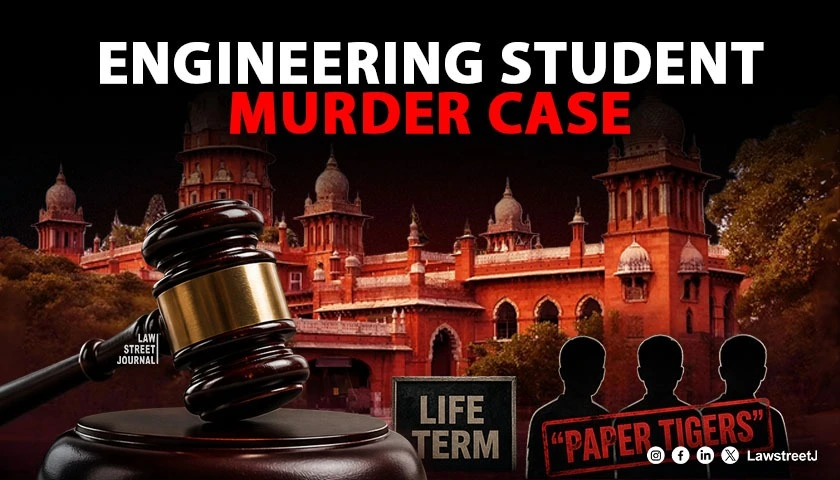
A Division Bench of the Madurai Bench of the Madras High Court dismissed the criminal appeal of a man convicted for murdering a fellow student inside a college classroom, upholding life imprisonment, while strongly censuring student eyewitnesses who turned hostile and warning that social media activism without real-world courage makes them no more than “paper tigers”.
The Madurai Bench of the Madras High Court dismissed an appeal filed by Udayakumar challenging his conviction and sentence for the murder of Sonali, a third-year BE Civil Engineering student of Karur College of Engineering, confirming life imprisonment and rejecting all contentions raised on the identity of the accused, reliability of the sole eyewitness, and alleged lapses in investigation.
A Division Bench of Justices N. Anand Venkatesh and K.K. Ramakrishnan also expressed deep disappointment at the conduct of student witnesses who were present during the attack but chose to turn hostile in Court, observing that expressing dissent on social media while failing to speak the truth before a court of law serves no purpose, and that such students only become “paper tigers” in real life.
Background
The appellant, Udayakumar, and the deceased Sonali were students of the same branch at Karur College of Engineering. Following personal differences, the accused allegedly developed hostility towards Sonali.
The prosecution case was that the accused entered the classroom carrying a wooden log and assaulted Sonali on her head, causing severe injuries. When another student intervened, he was also attacked and injured. Sonali was taken to Apollo Hospital, Madurai, where she succumbed to her injuries on the same day.
An FIR was registered at Karur Town Police Station initially under Sections 294(b), 324, 506(II), and 307 of the Indian Penal Code. After Sonali’s death, the case was altered to include Section 302 IPC, along with Section 449 IPC.
The Trial Court convicted the accused under Sections 302, 449, 324, 506(II), and 294(b) IPC and sentenced him to life imprisonment along with other terms. Challenging the conviction, the accused approached the High Court.
Arguments
The appellant’s counsel argued that the identity of the accused was doubtful and that the conviction was based mainly on the testimony of PW1, as the other eyewitnesses either turned hostile or did not witness the actual assault. It was submitted that PW1 had joined the college only 45 days before the incident and did not know the accused earlier. Since no test identification parade was conducted, the identification of the accused for the first time before the Court was unreliable.
The defence further pointed out inconsistencies regarding the recovery of the wooden log used in the alleged assault. While witnesses stated that the accused had left the weapon in the classroom, the investigating officer claimed that it was recovered from a bush after the accused’s arrest. It was argued that these discrepancies, along with contradictions in PW1’s statements, created reasonable doubt and the accused was entitled to acquittal.
Opposing the appeal, the State submitted that PW1 was an injured eyewitness who had personally witnessed the incident and had identified the accused before the Court. The prosecution argued that the accused’s identity was established through other students who knew him from the college and that investigative lapses could not discredit reliable eyewitness evidence supported by medical findings.
Analysis
The High Court examined the challenge to the conviction, particularly the reliability of the identification of the accused. The Court held that a test identification parade is only an aid to investigation and its absence does not by itself render an in-court identification unreliable. The Court observed that the real test is whether the identification made before the Court is trustworthy and supported by the surrounding circumstances.
Relying on the Supreme Court’s decision in Pargan Singh v. State of Punjab and Another, (2014) 14 SCC 619, the Court held that a person who experiences a violent attack is likely to remember the face of the assailant for a long period. The Court noted that PW1 was an injured eyewitness who had personally encountered the accused during the incident and his identification after about two years could not be treated as doubtful.
The Court reiterated the principle that the testimony of an injured witness carries a higher degree of credibility and cannot be discarded without compelling reasons. It held that minor contradictions regarding details such as the accused’s clothing or the manner in which the complaint was lodged did not affect the prosecution case.
On the issue of recovery of the wooden log, the Court criticised the investigating officer for incorrectly showing the recovery after the accused’s arrest, despite witnesses stating that the weapon was left at the scene. However, relying on the settled principle that defective investigation alone cannot demolish an otherwise credible prosecution case, the Court held that the lapse did not create reasonable doubt. The weapon’s presence at the spot and the medical evidence linking the injuries to it supported the prosecution version.
The Court also considered the conduct of PW27, who initially supported the prosecution case but later changed his version during cross-examination. Referring to Dharmaraj v. The Inspector of Police, Athanakottai Police Station, Pudhukottai District (2015) 2 LW (Crl.) 458 and Rasukannu @ Rengasamy and Karthik v. State through the Inspector of Police, Alangudi Police Station, Pudukottai District (2018) 1 MLJ 306, the Court held that the later version of the witness appeared unreliable and that the witness had been won over.
After analysing the evidence, the Court concluded that the prosecution had established the identity of the accused beyond reasonable doubt and upheld the conviction.
Conclusion
The Court dismissed the criminal appeal and confirmed the judgment and sentence of the trial Court. The trial Court was directed to take steps to secure the presence of the accused to undergo the remaining period of sentence.
The Court also issued a strong message to students. Expressing deep disappointment that the eyewitness students, who had watched the attack unfold in front of them did not attempt to stop the accused, did not overpower him after the fact, and chose to depose falsely in Court, the Court observed that no purpose is served by students who express dissent on social media but lack the moral courage to act or speak the truth when it matters.
The Court held that unless acts of this nature are identified and the assailant is punished with the active cooperation of all concerned, such violence is only bound to continue.
Case Title: Udayakumar v. The State through the Inspector of Police, Karur Town Police Station, Karur District (Crl. A. (MD) No. 301 of 2023)



![TN Medical Council declares change of gender identity of LGBTQIA+ as misconduct [Read Notification]](/secure/uploads/2022/12/lj_5268_5cebb05a-97fb-40fb-8045-25cdf8f4207a.jpg)
![Madras High Court Directs Tamil Nadu Government to Ensure Quota for Transgenders in Local Body Elections [Read Order]](/secure/uploads/2023/08/lj_2507_7a03d113-08b1-4670-b6fb-9058aee481d0.jpg)
![Anti Corruption sleuths acted like "puppets in The Muppet Show", HC notice to ex TN CM in disproportionate assets case [Read Order]](/secure/uploads/2023/09/lj_8675_7b37fc02-1b2d-4f4a-9816-3df20545b37e.jpg)