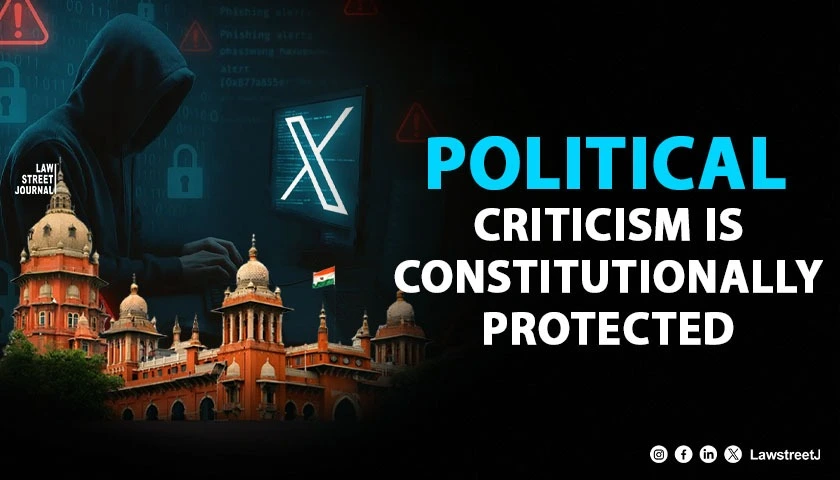
Chennai: A Division Bench of the Madras High Court, comprising Justice L. Victoria Gowri and Justice N. Senthilkumar, has stayed a notice issued by the Superintendent of Police, Cyber Crime Wing, Tamil Nadu, directing the removal and blocking of multiple URLs on X/Twitter.
The order was passed in a writ petition filed by P. Chockalingam, President of the Vishwa Hindu Parishad, North Tamil Nadu, who had challenged the notice as unconstitutional, arbitrary, and violative of Articles 14 and 19(1)(a) of the Constitution of India.
The impugned notice, issued by invoking Section 79(3)(b) of the Information Technology Act, 2000, read with Rule 3(1)(d) of the Information Technology (Intermediary Guidelines and Digital Media Ethics Code) Rules, 2021, directed the removal or blocking of multiple Twitter/X URLs belonging to different users under a single omnibus direction, requiring compliance within three hours.
The petitioner, represented by Mr. Sunny Sheen for Mr. C. Gunasekaran, submitted that one of the affected posts appeared, on a plain reading, to contain political criticism and commentary concerning contemporary political developments in Tamil Nadu. It was argued that the notice clubbed together multiple URLs of different users under a common direction without separately examining the content, context, and constitutional status of each individual post. The petitioner contended that such omnibus directions, unsupported by individualised reasoning or proper application of mind, were manifestly excessive, arbitrary, and disproportionate.
Petitioner’s counsel placed strong reliance on the Supreme Court’s judgment in Shreya Singhal v. Union of India, urging that the notice used broad, generalized expressions such as “provocative political remarks”, “disturbing public tranquillity”, “maintenance of law and order”, and “politically sensitive remarks”, without disclosing how each post crossed the constitutional threshold of incitement to violence or public disorder under Article 19(2).
It was further submitted that Section 79(3)(b) does not confer an independent censorship power upon the State, and that in the absence of compliance with Section 69A and the procedure prescribed under the Blocking Rules, the notice was ex facie constitutionally untenable. The petitioner also assailed the three-hour compliance window as wholly disproportionate in the absence of any disclosed emergency or imminent threat to public order.
The State, represented by Mr. L.S.M. Hasan Fizal as Additional Government Pleader for Respondent 1 and Mr. S. Raja Kumar as Additional Public Prosecutor for Respondents 2 to 4, contended that the notice was issued in the interest of law, order, and public tranquillity, and that authorities are empowered to take preventive action against online content likely to generate communal, political, or social tension. No counter affidavit explaining the specific basis for blocking each URL was filed at the interlocutory stage.
The Court, at the interlocutory stage, framed the question as to whether the petitioner had made out a prima facie case for an interim stay of the impugned notice and a direction to restore the blocked URLs pending disposal of the writ petition.
Proceeding to analyse the matter, the Court observed that the impugned notice prima facie clubbed together multiple URLs under a common direction without containing individualised reasons referable to each URL. The notice did not disclose the precise words or context rendering each post unlawful, nor did it indicate how any individual post satisfied the threshold of incitement to violence or public disorder under Article 19(2). The Court held that the constitutional infirmity in a blanket direction lay not merely in its width but in its silence. It emphasized that when the State restricts speech, it must speak through reasons, and that a political opinion cannot be removed merely because it is sharp, inconvenient, satirical, or dissenting.
Drawing upon Shreya Singhal, the Court reiterated the constitutional distinction between discussion, advocacy, and incitement, holding that only incitement crosses the constitutional boundary. It cautioned that vague and open-ended restrictions create a chilling effect, operating silently to compel citizens to self-censor. On the statutory framework, the Court held prima facie that Section 79(3)(b) is not an independent reservoir of blocking power and cannot be converted into a general censorship mechanism, and that where the State seeks to block public access to information, the procedure under Section 69A and the Blocking Rules, which require recording of reasons in writing, must be followed. The three-hour compliance window, the Court found, prima facie appeared disproportionate in the absence of any disclosed emergency.
The Court held that the balance of convenience tilted in favour of preserving the constitutional status quo, as allowing the notice to operate without scrutiny risked immediate and continuing injury to democratic discourse. Accordingly, the Division Bench granted an interim stay of the impugned notice and directed the fourth respondent to forthwith communicate to X Corp seeking the restoration and unblocking of all URLs mentioned therein, pending disposal of the writ petition. The Court, however, clarified that the interim order would not preclude the respondents from taking action against any specific content that independently satisfied the Article 19(2) threshold, provided the procedure under the Information Technology Act and the relevant Rules was duly followed with recorded reasons and application of mind.
The Additional Public Prosecutor was directed to file a detailed counter affidavit addressing, inter alia, the statutory source of power invoked, the individual reasons for blocking each URL, the manner in which each URL falls within permissible restrictions under Article 19(2), whether the Section 69A procedure was followed, the basis for the three-hour deadline, and whether any opportunity of hearing or post-decisional review was afforded to the affected users. The matter was listed for filing of the counter on 08.06.2026.
Case Title: P. Chockalingam v. The Additional Chief Secretary to Government, Home Department, Government of Tamil Nadu & Others, WP No. 19439 of 2026.



![TN Medical Council declares change of gender identity of LGBTQIA+ as misconduct [Read Notification]](/secure/uploads/2022/12/lj_5268_5cebb05a-97fb-40fb-8045-25cdf8f4207a.jpg)
![Madras High Court Directs Tamil Nadu Government to Ensure Quota for Transgenders in Local Body Elections [Read Order]](/secure/uploads/2023/08/lj_2507_7a03d113-08b1-4670-b6fb-9058aee481d0.jpg)
![Anti Corruption sleuths acted like "puppets in The Muppet Show", HC notice to ex TN CM in disproportionate assets case [Read Order]](/secure/uploads/2023/09/lj_8675_7b37fc02-1b2d-4f4a-9816-3df20545b37e.jpg)