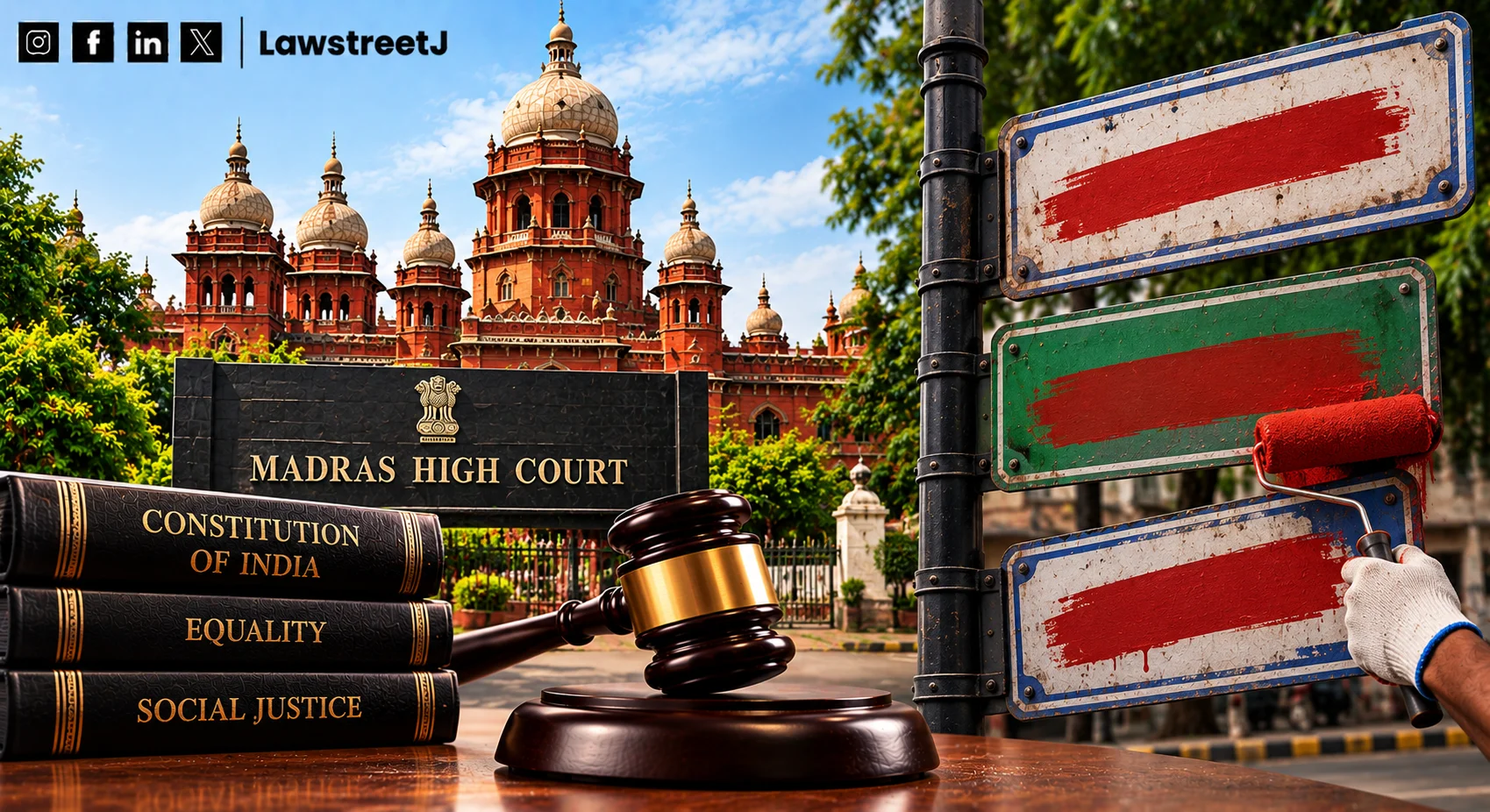
Madurai: The Madurai Bench of the Madras High Court has dismissed a writ petition challenging G.O.(Ms) No.313 issued by the Tamil Nadu Government for identifying and renaming residential areas, streets, roads and water bodies bearing caste-based or objectionable names, holding that the names are so derogatory that they can never be uttered in open court and that the step should have been taken many years ago.
A Division Bench of Justice C.V. Karthikeyan and Justice R. Sakthivel was hearing a petition filed under Article 226 of the Constitution, seeking a writ of certiorari to quash the Government Order dated 06.10.2025, issued by the Municipal Administration and Water Supply Department. The order directs that caste-based names be identified and replaced, either by retaining the locality's name independently or by adopting the names of leaders who fought for social justice.
The petitioner contended that the Government Order was issued only to gain political advantage by disturbing communal harmony ahead of the assembly election. He argued that it violated natural justice, as it allowed only 21 days for public objections after a gazette notification of the proposed names and a further 21 days to consider objections before a second notification, which he termed an eyewash. He also submitted that it was against public policy to rename localities after leaders and favourites of the ruling party, when names of Sangam period Tamil scholars or saints such as the Nayanmargal and Azhwargal could have been chosen.
The State, which had sought to vacate the interim stay granted earlier, defended the order as constitutionally valid, socially progressive and consistent with the Directive Principles of State Policy. It submitted that the initiative was meant to promote equality, eradicate caste-based discrimination and keep public spaces inclusive and neutral. It pointed to an earlier Government Order of 1978 that had also directed removal of caste-based names from roads and streets, and to the provision for objections and a second gazette notification. Names such as Harijan Colony and Night Soil Depot Street were among those identified for change, and the State cited resolutions passed by municipal corporations, town panchayats and village panchayats across Tamil Nadu.
Noting that the petitioner himself had suggested that names of eminent persons could be used as alternatives, the court held that he could not dispute the fundamental concept that caste names must be deleted. The only issue, it observed, was whether the original name should be retained or an alternate name adopted, and if so, whether it should honour persons of eminence in social justice or in literature and other fields.
Examining the illustrations furnished by the State, the court found that the new names were neutral or drawn from revered figures. Harijan Colony in Chengalpattu had become Thiruvalluvar Street, Irular Colony in Thiruvannamalai had become Kabilar Theru, and Adi Dravidar Colony in Vellore had become Kambar Street, while names such as Roja Nagar and Malligai Nagar signified only flowers. The court added that Kamarajar Nagar and Perarignar Anna Theru honoured former Chief Ministers elected through a democratic process, to whom there could be no objection. Observing that "the existing names can never be uttered in open Court," the Bench said the Government should not have waited all these years.
On the challenge to the 21 day period, the court held that objections cannot be invited for an indefinite time and that while the period could be 40 or 50 days, there must be some limit. It found no objection to the implementation of the Government Order, and noted that the new order merely supplements the 1978 order.
Rejecting the argument that removing caste names would cause confusion, the court said that confusion would arise only in the minds of those who retain caste in their minds, and that caste names would disappear into oblivion over time. It also disagreed with the written submission that there would be pride in calling a residential area by a caste name, stating that "There should be a change in the mindset of the general public," and that a petitioner unwilling to accept change would be left to brood over his alleged grief without any solace from the court.
The court further observed that residents themselves should have voluntarily petitioned the Government to change the caste names. It called upon the Government to identify the names and areas left out of G.O.(Ms) No.313 and to issue a further Government Order, describing the exercise as a continuous process.
Dismissing the writ petition, the Bench allowed the State's application to vacate the interim stay, dismissed the petitioner's stay application, and ordered dispensation with production of the Government Order for the time being. There was no order as to costs.
Appearances:
For the Petitioner: Mr. G. Karthikeyan, Senior Counsel, assisted by Mr. M. Karthikeya Venkitachalapathy, Advocate.
For the Respondents: Mr. Vijay Narayan, Advocate General, assisted by Mr. M.P. Senthil, Government Pleader.
Case Title: S. Paramasivam vs. State of Tamil Nadu & Anr., W.P.(MD) No. 29428 of 2025



![Madras High Court Directs Tamil Nadu Government to Ensure Quota for Transgenders in Local Body Elections [Read Order]](/secure/uploads/2023/08/lj_2507_7a03d113-08b1-4670-b6fb-9058aee481d0.jpg)