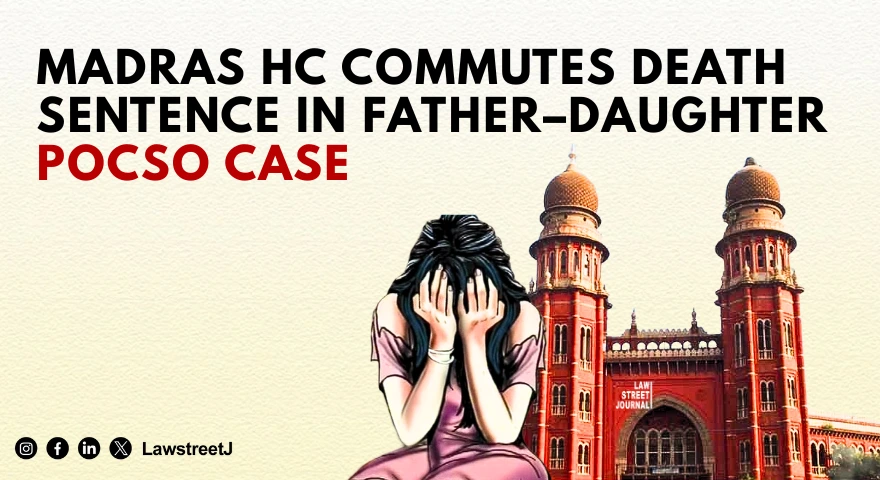
Chennai: The Madurai Bench of the Madras High Court has commuted the death sentence awarded to a man convicted of repeatedly subjecting his minor daughter to aggravated penetrative sexual assault, substituting it with imprisonment for the remainder of his natural life.
The division bench held that while the crime was grave and the conviction was unimpeachable, the case did not cross the strict constitutional threshold for capital punishment under the “rarest of rare” doctrine.
The Court also took the opportunity to lay down a detailed sentencing framework for offences under various sub-sections of Section 5 of the Protection of Children from Sexual Offences Act, 2012, categorising cases into three tiers: those warranting the statutory minimum of twenty years, those justifying life imprisonment extending to the end of natural life, and the exceptional category warranting the death penalty.
The proceedings arose from a death sentence reference and a criminal appeal, both tagged together, challenging the judgment of conviction dated 30.12.2025 and the sentence dated 05.01.2026, passed by the learned Sessions Judge, Special Court for POCSO Act Cases, Tirunelveli, in Spl.C.C.No.116 of 2025. The Trial Court had convicted the sole accused, Murugan, for offences punishable under Sections 5(l), 5(n), and 5(j)(ii) read with Section 6 of the POCSO Act, 2012, and Section 351(3) of the Bharatiya Nyaya Sanhita, 2023.
The prosecution’s case was that the accused, who had contracted a second marriage, was the biological father of the victim girl. His second wife was employed as an agricultural labourer in a garden and was frequently away from home.
Taking advantage of her absence and the consequent isolation of the victim, the accused repeatedly committed penetrative sexual assault upon his minor daughter on more than twenty occasions. The victim, born on 07.06.2011 and aged approximately thirteen to fourteen years at the time of the offences, had discontinued her schooling after completing the eighth standard.
The abuse came to light when the mother of the victim noticed physical changes in the victim and took her to the Primary Health Centre at Panangudi on 05.02.2025, where a pregnancy of approximately twenty-two weeks was detected. The victim was subsequently referred to the Government District Hospital, Tirunelveli, where medical termination of pregnancy was carried out. A complaint was registered, the accused was arrested on 06.02.2025, and biological samples of the victim and the accused were forwarded to the Forensic Science Laboratory. DNA analysis conclusively established that the accused was the biological father of the foetus.
Before the High Court, the State Public Prosecutor submitted that the charges had been proved beyond reasonable doubt through the cogent and consistent testimony of the victim, corroborated by medical evidence and the DNA report, and that the Trial Court had rightly imposed the sentence of death given the gravity of the offence. The legal aid counsel for the accused challenged the conviction on grounds including alleged contradictions in the prosecution case, delay in FIR registration, absence of precise dates of occurrence, and disputed the reliability of the DNA evidence, pointing to a delay in collecting the accused’s blood sample. On sentence, he argued that the accused had no prior criminal antecedents and that the Trial Court had not properly applied the “rarest of rare” doctrine.
On conviction, the High Court independently evaluated the entire evidence and affirmed the Trial Court’s findings. The Court found the victim’s testimony to be cogent, credible, and trustworthy, amply corroborated by medical and scientific evidence including the DNA report. The defence’s contention that the delay in collecting the accused’s blood sample rendered the DNA analysis unreliable was rejected, as the challenge had not been effectively put to the forensic experts during cross-examination and no material suggesting tampering or procedural irregularity was produced. The Court held that the prosecution had discharged the foundational burden, attracting the statutory presumption under Section 29 of the POCSO Act, which the accused had wholly failed to rebut.
On the question of sentence, the Court conducted an extensive review of the jurisprudence governing capital punishment from Bachan Singh v. State of Punjab (1980) through to recent pronouncements, and formulated a category-wise sentencing guide for offences under each sub-clause of Section 5 of the POCSO Act. For offences under Section 5(n), involving sexual assault by a blood relative, the Court held that the baseline appropriate sentence is twenty years’ rigorous imprisonment, escalating to life imprisonment in exceptional circumstances involving threats and physical violence, and to death where the offence is perpetrated covertly through the administration of drugs.
Turning to the present facts, the Court found that the accused had committed repeated acts of penetrative sexual assault over a prolonged period, had intimidated the victim into silence, and that the assault had resulted in pregnancy requiring abortion. However, it also noted the following mitigating aspects: the Probation Officer’s report reflected good conduct in jail and the absence of any likelihood of recidivism; the accused had not physically assaulted the victim; he lacked prior criminal antecedents; he was about fifty years of age; and, crucially, the prosecution had not discharged its burden of establishing that he was beyond reformation and rehabilitation.
The Court additionally found that the Trial Court had committed procedural errors in not furnishing the materials in Exhibits C1 to C4 to the accused before imposing the death sentence and had improperly reversed the burden of proof on the question of reformation.
The Court further observed that the accused stood in a state of complete social and familial abandonment as his wife and children had sought the severest penalty against him, no relative had visited him in prison, and upon eventual release he would face total social alienation. Relying on the Supreme Court’s ruling in Rajendra Pralhadrao Wasnik v. State of Maharashtra (2019) 12 SCC 460, the Court held that where the possibility of social reintegration is bleak, a long custodial sentence in preference to the death penalty is permissible. It also found that the Trial Court had been improperly influenced by emotion and sentiment rather than principled sentencing analysis.
Placing reliance on the Supreme Court’s recent decision in Bhanei Prasad alias Raju, 2025 SCC Online SC 1636, involving comparable factual circumstances including allegations against a father, the Court held that the present case fell within Category (B) of its own framework warranting imprisonment for the remainder of natural life and not within the exceptional Category (C) warranting death. The death sentence was accordingly commuted.
The criminal appeal was partly allowed. The conviction was affirmed. The sentence of death was set aside and substituted with imprisonment for life for the remainder of the accused’s natural life, without entitlement to premature release, remission, or commutation. The reference in R.T.(MD).No.2 of 2026 was answered in the negative. The fine imposed by the Trial Court was confirmed.
For the Appellant: Mr. R. Manickam, Advocate (Legal Aid Counsel)
For the Respondent: Mr. Hasan Mohammed Jinnah, State Public Prosecutor, assisted by Mr. E. Antony Sahaya Prabahar, Additional Public Prosecutor
Case Title: State of Tamil Nadu v. Murugan, R.T.(MD).No.02 of 2026 and Crl.A.(MD).No.425 of 2026



![TN Medical Council declares change of gender identity of LGBTQIA+ as misconduct [Read Notification]](/secure/uploads/2022/12/lj_5268_5cebb05a-97fb-40fb-8045-25cdf8f4207a.jpg)
![Madras High Court Directs Tamil Nadu Government to Ensure Quota for Transgenders in Local Body Elections [Read Order]](/secure/uploads/2023/08/lj_2507_7a03d113-08b1-4670-b6fb-9058aee481d0.jpg)
![Anti Corruption sleuths acted like "puppets in The Muppet Show", HC notice to ex TN CM in disproportionate assets case [Read Order]](/secure/uploads/2023/09/lj_8675_7b37fc02-1b2d-4f4a-9816-3df20545b37e.jpg)