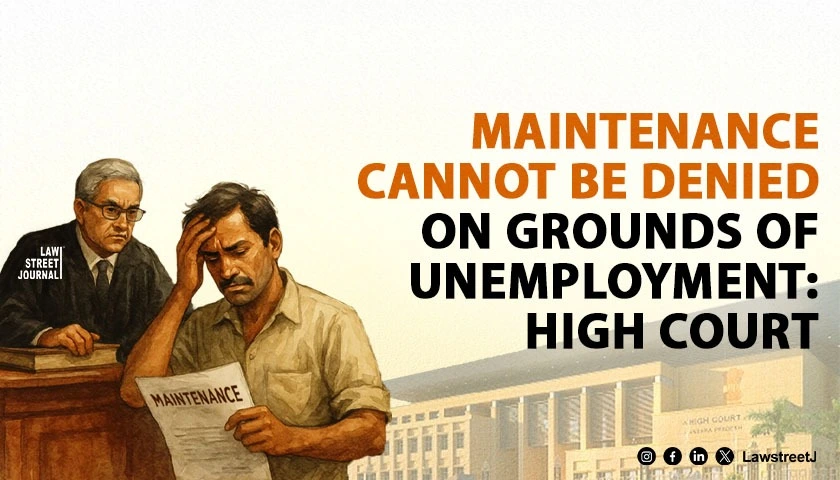
Andhra Pradesh: The High Court of Andhra Pradesh at Amaravati has dismissed a criminal revision petition challenging a Family Court order granting maintenance to a wife and minor child, firmly holding that the obligation of a husband to provide maintenance is absolute, continuous, and cannot be defeated by pleading financial constraints, unemployment, or the pendency of collateral proceedings.
Justice Dr. Y. Lakshmana Rao further held that the right to claim maintenance is independent and recurring in nature, crystallizing afresh upon each instance of default.
The petitioner, Chinnan Krishore Kumar, challenged the order dated March 9, 2022, passed by the IV Additional District Judge-cum-Judge, Principal Family Court, Vijayawada, in F.C.O.P. No. 1008 of 2018, by which maintenance of Rs. 7,500 per month was awarded to Respondent No. 2, his wife, Chinnam Kiranmayi Smily, and Rs. 5,000 per month to Respondent No. 3, their minor child, Chinnam Vineeth Kumar.
The petitioner assailed the impugned order primarily on the ground that the Family Court had erred in granting maintenance without proper appreciation of the chief affidavit filed under Order XVIII Rule 4 of the Code of Civil Procedure, 1908, constituting a procedural violation. He further contended that Respondent No. 2 had failed to substantiate her allegations regarding alleged payments of cash and Adapaduchukatnam with documentary proof, yet the Family Court erroneously allowed the petition.
Additionally, the petitioner argued that the present proceedings amounted to a second round of litigation, having been filed after the withdrawal of M.C. No. 144 of 2017, and were accordingly barred by principles of judicial propriety. He also submitted that the Family Court ought to have taken into account the pendency of D.O.P. No. 3 of 2016 before the learned Principal District Judge, Machilipatnam, and G.W.O.P. No. 52 of 2017 before the learned Family Court, Vijayawada, as evidence that the respondent was attempting to harass him through multiplicity of proceedings. The quantum awarded was also assailed as excessive and arbitrary.
Respondent Nos. 2 and 3, represented through Legal Aid Counsel, opposed the revision, contending that the Family Court had rightly exercised its jurisdiction under Section 125 of the Code of Criminal Procedure, 1973, and that the absence of documentary proof did not negate the credible oral testimony of PW.1. It was submitted that maintenance is a measure of social justice intended to prevent destitution, and that the multiplicity of proceedings was attributable solely to the petitioner’s continued neglect and refusal to provide sustenance.
Justice Dr. Y. Lakshmana Rao undertook an extensive survey of the jurisprudence on maintenance and dismissed each of the petitioner’s contentions in turn. On the question of procedural violation regarding the chief affidavit, the Court held that proceedings under Section 125 of the CrPC are summary in nature, designed to dispense expeditious relief without the rigours of plenary civil adjudication. Accordingly, the oral testimony of PW.1, which contained cogent details of the petitioner’s neglect and the respondent’s indigence, was sufficient to discharge the evidentiary threshold, rendering the absence of corroborative documentary proof inconsequential.
On the contention that the petition constituted a second round of litigation following the withdrawal of M.C. No. 144 of 2017, the Court emphatically rejected the argument, reiterating that the right to maintenance is not extinguished by prior proceedings but accrues afresh with each instance of default. The Court held that neither res judicata nor constructive res judicata finds any foothold in maintenance proceedings, given the independent and recurring character of the entitlement. It further observed that the multiplicity of proceedings, far from evidencing harassment, was a direct consequence of the petitioner’s own obdurate refusal to fulfil his statutory and moral obligation under Section 125(1) of the CrPC.
As regards the pendency of collateral proceedings, the Court reiterated that maintenance entitlements are not mutually exclusive and operate in tandem to effectuate equity. The doctrine of lis pendens does not vitiate the respondent’s invocation of concurrent remedies, each tailored to discrete facets of matrimonial discord, and the petitioner cannot leverage parallel litigations as a shield against his inescapable liabilities.
Addressing the challenge to the quantum awarded, the Court held that maintenance must be just and adequate, commensurate with the husband’s pecuniary resources, the dependents’ reasonable needs, and prevailing living standards. The awards of Rs. 7,500 per month to the wife and Rs. 5,000 per month to the minor child were found to be reasonable and calibrated to the petitioner’s earning capacity and the respondents’ exigencies. The Court found no arbitrariness or violation of natural justice in the Family Court’s adjudication, which evinced a balanced appraisal of the competing equities.
The Court further laid down that the jurisprudential foundation of maintenance rests upon the absolute personal obligation of a husband flowing inexorably from the jural relationship of marriage itself, independent of his proprietary holdings. Excuses of unemployment or poor business cannot absolve a healthy, able-bodied husband of his duty, and the liability remains continuous and enforceable until discharged by actual payment.
Finding no illegality, patent infirmity, or miscarriage of justice, the Criminal Revision Case was dismissed without costs.
Appearance:
Counsel for Petitioner: Sri M. Venu Gopal
Counsel for Respondents: Sri A.K. Kishore Reddy, Legal Aid Counsel
Case Title: Chinnan Krishore Kumar v. State of Andhra Pradesh & Others