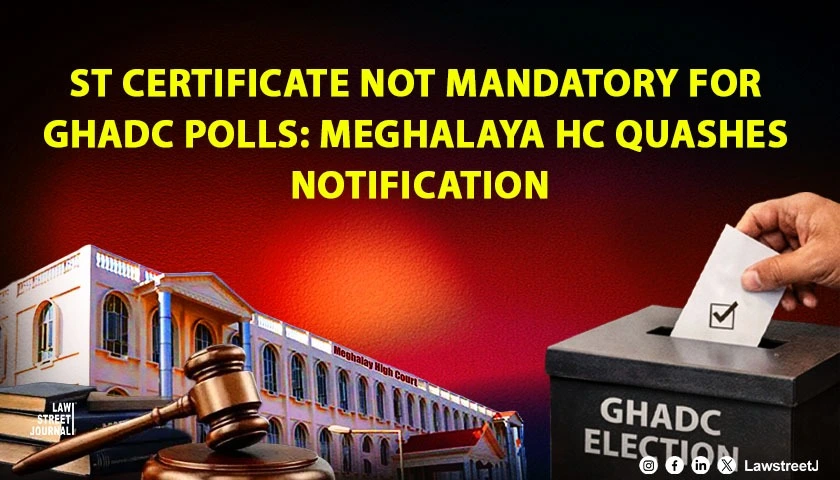
Meghalaya: The High Court of Meghalaya has quashed a notification issued by the Garo Hills Autonomous District Council requiring candidates to submit a Scheduled Tribe Certificate as a mandatory condition at the time of filing nomination papers for elections to the Council.
Justice H.S. Thangkhiew held that the notification was issued without following the due process of law prescribed under the Assam and Meghalaya Autonomous Districts (Constitution of District Councils) Rules, 1951, and that the Executive Committee of the District Council lacked the competence to bring about such a change through an executive order without placing it before the full District Council and obtaining the Governor’s approval.
The case arose from a notification dated February 17, 2026, issued by the Chief Executive Member of the Garo Hills Autonomous District Council pursuant to a resolution passed by the Executive Committee on February 9, 2026. By this notification, submission of an ST Certificate was made a mandatory requirement for filing nomination papers for election to the Council.
The petitioner, a non-tribal voter enrolled in the electoral rolls of a Council constituency, challenged the notification on the ground that it effectively disenfranchised legitimate non-tribal voters and aspiring candidates, and that such a change could not be introduced by way of a mere executive order of the Executive Committee.
Before the High Court, the petitioner’s counsel argued that under paragraph 2(6) of the Sixth Schedule to the Constitution of India, the power to prescribe qualifications for voting and for being elected to the District Council is vested in the Governor. In exercise of this power, the Assam and Meghalaya Autonomous Districts (Constitution of District Councils) Rules, 1951 were framed.
Rule 8(c) of these Rules provides that a person is qualified to be elected as a member of the District Council if they are entitled to vote in the election. Rule 128 prescribes the qualifications for electors and permits a non-tribal person who is a permanent resident within the territorial limits of the Autonomous District to vote.
These Rules have remained unchanged since the inception of the District Councils, and non-tribal persons have freely voted and even served as elected members of the Garo Hills Autonomous District Council since 1952. Counsel further submitted that any amendment to these Rules must follow the procedure prescribed under Rule 72, which requires that such rules be drafted by the Executive Committee, placed before the full District Council in session, and thereafter submitted for the Governor’s approval before coming into force.
The Garo Hills Autonomous District Council and its Chief Executive Member defended the notification, arguing that changing demographics necessitated the protection of indigenous tribal rights, and that the Executive Committee acted under powers vested in it by Rule 29(a) and (b) and Rule 30 of the 1951 Rules, which permit it to take up matters involving important administrative changes and to make proposals for regulations and rules.
The State of Meghalaya, however, through the Advocate General, conceded that the impugned notification had been issued without following the due process prescribed under Rule 72, and that no valid amendment to Rules 8 and 128 had been made.
The Court examined the relevant provisions in detail. It noted that Rule 29(2)(b), while authorising the Executive Committee to take up proposals for making regulations and rules, expressly requires such matters to be referred to the District Council for final approval. The impugned notification had been issued at the level of the Executive Committee itself, without being placed before the Council.
The Court further held that Rule 30, which permits the Executive Committee to take emergency action when the Council is not in session, does not empower it to make rules or regulations. That provision only allows proposals to be made, and every such case must be placed before the District Council at its next session.
The Court also examined Rule 72, which lays down the complete legislative process for rule-making by the District Council. Under this Rule, all rules are to be drafted by the Executive Committee, placed before the District Council in session for consideration and confirmation, then submitted to the District Council Affairs Department, and finally presented to the Governor for approval before publication in the State Gazette.
The Court held that the impugned notification, at best, amounted only to the first stage of this process—namely, a proposal—and would require corresponding amendments to Rule 8 and Rule 128 of the 1951 Rules to have any legal effect.
The Court acknowledged the broader debate surrounding the participation of non-tribals in District Council elections, noting that the Council was primarily established for the benefit of Scheduled Tribes and that demographic changes had triggered the controversy.
However, the Court clarified that it was confining itself to the limited question of whether the notification was legally valid and in conformity with the applicable rules, without entering into the broader policy debate.
Holding that the notification could not withstand legal scrutiny, the Court set it aside and quashed it.