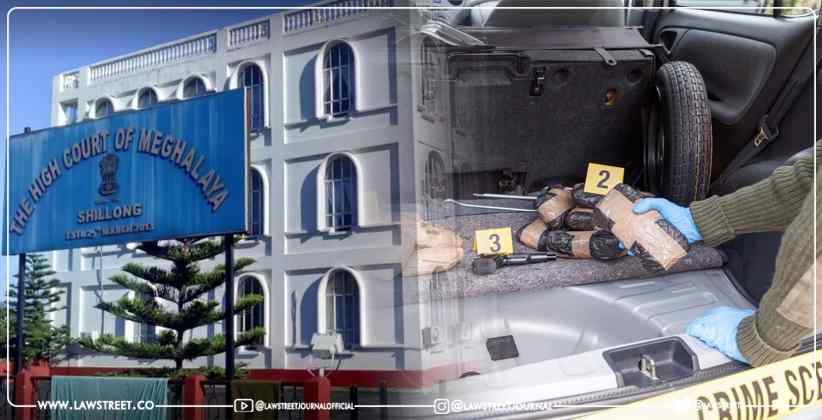
The Meghalaya High Court has upheld an order granting bail to the accused in a high-profile murder case, dismissing the State’s petition seeking cancellation of bail and holding that the grounds of arrest furnished to her were so vague and formulaic that they amounted to a violation of Article 22(1) of the Constitution.
Justice W. Diengdoh, while dismissing the petition filed by the State of Meghalaya under Section 528 read with Section 483(3) of the Bharatiya Nagarik Suraksha Sanhita, 2023, observed that “the arrestee does have a strong case to contend that no such effective grounds have ever been intimated to her at the initial stage of her arrest,” and that the Trial Court was justified in granting bail on this ground.
The case arose out of an order dated 27.04.2026 passed by the Additional Deputy Commissioner (Judicial), by which the accused was released on bail in connection with a Sessions Case, primarily on the ground that the “Grounds of Arrest” had not been intimated to her. The State challenged this order before the High Court, contending that the accused had already filed three unsuccessful bail applications and had raised the issue of non-communication of grounds of arrest only in her fourth application.
The learned Advocate General, appearing for the State, argued that the accused had all along been duly informed of the grounds of her arrest, pointing to contemporaneous documents bearing her signature, an order of the Chief Judicial Magistrate, Ghazipur, granting transit remand after being satisfied that the grounds were intimated, and a subsequent order of the Magistrate at Sohra recording that the accused had verbally confirmed her awareness of the reasons for arrest. It was submitted that the Trial Court had wrongly relied on what was merely a typographical error, namely a reference to “Section 403 BNS” instead of “Section 103 BNS,” to grant bail, and that this error had in any event been negated by the accused’s own admission of the correct provisions in her bail application.
The State further contended that the ruling in Mihir Rajesh Shah v. State of Maharashtra & Anr., (2026) 1 SCC 500, which made it mandatory to furnish written grounds of arrest in the language known to the accused, applied only prospectively from the date it was pronounced on 06.11.2025, and could not assist the accused, who was arrested on 09.06.2025. Reliance was placed on the Supreme Court’s observation in that judgment that the requirement would govern arrests “henceforth.”
Counsel for the accused countered that the requirement to furnish written grounds of arrest was already well settled through a line of Supreme Court decisions, including Prabir Purkayastha v. State (NCT of Delhi), (2024) 8 SCC 254, and Vihaan Kumar v. State of Haryana & Anr., (2025) 5 SCC 799, the latter of which applied the same principle to offences under the Indian Penal Code even before Mihir Rajesh Shah was decided. It was submitted that mere mention of the alleged offence in a remand report did not satisfy the constitutional mandate, and that the accused had suffered real prejudice in the form of being deprived of an effective opportunity to seek bail and prepare her defence.
The Court extensively traced the evolution of the law on intimation of grounds of arrest, beginning with Pankaj Bansal v. Union of India & Ors., (2024) 7 SCC 576, through its extension to all criminal offences in Prabir Purkayastha, and its reaffirmation in Vihaan Kumar and Mihir Rajesh Shah. Relying on the Delhi High Court’s reasoning in Brijesh Kothia v. State (NCT of Delhi), 2026 SCC OnLine Del 3410, and the Supreme Court’s decision in Dr. Rajinder Rajan v. Union of India & Ors., 2026 SCC OnLine SC 802, the Court held that “Mihir Rajesh Shah does not create a fresh prospective regime but merely re-affirms the constitutional requirement inherent in Article 22(1),” and that the obligation traces back to Pankaj Bansal itself.
On examining the actual document furnished to the accused at the time of her arrest, captioned “Intimation of Grounds of Arrest,” the Court found it to be a generic tick-box format containing seventeen pre-printed entries, several of which were plainly inapplicable and, in the Court’s words, “ridiculous,” including boxes for being “a deserter from any of the Armed Forces of the Union” and being “involved in an offence committed outside India.” The Court held that this reflected “a total non-application of judicious mind on the part of the arresting agency, which strikes at the root of the process of arrest.”
The Court further noted that the recurring reference to a non-existent “Section 403(1) BNS” across multiple records could not be dismissed as a mere typographical error, since the same error appeared at several places, reflecting consistent non-application of mind by the investigating authorities rather than an isolated slip.
Holding that the foundational basis for the arrest itself was insufficiently established, the Court found no infirmity in the Trial Court’s order and declined to disturb the bail granted to the accused. The Court clarified that it had not commented on the merits of the investigation or the subsequent framing of charges, with the trial proceeding unaffected, and observed that the concerned authorities would do well to revisit the manner in which grounds of arrest are prepared and communicated going forward.
Accordingly, the petition was dismissed, with no order as to costs.
For the Petitioner: Mr. A. Kumar, Advocate General, with Mr. N. Khera, Spl. PP, and other Advocates
For the Respondent: Mr. S. Thapa, Advocate, with Mr. S. Chanda, Advocate
Case Title: State of Meghalaya v. Sonam Raguvanshi @ Bitti @ Bittu, Crl. Petn. No. 47 of 2026