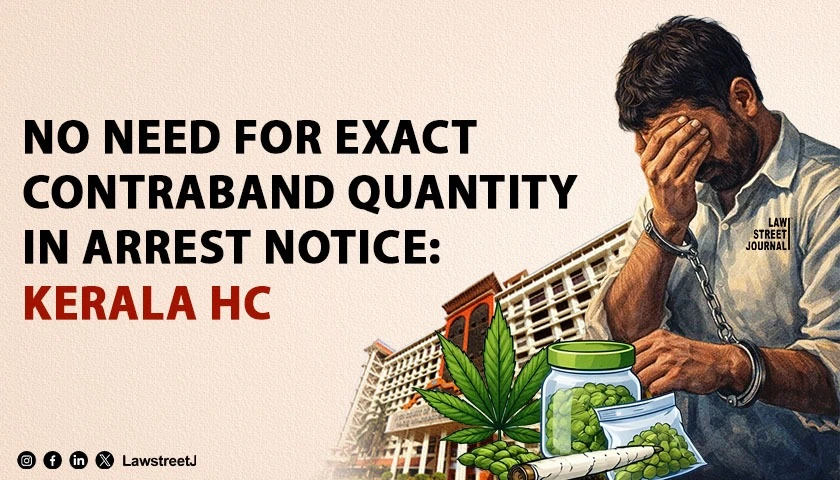
Kerala: The High Court of Kerala has held that it is not necessary to mention the exact quantity of contraband seized in the notice communicating the grounds of arrest to an accused under the Narcotic Drugs and Psychotropic Substances Act, 1985 (NDPS Act), provided the notice specifies the nature of the quantity involved, that is, whether it is a small, intermediate, or commercial quantity.
Such specification, the Court held, is sufficient to comply with Sections 47 and 48 of the Bharatiya Nagarik Suraksha Sanhita, 2023 (BNSS).
The order was passed by Dr. Justice Kauser Edappagath while dismissing the regular bail application filed under Section 483 of the BNSS by Arun Kumar P., aged 28 years, a resident of Kozhikode District, who was the accused in Crime No. 27/2026 of Medical College Police Station, Kozhikode, registered for an offence punishable under Section 22(c) of the NDPS Act.
The prosecution case was that on 08.01.2026, at about 08:44 a.m., the applicant was found in possession of 194.99 grams of MDMA, a psychotropic substance, near Kovoor Cochin Bakery, Kozhikode, and thereby committed the alleged offence. The applicant was arrested on the same date and has been in judicial custody since then.
The primary argument raised on behalf of the applicant was that the requirement of informing an arrested person of the grounds of his arrest is a mandatory constitutional and statutory right guaranteed under Article 22(1) of the Constitution of India and Section 47 of the BNSS. Since the grounds of arrest notice did not mention the quantity of contraband seized, there was no effective communication of the grounds of arrest, rendering the arrest illegal and entitling the applicant to be released on bail.
The State, represented by the Senior Public Prosecutor, submitted that all legal formalities required under Chapter V of the BNSS had been duly complied with at the time of arrest, and that the alleged incident constituted intentional criminal acts of the applicant, disentitling him to bail at this stage.
The Court began its analysis by tracing the legal framework governing the communication of grounds of arrest. It noted that Section 47 of the BNSS requires every police officer or person arresting any individual without a warrant to forthwith communicate to him the full particulars of the offence for which he is arrested or other grounds for such arrest. Article 22(1) of the Constitution of India similarly mandates that no person arrested shall be detained in custody without being informed, as soon as may be, of the grounds for such arrest. The Court held that this requirement is not a mere formality but a mandatory statutory and constitutional obligation, non-compliance with which would constitute a violation of the fundamental right guaranteed under Article 22(1) and also of the right to personal liberty under Article 21 of the Constitution.
The Court then surveyed the evolution of the law on this point through a series of Supreme Court decisions. In Pankaj Bansal v. Union of India and Others (2024) 7 SCC 576 and Prabir Purkayastha v. State (NCT of Delhi) (2024) 8 SCC 254, the Supreme Court held that informing a person of the written grounds of arrest is a mandatory requirement under Article 22(1) and Section 47 of the BNSS, and that the absence of such communication would render the arrest illegal.
Subsequently, in Vihaan Kumar v. State of Haryana and Others (2025 SCC OnLine SC 269), the Supreme Court reiterated that informing the arrested person of the grounds of arrest is a mandatory constitutional requirement, though it clarified that there is no absolute requirement to communicate the grounds in writing in every case.
The position was crystallised by a three-Judge Bench of the Supreme Court in Mihir Rajesh Shah v. State of Maharashtra and Another (2025 SCC OnLine SC 2356), which, after examining earlier decisions, held that the grounds of arrest must be informed to the arrested person in each and every case without exception, and that the mode of communication must be in writing in a language understood by the arrested person.
Turning to the requirement of mentioning the quantity of contraband in NDPS cases, the Court referred to three earlier decisions of Single Benches of the Kerala High Court in Yazin S. v. State of Kerala (2025 KHC OnLine 2383), Rayees R.M. v. State of Kerala (2025 KHC 2086), and Vishnu N.P. v. State of Kerala (2025 KHC OnLine 1262), which had taken the view that specification of the quantity of contraband seized is mandatory for effective communication of the grounds of arrest.
On a review of the case diary, the Court found that notices had been served on the applicant and his relative under Sections 47 and 48 of the BNSS, and that specific grounds and reasons for the arrest had been communicated to both. Although the notices did not specify the exact quantity of contraband seized, they expressly stated that what was seized was a commercial quantity.
The Court held that the purpose of mentioning the quantity of contraband in the grounds of arrest notice is to enable the accused to determine whether the offence is bailable or non-bailable and to understand whether the quantity involved is small, intermediate, or commercial, since the severity of the offence and applicable bail conditions under the NDPS Act differ depending on the category.
The Court reasoned that once the grounds of arrest state that the quantity seized is intermediate or commercial, that is sufficient to satisfy the requirements of Sections 47 and 48 of the BNSS, even if the exact weight or measure is not specified.
Applying this principle, the Court held that since the arrest notice explicitly stated that the seized substance was a commercial quantity, there had been proper and effective communication of the grounds of arrest. The contention that the absence of the exact quantity vitiated the arrest was accordingly rejected.
The Court found that prima facie there were materials on record connecting the applicant with the crime. Having rejected the challenge to the legality of the arrest and finding no other ground entitling the applicant to bail, the Court dismissed the bail application.
Appearance:
For the Petitioner/Accused: Sri P. Mohamed Sabah, Sri Libin Stanley, Smt Saipooja, Sri Sadik Ismayil, Smt R. Gayathri, Sri M. Mahin Hamza, Shri Alwin Joseph, and Shri Benson Ambrose, Advocates
For the Respondents/State: Smt Sreeja V., Senior Public Prosecutor
Case Title: Arun Kumar P. v. State of Kerala & Anr. (Citation: 2026:KER:24697)



![Kerala HC Quashes 498A Dowry Harassment Case Against Live-In Partner, Citing Lack of Relative Status [Read Order]](/secure/uploads/2023/08/lj_5693_1057c042-1e57-4e27-8c9e-25af0ec38ec4.jpg)
![Watching porn on mobile: Kerala HC highlights importance of mother cooked meals, outdoor sports [Read Order]](/secure/uploads/2023/09/lj_9155_Parental_supervision_of_mobile_phone_usage.jpg)
![Lakshadweep MP Mohammed Faizal Disqualified from Lok Sabha After Conviction Suspension Plea Rejected by Kerala High Court [Read Notice]](/secure/uploads/2023/10/lj_9640_87b5fd97-0e05-4ff8-9a99-3be1e4446192.jpg)