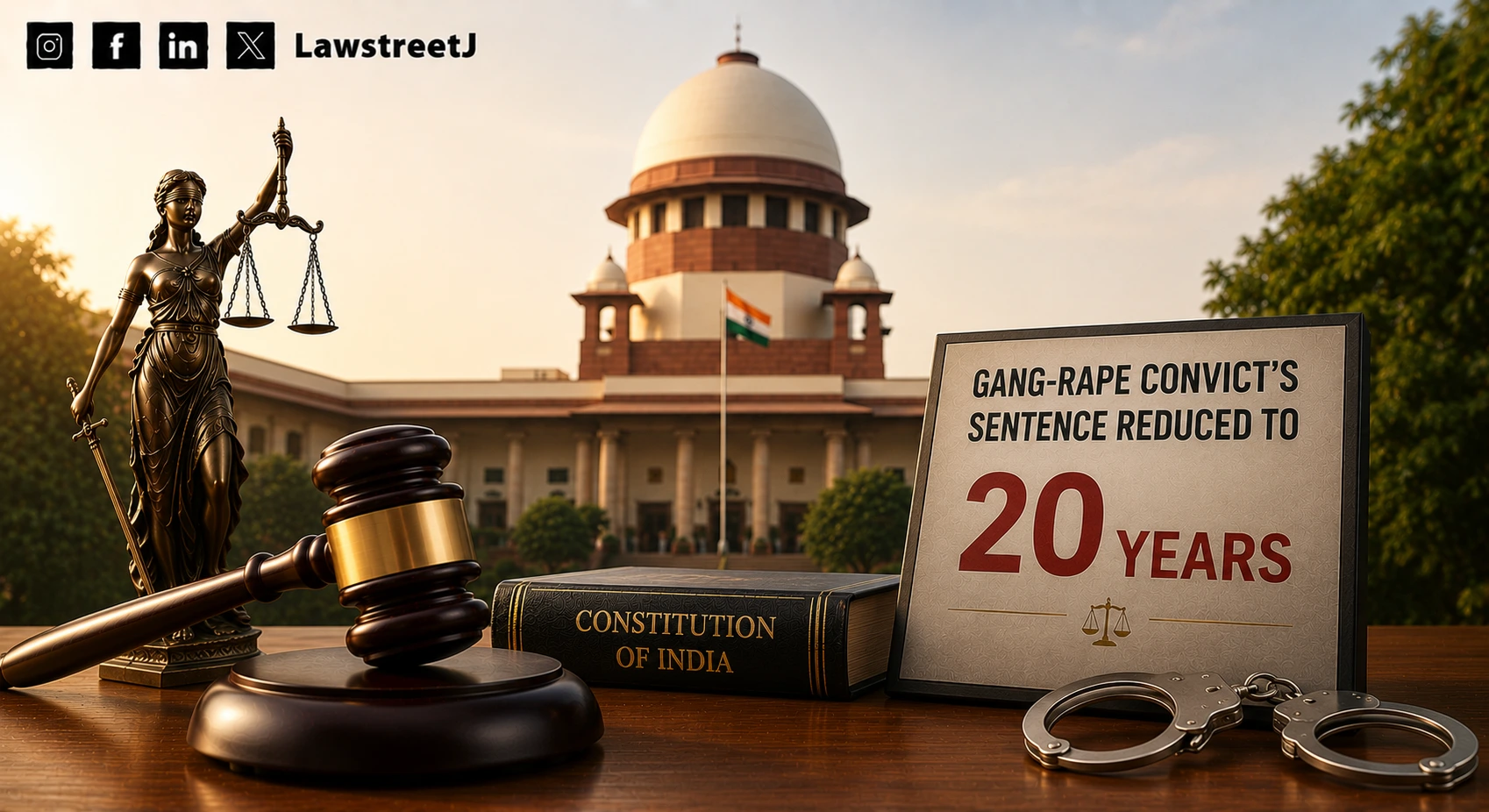
New Delhi: The Supreme Court on Monday (July 20) modified the sentence of a life convict in a gang rape case to a minimum sentence of twenty years, after noting that the convict is young, has no criminal antecedents, and there's a possibility of reformation.
A Bench of Justice Sanjay Karol and Justice Augustine George Masih was hearing an appeal filed by the convict, Ehsaan, against a Delhi High Court judgment that had affirmed his conviction under Section 376-D of the Indian Penal Code, 1860 and his sentence of rigorous imprisonment for the remainder of his natural life, along with a fine of Rs.25,000 payable to the victim. The case arose from an FIR registered in September 2016 after the victim, who had taken a rickshaw from the Delhi Railway Station on the driver's assurance that he would drop her home, was instead taken to a deserted place where another accused was waiting, and the two men committed gang rape upon her. The Trial Court had convicted the appellant and a co-accused, and while issuing notice on the present appeal in January 2026, the Supreme Court had already declined to interfere with the conviction, confining its examination to the quantum of sentence alone.
The Trial Court, in imposing sentence, had relied on this Court's decisions in State of Punjab v. Saurabh Bakshi, Gopal Singh v. State of Uttarakhand and State of Punjab v. Bawa Singh, and held that considering the manner of commission of the offence and the brutality inflicted upon the victim, the ends of justice would be met only by sentencing both convicts to imprisonment for the remainder of their natural lives, together with the fine. The Delhi High Court, in appeal, independently examined the evidence and recorded its agreement with the Trial Court in full, affirming both the conviction and the sentence.
Setting out the framework for its enquiry, the Court noted that its task was to examine whether the sentence satisfied the doctrine of proportionality. Recalling Justice P.N. Bhagwati's dissenting opinion in Bachan Singh v. State of Punjab, the Bench reiterated that “the sentence imposed must be proportionate to the offence,” failing which it would be arbitrary and fall foul of Articles 14, 19 and 21 of the Constitution. It also drew on SurinderSingh v. State (UT of Chandigarh), which held that proportionality depends on the mischief caused, the offender's overall conduct, and the motive behind the crime, and on State of Karnataka v. Krishnappa, which emphasised that sentencing in rape cases must be governed by the gravity of the offence and not the social status of victim or accused.
Drawing together its precedents, the Bench distilled a non-exhaustive set of factors relevant to sentencing: the nature and gravity of the crime, the deterrent purpose of punishment, the offender's motive and conduct, whether the offence was premeditated, the offender's age and criminal history, the number of victims, the possibility of reformation, and any abuse of trust involved, while excluding the offender's religion, race, caste or creed as a relevant consideration. The Court surveyed a line of cases in which sentences had been modified after weighing such factors, including Shankar Kisanrao Khade v. State of Maharashtra, where a death sentence was reduced to life imprisonment; Rajkumar v. State of M.P. and Selvam v. State, where death sentences were altered to fixed terms without remission; Parsuram v. State of M.P., where the accused's age of 22 and absence of antecedents warranted a 30-year term; and Sundar v. State, where similar factors led to a minimum term of twenty years.
Applying these principles, the Bench found that the appellant had no criminal antecedents, was only 25 years old at the time of the offence, and that the State had neither shown that reformation was impossible nor disputed the appellant's claim of good conduct during his nearly ten years in custody, including remission. At the same time, the Court underscored that the offence was heinous and an affront to society at large, referring to NCRB data on rape cases reported between 2021 and 2024 to emphasise that such crimes continue unabated despite legal reform. It also noted that Section 376-D IPC, introduced by the Criminal Law (Amendment) Act, 2013 in the aftermath of the Nirbhaya incident, prescribes a mandatory minimum sentence of twenty years without the judicial discretion to reduce it for special reasons that existed under the unamended provision, reflecting a clear legislative intent regarding the seriousness of the offence.
Balancing the gravity of the crime against the mitigating factors in the appellant's favour, and invoking the epigraph with which the judgment opens, that a court must, “stern where it should be, and tempered with mercy where it warrants to be,” the Bench modified the sentence from imprisonment for the remainder of natural life to twenty years' rigorous imprisonment, with the benefit of any remission earned. The appeal was accordingly partly allowed, and any pending applications were closed.
Case Title: Ehsaan vs. State of National Capital Territory of Delhi, Criminal Appeal arising out of SLP(Crl.) No.3407 of 2026 (2026 INSC 720)