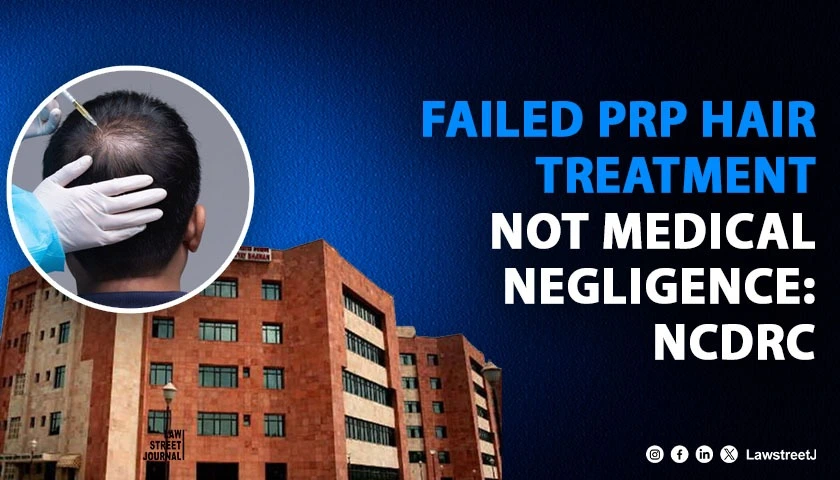
New Delhi: The National Consumer Disputes Redressal Commission (NCDRC) has held that a mere failure to achieve the desired results of Platelet-Rich Plasma (PRP) hair regrowth treatment does not, by itself, constitute medical negligence or deficiency in service on the part of the treating doctors or the kit supplier.
The Commission set aside the orders passed by the District Forum and the Maharashtra State Consumer Disputes Redressal Commission, which had held all opposite parties jointly and severally liable and awarded compensation to the complainant.
The Commission further clarified the distinction between PRP therapy and stem cell therapy, observing that the two had been used interchangeably in the complaint and the impugned orders without appreciating the substantial differences between them. It held that this confusion had erroneously led the lower fora to apply licensing requirements under the Drugs and Cosmetics Act, 1940, which were not applicable to PRP procedures for hair regrowth.
The complainant, Sushil Mukesh Gaglani, an advocate by profession, had approached Lifecell International Pvt. Ltd. (OP-1) during his wife’s pregnancy in connection with the preservation of the umbilical cord. During this process, he came in contact with Chetan Purushottam (OP-2), a marketing executive of OP-1, who explained to him the procedure of PRP for stimulating hair regrowth. According to the complainant, OP-2 assured him of 100% positive results and informed him that the procedure had received approvals from DCGI India, FDA, and CE Mark (Europe), and that OP-3 and OP-4 were experienced doctors who had performed the procedure on over thirty thousand patients.
The complainant underwent three sessions of PRP treatment—the first conducted by Dr. Madhuri Agarwal (OP-3), a dermatologist, at her clinic in West Mumbai, and the second and third sessions by Dr. Satish Kishoranand Arolkar (OP-4), a plastic surgeon, at Mahavir Hospital, Khar West, Mumbai. The complainant paid a total consideration of approximately Rs. 59,525/- for the three sessions.
The complainant alleged that despite undergoing all three sessions of PRP treatment, no hair regrowth was observed. He further alleged that the first session was not competently performed, as only 14 ml of blood was extracted instead of the requisite 30 ml; that an ointment was applied during the first session but not the second; and that OP-2 actively participated in the procedure. A police complaint was also lodged by him under Sections 406, 420, and 120B read with Section 24 of the IPC. The complainant also relied on RTI replies to contend that OP-1 did not possess a licence to conduct PRP or stem cell procedures. He claimed compensation of Rs. 19,59,525/- with interest.
OP-1 and OP-2 denied having given any assurance of guaranteed results and stated that their role was limited to supplying PRP kits to registered medical practitioners. They submitted that OP-1 possessed a valid registration certificate from the Central Drugs Standard Control Organization (CDSCO) under the Ministry of Health and Family Welfare, and that no further approval under the Drugs and Cosmetics Act, 1940, was required for the supply of PRP kits.
Dr. Madhuri Agarwal (OP-3) submitted that she had obtained a duly signed consent form from the complainant before the first session and that no warranty of results had been given. Dr. Satish Kishoranand Arolkar (OP-4) stated that the second and third sessions were carried out as per protocol and that the complainant was informed that no guarantee of positive results could be given, as the human body does not predictably respond to identical procedures.
The District Forum, Mumbai, by order dated 04.12.2018, held all four opposite parties jointly and severally liable for unfair trade practice and awarded a refund of Rs. 59,525/- along with compensation of Rs. 10,00,000/- for mental torture and harassment, and costs of Rs. 10,000/-. The Maharashtra State Commission, by order dated 17.03.2020, affirmed the finding of unfair trade practice and deficiency in service but reduced the compensation to Rs. 6,00,000/- with interest at 10% per annum from the date of filing of the complaint, along with the refund amount and costs.
The NCDRC, after considering the contentions raised by all parties, noted the settled legal position that a doctor is not negligent if he acts in accordance with accepted norms of medical practice, as laid down in Bolam v. Friern Hospital Management Committee (1957) and affirmed by the Supreme Court in Jacob Mathew v. State of Punjab, (2005) 6 SCC 1, and reiterated in Kusum Sharma v. Batra Hospital, (2010) 3 SCC 480 and M.A. Biviji v. Sunita, (2024) 2 SCC 242.
The Commission clarified that PRP therapy for hair regrowth involves injecting a patient’s own concentrated blood plasma into the scalp and is distinct from stem cell therapy, which involves stem cells harvested from fat or bone marrow to create new tissues. It observed that it is well established that not all patients uniformly benefit from PRP hair treatment, and that the absence of positive results does not reflect on the competency of the practitioner or the efficacy of the treatment.
The Commission further held that the application of an ointment by OP-3 during the first session and its non-application by OP-4 during subsequent sessions did not warrant an adverse inference, as the use of such medication is a discretionary clinical decision to reduce pain.
On the question of licensing, the Commission held that the RTI replies relied upon by the complainant were generalised responses that did not distinguish between PRP therapy for hair regrowth and stem cell therapy and had led to misplaced reliance on licensing requirements meant for the latter.
The Commission further held that dermatologists and plastic surgeons with MD degrees are fully competent and qualified to administer PRP treatment, and that there is no legal requirement for them to obtain any separate government declaration or licence to conduct such procedures. It also held that the requirement of a fitness certificate prior to the drawing of blood applies in the context of blood donation to third parties and blood banks, and not to the extraction of blood for PRP treatment administered to the same patient.
The Commission further noted that the complainant, being a professional advocate, had access to OP-1’s brochure and website, had duly signed the consent form, and had filed the complaint only after more than two years from completion of the third session. No expert evidence had been led to prove negligence in the administration of treatment.
The Commission observed that a mere averment in a complaint, denied by the other side, cannot be treated as evidence, and that the onus to prove medical negligence lies on the claimant, which must be discharged through cogent and credible evidence.
The Commission accordingly held that no negligence or deficiency in service on the part of OP-3 and OP-4 had been proved, and that OP-1 and OP-2 appeared to have been impleaded merely on account of having referred the complainant to OP-3 and OP-4 for treatment. The findings of both the District Forum and the State Commission were held to suffer from material irregularity and were set aside.
Accordingly, Revision Petitions No. 1038/2020, 1183/2020, and 182/2021 preferred on behalf of the opposite parties were allowed, and Revision Petitions No. 681/2022, 682/2022, and 683/2022 preferred on behalf of the complainant were dismissed. No order as to costs was made.
The Bench comprised AVM J. Rajendra, AVSM, VSM (Retd.), Presiding Member, and Justice Anoop Kumar Mendiratta, Member.
For Dr. Satish K. Arolkar: Dr. S.K. Khattri and Mr. S.K. Sarathi, Advocates.
For Lifecell International: Mr. Sidharth Mahajan and Mr. Sumit Roy, Advocates.
For Sushil Mukesh Gaglani: Mr. Arjun D. Singh, Advocate.
For Dr. Madhuri Agarwal: Mr. Pankaj Bhagat and Mr. Ritwik Prasad, Advocates.
Case Title: Dr. Madhuri Agarwal v. Sushil Mukesh Gaglani & Ors. and connected matters


![Promotional trailers of movie not a promise or offer: SC [Read Judgment]](/secure/uploads/2024/04/lj_7881_b0919396-9867-4083-b2db-00dbcd5b0b69.webp)
![Deterioration in patient's condition not necessarily sign of medical negligence: SC [Read Judgment]](/secure/uploads/2024/10/lj_8648_WhatsApp_Image_2024-10-26_at_5.52.41_PM.webp)
![One-sided agreement can't be relied upon to forfeit beyond 10% of flat price on cancellation: SC [Read Judgment]](/secure/uploads/2025/02/lj_2384_One-sided_agreement.webp)
![Landowners Not Liable for Delay in Flat Possession, Developer Alone to Pay Compensation: SC [Read Judgment]](/secure/uploads/2026/02/lj_8951_Landowners_Not_Liable_for_Delay.webp)