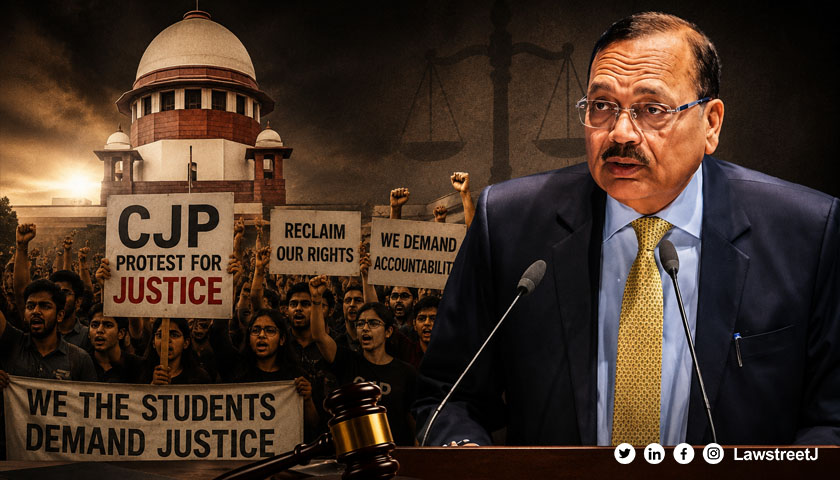
The Supreme Court of India on Monday issued a stern reminder that the right to peaceful protest is a constitutionally guaranteed freedom that cannot be suppressed through the arbitrary use of force.
A bench comprising Chief Justice of India (CJI) Surya Kant, Justices Joymalya Bagchi and V. Mohana made these observations while hearing a batch of petitions concerning the police crackdown on student demonstrators. The proceedings followed a series of nationwide agitations led by the youth-based Cockroach Janta Party (CJP) over alleged paper leaks in the NEET-UG medical entrance examination and marking irregularities within the CBSE system.
The court specifically focused on the events of July 20, 2026, when a "Sansad Chalo" march in New Delhi was met with baton charges and tear gas as protesters attempted to reach Parliament House.
Chief Justice Surya Kant orally observed that "mere agitation" by citizens is not a sufficient legal ground to justify police excesses or a lathi-charge. He emphasised that the right to peaceful and lawful protest is absolutely protected under the Indian Constitution and cannot be denied by the state. The CJI further remarked that just because there is an active agitation, it does not automatically mean that security forces should resort to physical force. Instead, the bench called for the exercise of "self-evolved discipline" by law enforcement, which it described as essential to the democratic process. The court indicated that it is considering the formulation of nationwide guidelines to govern how authorities handle public demonstrations to ensure uniformity across different states.
During the hearing, advocate Fauzia Shakil, appearing for Rajya Sabha MP Manoj Jha, submitted a comprehensive writ petition alleging severe police brutality. She informed the court of an incident in Bihar’s Siwan district where security forces reportedly used AK-47 automatic weapons against protesters, claiming that data regarding this firing had been filed with the court. Another petition, filed through Advocate-on-Record Chand Qureshi, sought specific directions to regulate police action, including a ban on the deployment of plainclothes personnel for crowd-control duties. This petition alleged that the atrocities committed against students on July 20 were comparable to historic instances of state violence and cited violations of Articles 14, 16, 19, and 21 of the Constitution.
These also highlighted the broader impact of the police response on civilian life. Petitioners contended that the closure of 16 to 18 metro stations and the imposition of internet shutdowns in Central Delhi disrupted the daily routines of commuters, students, and emergency service seekers. They argued that the repeated invocation of Section 163 of the Bharatiya Nagarik Suraksha Sanhita (BNSS), which replaced Section 144 of the CrPC, has effectively converted a fundamental right into a system requiring prior police permission. The court was asked to examine whether these "rolling prohibitory orders" imposed over long periods without a proximate threat to public order were unconstitutional.
Justice Joymalya Bagchi noted that the court’s concern extended to all individuals involved, including law enforcement personnel. He observed that the life of every individual is important and noted that the state must explain why police personnel were not consistently provided with adequate safety gear, such as helmets, to handle such situations safely. This remark came after a lawyer representing the families of injured security officials argued that police officers had been subjected to violence and deserved to be heard by the court. The Delhi Police officially claimed that at least 118 personnel were hurt during the clashes, while hospital sources reported that more than 60 protesters sustained injuries to their heads and upper bodies.
Solicitor General Tushar Mehta, representing the Delhi Police, stated that the authorities had no objection to all related petitions being heard together. He clarified that the police were not taking the court's scrutiny adversely and agreed to a consolidated hearing for all pending matters from across the country.
This consolidated hearing is scheduled for Tuesday, July 28.
The court's decision to entertain these pleas followed a clarification from the CJI regarding earlier reports. CJI Kant explained that the court is "available 24 hours" but had previously declined to list a letter petition because a formal writ petition had not been properly filed at that time. He stressed that while the law is supreme and procedural requirements must be followed, the Supreme Court remains committed to addressing any form of injustice.
The hearing takes place against the backdrop of significant political developments, including the resignation of Union Education Minister Dharmendra Pradhan, who stepped down following weeks of sustained protests. While the CJP has called off its primary nationwide agitation after the government assured them that cases against non-violent protesters would be withdrawn and compensation provided to the families of students who died by suicide, the legal scrutiny of police conduct continues. The Delhi High Court has already directed authorities to preserve all CCTV footage and videography records related to the July 20 crackdown to prevent the destruction or tampering of evidence.
Case title: Shailendra Mani Tripathi v. Union of India & Ors. (Diary no. 44078/2026 and connected cases).