

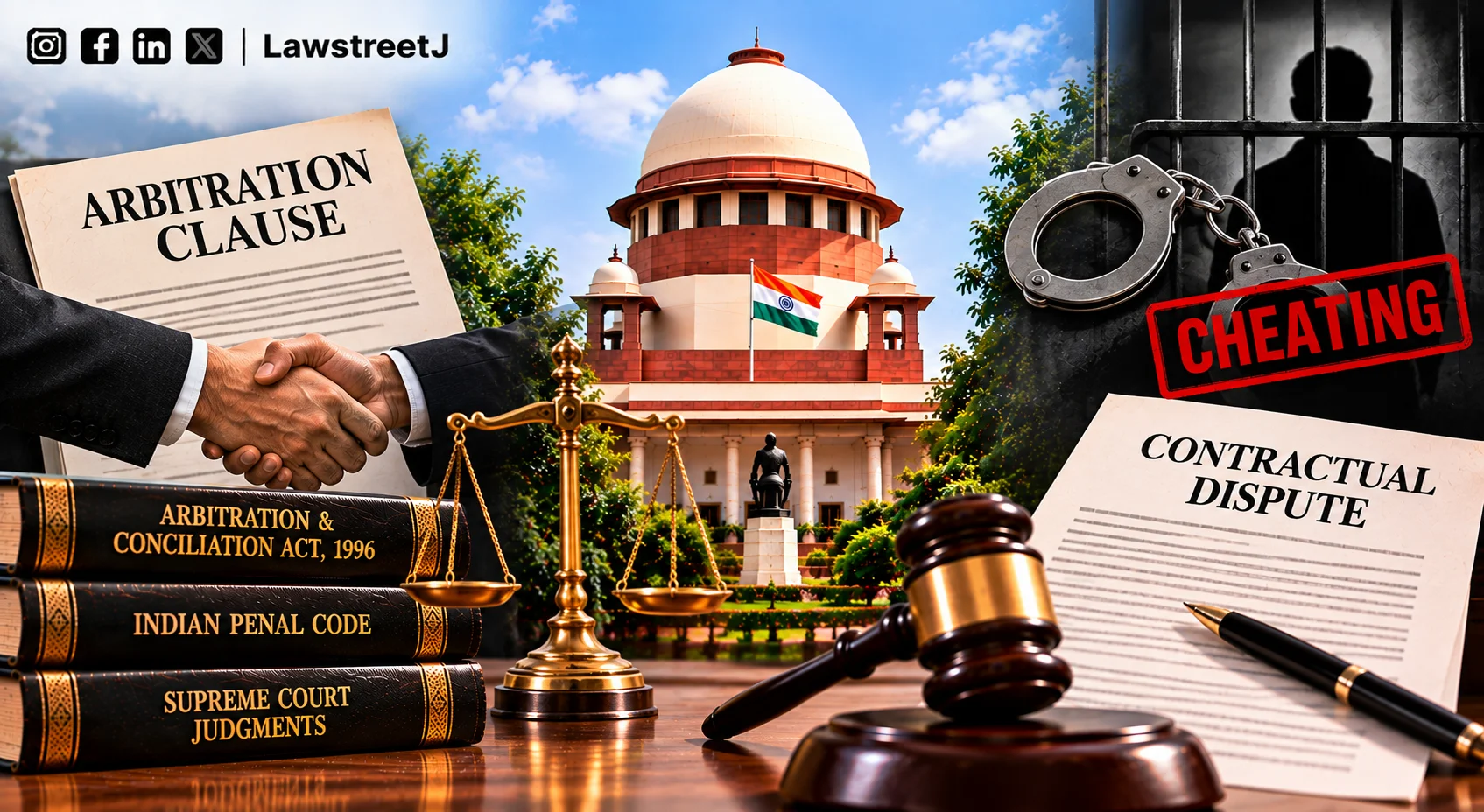
New Delhi: The Supreme Court has quashed a cheating prosecution against the Chief Executive Officer of a tea company over a failed Rs. 40 lakh agreement to acquire a tea estate, holding that the complaint did not disclose dishonest intention at the inception of the transaction and that continuing the case would give a contractual dispute the colour of a criminal prosecution.
A Bench of Justice Vikram Nath and Justice Sandeep Mehta was hearing an appeal against the Gauhati High Court, Kohima Bench, judgment dated 13 May 2025, which had refused to quash C.R. Case No. 17 of 2022 pending before the Judicial Magistrate First Class, Dimapur, Nagaland, for offences under Sections 417 and 420 of the Indian Penal Code, 1860.
The appellant, Indroneel Goho, was the CEO and authorised signatory of Darjeeling Organic Tea Estates Private Limited. Respondent No. 1, proprietor of C.R. Traders, negotiated with the company regarding the Jamguri Tea Estate at Golaghat, Assam. A Memorandum of Understanding was executed on 1 June 2021, and on 7 June 2021 she transferred Rs. 40 lakh to the company's bank account. Disputes followed over performance of the obligations, and the company terminated the MoU on 26 July 2021, alleging that she had failed to comply with its terms.
On 17 August 2022, respondent No. 1 filed a criminal complaint alleging that the appellant had induced her to part with the money by representing that the tea estate belonged to the company, when it was owned by Bhumya Tea Company Private Limited and was the subject of proceedings involving UCO Bank. The Magistrate found prima facie grounds on 21 September 2022 and issued summons.
The appellant approached the High Court under Section 482 of the Code of Criminal Procedure, 1973, contending that the dispute was purely contractual, that the MoU was signed by the company and not by him personally, that the money went to the company's account, and that the company had not been made an accused. The High Court dismissed the petition, holding that a prima facie case was made out and that the arbitration clause in the MoU was no ground for quashing.
Setting out the governing principle, the Supreme Court reiterated that for cheating under Sections 417 and 420 IPC, the fraudulent or dishonest intention must exist at the inception of the transaction and must have induced the complainant to part with property. A later failure to perform a contractual obligation cannot by itself give rise to an inference of such intention. It relied on its recent decision in G. Saminathan and Another v. State, represented by the Sub-Inspector of Police and Another (2026 INSC 772).
Applying these principles, the Court found that the complaint did not disclose the ingredients of cheating. The appellant had signed the MoU only as CEO and authorised signatory, and, "more importantly", the Rs. 40 lakh was transferred directly to the company's account, with no allegation that he received or appropriated any part of it for personal benefit.
The Court examined the complainant's central allegation that the appellant knew the tea estate did not belong to the company. It held that the assertion had to be read in the context of the whole transaction. Respondent No. 1 was aware even before the MoU that the estate was mortgaged with UCO Bank, and the MoU itself contemplated clearance of the Bank's dues and encumbrances and the eventual acquisition of the estate. The material also indicated that the company was in possession of and operating the estate and had substantial claims over it. A bare assertion of knowledge of falsity, the Court held, does not without more establish dishonest intention at the inception.
The Court also treated the later events as a contractual dispute. Whether the termination was valid and whether the complainant is entitled to a refund are matters with civil consequences, and "cannot assume a criminal character merely because the contractual relationship subsequently failed."
On the arbitration clause, the Court agreed with the High Court that such a clause does not by itself bar criminal proceedings, but said that this did not answer the real question. The Court must first determine whether the allegations disclose the essential ingredients of the offence, and here the material did not provide sufficient factual foundation to infer dishonest intention at the inception.
Holding that the ingredients of Sections 417 and 420 IPC were not made out and that continuing the proceedings would be an abuse of the process of law, the Court allowed the appeal and set aside the High Court's judgment dated 13 May 2025 in Criminal Petition No. 32 of 2022. C.R. Case No. 17 of 2022 and all proceedings arising from it stand quashed insofar as the appellant is concerned.
The Court clarified that the order does not preclude respondent No. 1 from pursuing any remedy available in law for her civil or contractual claims.
Appearances:
For the Appellant: Mr. Sudip Sanyal, Senior Advocate; Mr. Arun K. Sinha, Advocate-on-Record; Mr. Rakesh Singh, Advocate; and Mr. Jayanta Kumar Sanyal, Advocate.
For the Respondents: Mr. Harpreet Singh, Advocate; Mr. Praveen Kumar Jha, Advocate-on-Record; Mr. Jitin Singhal, Mr. Pravesh Bahuguna and Mr. Rudraksh Pandey, Advocates; Ms. K. Enatoli Sema, Advocate-on-Record; Mr. Amit Kumar Singh, Ms. Chubalemla Chang, Mr. Prang Newmai and Ms. Yanmi Phazang, Advocates.
Case Title: Indroneel Goho vs. Razouvonuo Thong & Anr., Criminal Appeal arising out of SLP (Crl.) No. 10621 of 2025 (2026 INSC 1115)