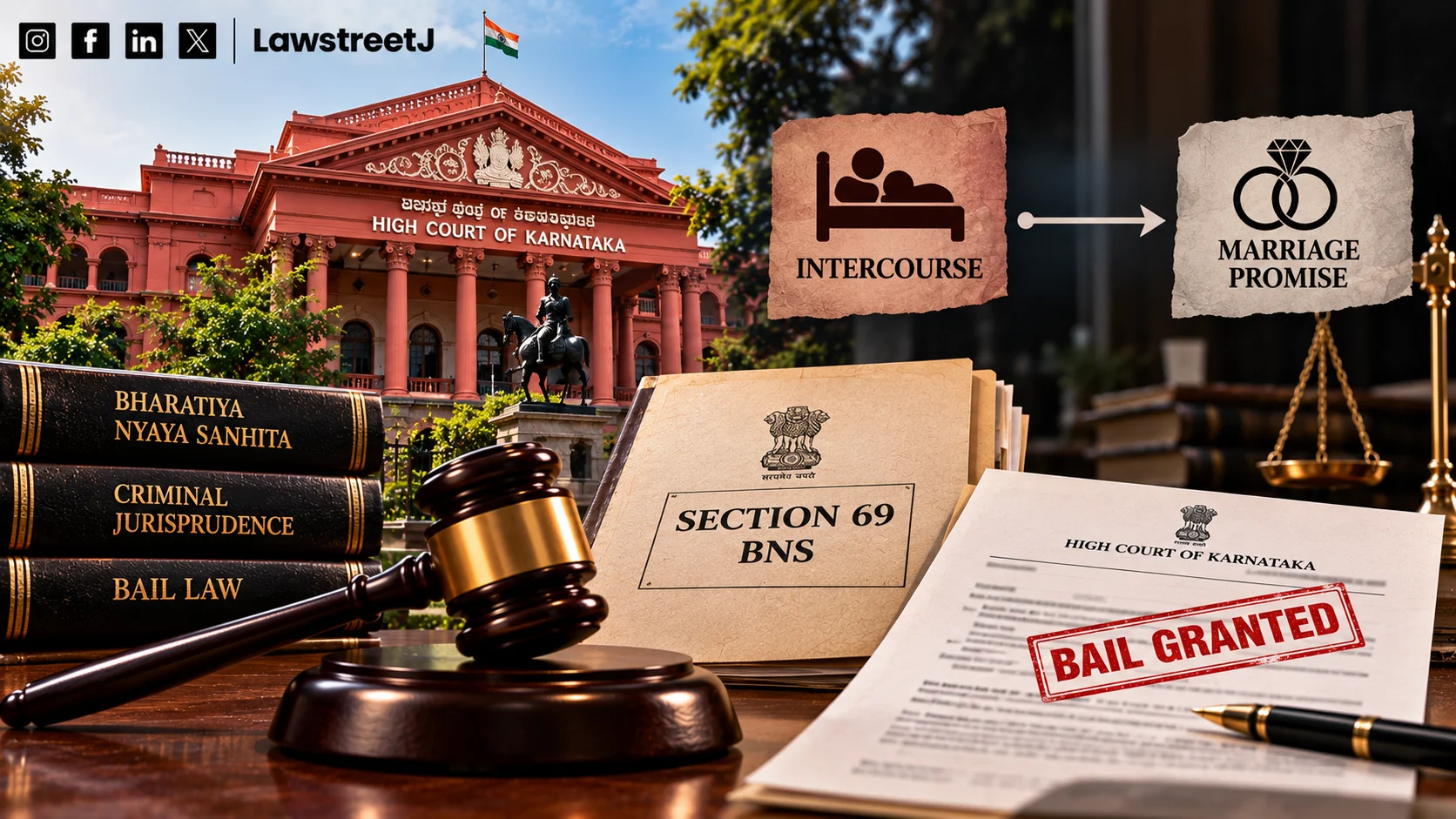
A consensual relationship between two adults cannot be treated as rape merely because the parties did not marry immediately, the Jharkhand High Court has held while setting aside the conviction of a man who had been sentenced to seven years' imprisonment for rape on the allegation that he established physical relations with the prosecutrix on a false promise of marriage.
Justice Rajesh Kumar was hearing a criminal appeal filed by Aalim Ansari against the judgment of conviction and order of sentence, convicting him under Section 376 of the Indian Penal Code and sentencing him to seven years' rigorous imprisonment along with a fine of Rs.20,000, with a further year's imprisonment in default of payment.
The prosecution case, was that the appellant had maintained a physical relationship with her for about eight months on the assurance of marriage. When she became pregnant, he kept deferring the marriage and, despite her pregnancy reaching five months, ultimately refused to marry her, allegedly also threatening her. A case was registered under Sections 376, 493 and 506 IPC, and after investigation, a charge-sheet was filed under the same provisions. The trial court, however, framed charge only under Section 376 IPC, and the matter proceeded to trial after the appellant pleaded not guilty.
The prosecution examined seven witnesses. Four members of the local panchayat were examined, all deposing that the matter had been taken up at a panchayat meeting where the victim stated that she was carrying the appellant's child and the appellant had admitted to the relationship and initially agreed to marry her. One of the panchayat witnesses also stated that the appellant had refused to marry the victim after the child's birth as he was already married, though he too admitted in cross-examination that the two were by then husband and wife. The victim's father similarly deposed that the appellant had raped his daughter on the assurance of marriage, though in cross-examination he admitted that Aalim Ansari was by then his daughter's husband, and that she had conceived before their Nikah was solemnised. The investigating officer and the examining doctor were also examined, the latter confirming a pregnancy of 24 weeks at the time of examination.
The prosecutrix herself, examined as PW-5, deposed that the appellant had assured her of marriage after the child's birth but had later refused, leading her to approach the police. In cross-examination, however, she admitted that she and the appellant had been in a love affair, that they had since married, that she was happy in the relationship, and that she had two children with him. She further stated that the marriage had taken place three years before the hearing, and that the case had been lodged prior to the marriage.
On this evidence, the trial court convicted the appellant under Section 376 IPC.
Before the High Court, counsel for the appellant argued that while the allegation centred on consent obtained through a false promise of marriage, the relationship was in fact consensual between two major individuals, both aware of the consequences of their conduct. It was submitted that a panchayat had been held, the parties had subsequently solemnised their marriage and now had two children, and that the victim's own deposition confirmed she had been happy in the relationship. Counsel contended that the complaint had been lodged only as a pressure tactic upon her pregnancy and the resulting delay in marriage, and that no offence under Section 376 IPC was made out. Counsel for the State, on the other hand, supported the conviction and sentence.
Examining the record, the Court found that both parties were majors and that their relationship was consensual, observing that the case appeared to have been lodged "as a pressure tactic." It held that "merely having a sexual relationship and the bald statement that on the false pretext of marriage, the consent has been obtained, is not enough to convict the appellant," particularly since this very claim had been negated by the victim in her own deposition, where she had admitted to a consensual love affair, a subsequent marriage, and two children with the appellant.
In view of this factual matrix, the Court quashed the appellant's conviction under Section 376 IPC and set aside the judgment of conviction and order of sentence dated 20.02.2021. The appeal was accordingly allowed and disposed of, the appellant was discharged from his bail bond liability, and the trial court records were directed to be sent back along with a copy of the judgment.
Case Title: Aalim Ansari v. The State of Jharkhand [Cr. Appeal (S.J) No. 118 of 2021]



![Supreme Court Collegium approves new Chief Justices for five key High Courts in India [Read Recommendations]](/secure/uploads/2023/12/lj_8000_380d1135-6f3a-4988-a00a-4d5cd5901815.jpg)
!['Arbitrary, impermissible,' SC quashes HC's resolution raising aggregate cut off marks on district judges appointment [Read Judgment]](/secure/uploads/2024/02/lj_3605_Rule-for-Judge-Selection.webp)