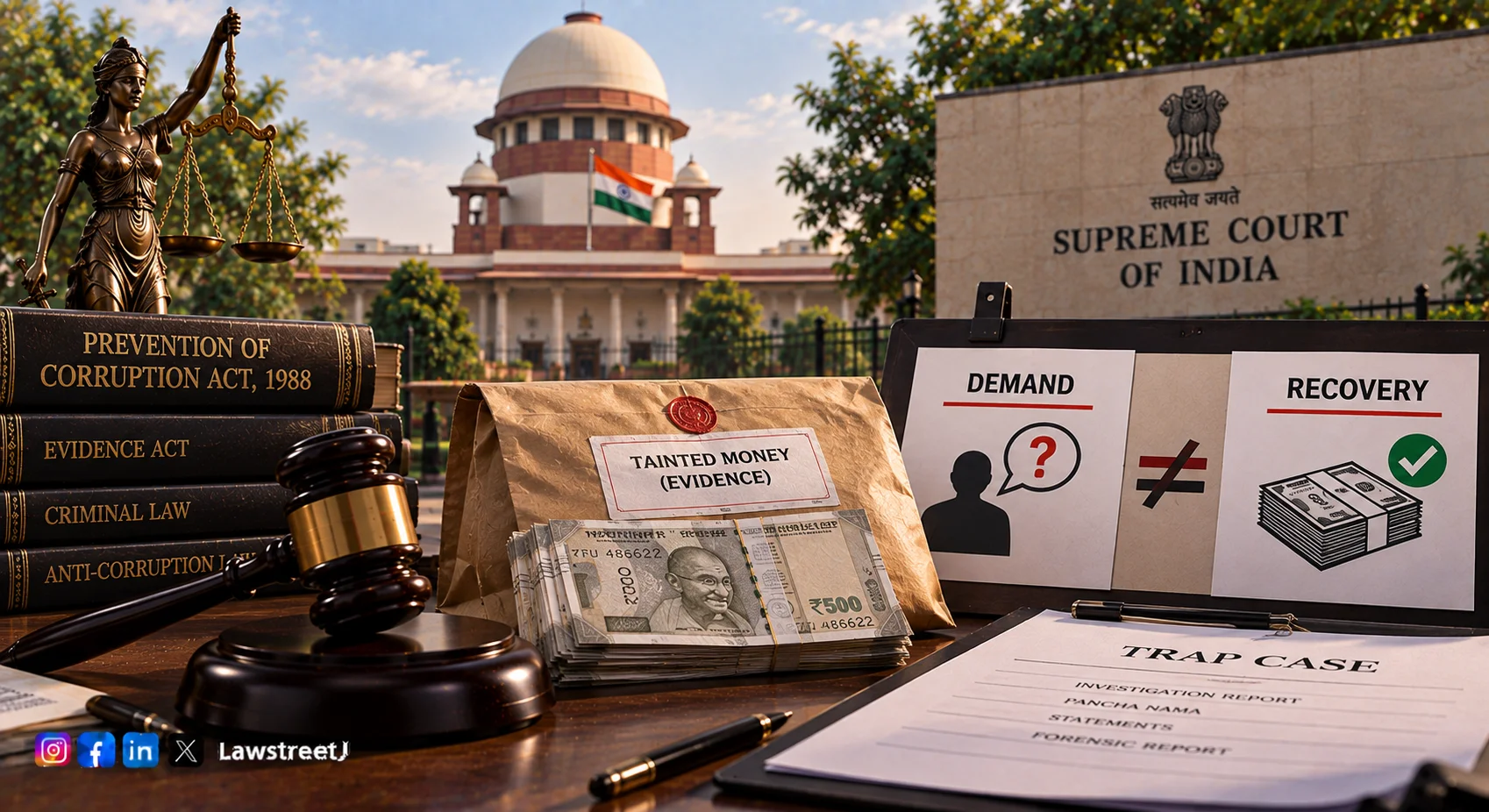
New Delhi: The Supreme Court has set aside the conviction of a Patwari under the Prevention of Corruption Act, 1988, holding that the prosecution failed to prove the demand for illegal gratification, an essential ingredient for conviction under Sections 7 and 13(2) of the Act.
A Bench of Justice Ujjal Bhuyan and Justice Arun Palli was hearing a criminal appeal against a judgment of the High Court of Punjab and Haryana at Chandigarh, which had affirmed the conviction and sentence of the appellant, a Patwari, recorded by the Special Judge, Hoshiarpur, under Section 7 read with Section 13(2) of the PC Act. The appellant had been sentenced to two years' rigorous imprisonment along with a fine. During the pendency of the appeal, the appellant died and his legal representatives were brought on record to continue the proceedings.
The prosecution's case was that the appellant, while posted as a Patwari, had demanded Rs. 10,000 from the complainant for mutating agricultural land in favour of the legal heirs of his deceased brother, which was later negotiated down to Rs. 9,500. Acting on a complaint, the Vigilance Bureau treated the currency notes with phenolphthalein powder and organised a trap in which a shadow witness accompanied the complainant to the appellant's office. Following a signal from the shadow witness, the raiding party apprehended the appellant and recovered the tainted currency notes, and a chemical test on his hand turned the solution pink.
Examining the evidence, the Court noted that neither the shadow witness nor the official witness who formed part of the raiding party had actually seen the complainant hand over the money to the appellant or seen it being recovered from him. The shadow witness admitted in cross-examination that he had stepped out of the office when the money was allegedly passed on, and that the recovery proceedings were conducted by the raiding party while he stood behind them. The Court also pointed to a contradiction between witnesses as to whether the money was recovered from the appellant's trouser pocket or his shirt pocket.
Relying on its earlier rulings in P. Satyanarayana Murthy v. State of A.P., the Constitution Bench decision in Neeraj Dutta v. State (Govt. of NCT of Delhi), and the more recent decision in Aman Bhatia v. State, the Court reiterated that proof of demand of illegal gratification is the sine qua non for a conviction under Sections 7 and 13(1)(d)(i) and (ii) of the PC Act, and that mere recovery of tainted currency, without proof of demand, cannot sustain a conviction.
Applying these principles, the Court held that since no witness had actually seen the appellant demand or accept the bribe, both the demand and acceptance of the bribe remained unproved on the record. It accordingly held that the case was squarely covered by the precedents cited and that the conviction could not be sustained.
The Court set aside the judgments of the Special Judge, Hoshiarpur and the High Court, declared that the charge against the appellant under Sections 7 and 13(2) of the PC Act could not be proved, and allowed the appeal, thereby clearing the appellant of the charges.
Case Title: Jaswinder Singh (Dead through LRs.) vs. State of Punjab, Criminal Appeal No. 2137 of 2014





.jpeg)