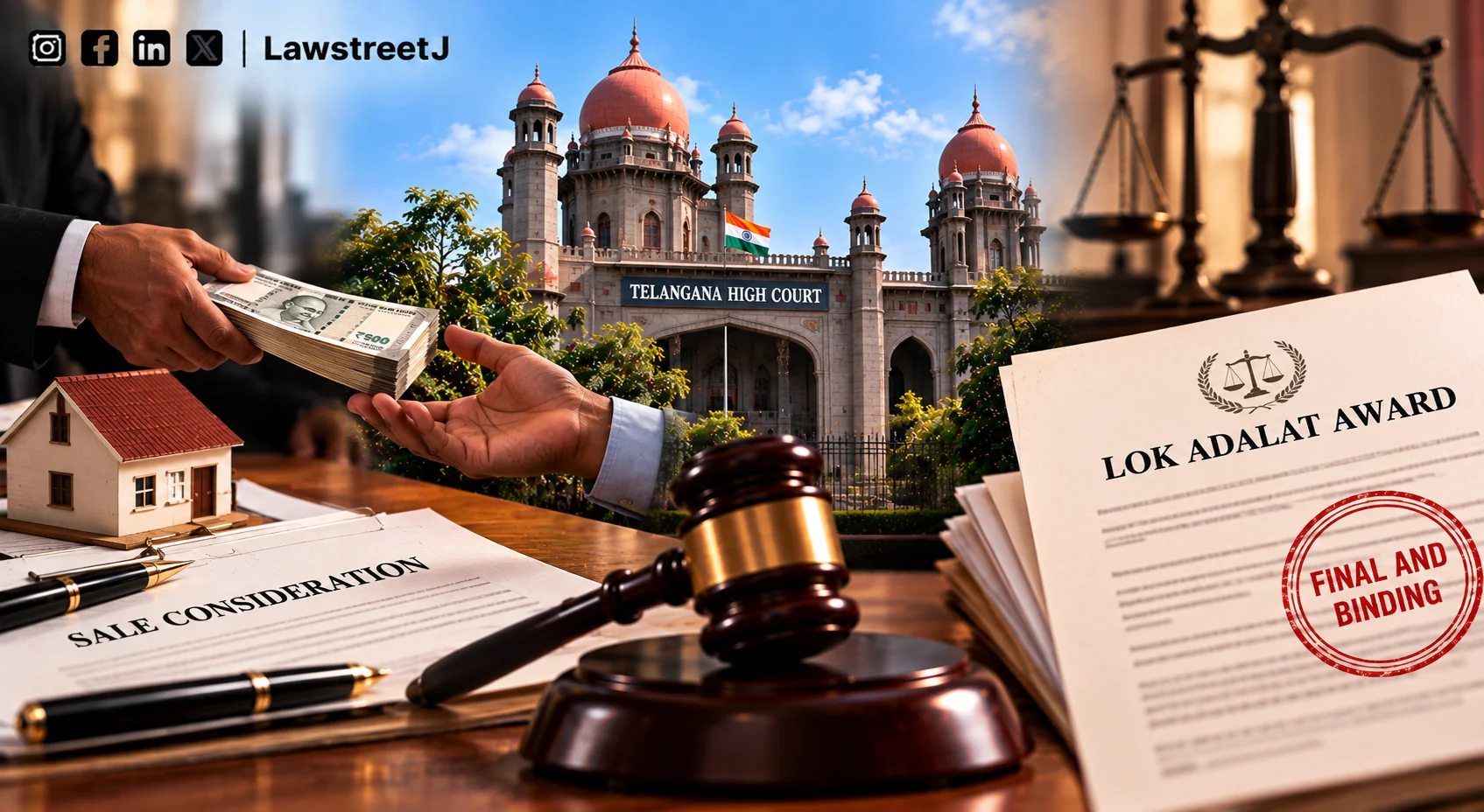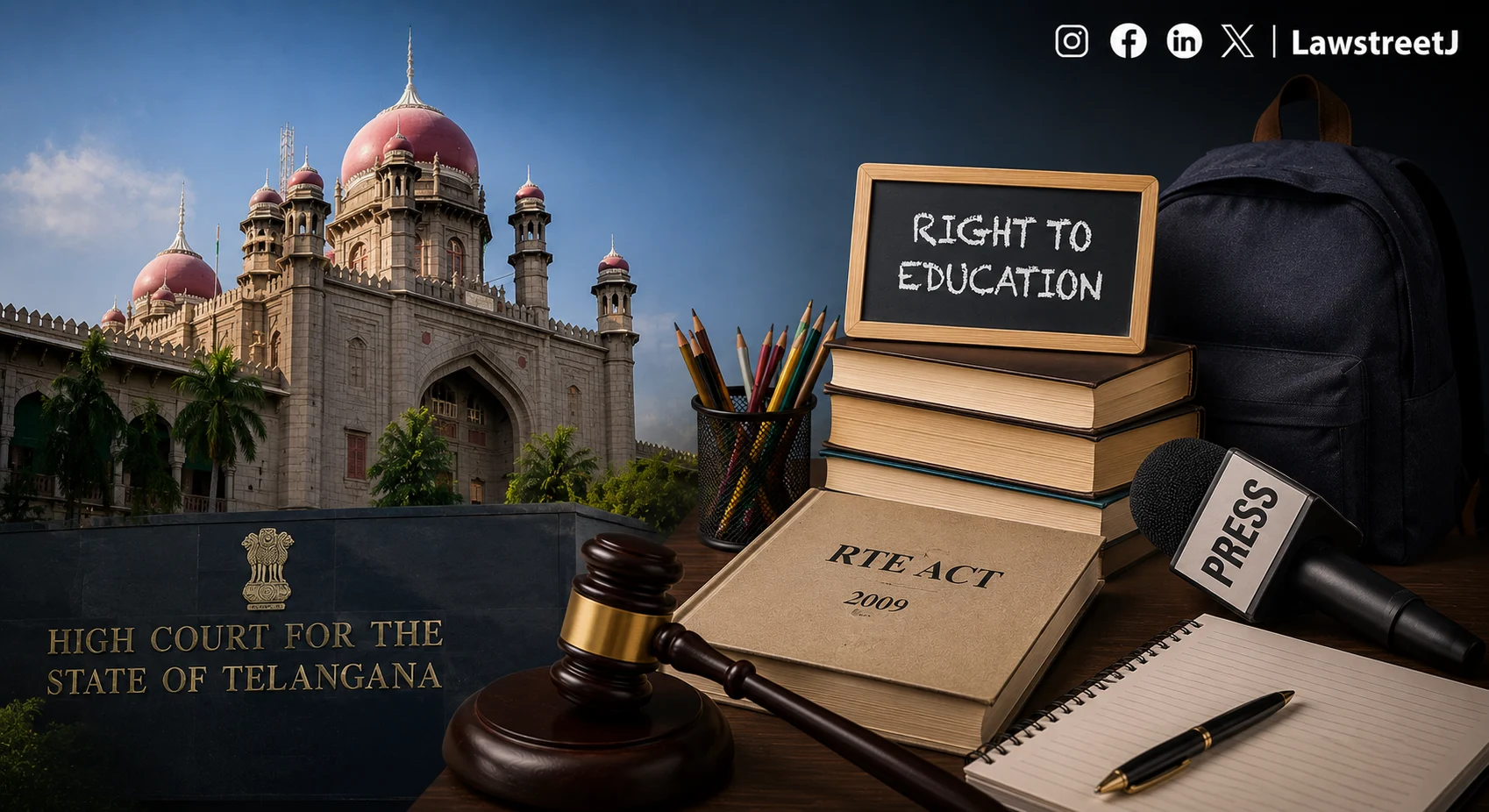
Hyderabad: The Telangana High Court has set aside proceedings issued by the State's school education authorities directing private recognised institutions, including minority educational institutions, to provide free education to the children of journalists in Hyderabad, Rangareddy, and Warangal districts.
The bench of Justice Juvvadi Sridevi disposed of two writ petitions filed by the Brothers of St Gabriel Educational Society and six other petitioners, challenging proceedings issued under the purported authority of the Right of Children to Free and Compulsory Education Act, 2009.
The petitioner-institutions, all unaided minority educational institutions, had been directed through separate proceedings dated 16.07.2014, 30.07.2014, and 11.09.2014 to extend free education to the children of journalists. Representations addressed to the authorities in December 2014 seeking withdrawal of the directions went unanswered, and the institutions faced administrative difficulties as several journalists whose children were enrolled refused to pay tuition fees, relying on the impugned proceedings.
Appearing for the petitioners, counsel argued that the institutions were minority educational institutions protected under Article 30(1) of the Constitution and were therefore beyond the reach of the RTE Act, relying on the Supreme Court's rulings in Society for Unaided Private Schools of Rajasthan v. Union of India and Pramati Educational and Cultural Trust v. Union of India. It was further contended that journalists did not constitute an economically weaker or specially privileged class entitled to free education for their children, that even under the RTE Act any such obligation would be confined to a specified percentage of seats rather than all children of a given class, and that extending such a benefit was a matter of governmental policy beyond the authorities' jurisdiction. The petitioners also contended that the proceedings had been issued without any opportunity of hearing, in violation of natural justice.
The Government Pleader, appearing for the respondents, produced a counter affidavit stating that the directions had followed representations from journalists claiming they could not afford the fees charged by private schools at admission. Significantly, the counter affidavit admitted that the impugned instructions were not mandatory in nature and had been issued only pursuant to requests made by journalists' associations.
The Court extracted the Supreme Court's holding in Society for Unaided Private Schools of Rajasthan, where it was held that Sections 12(1)(c) and 18(3) of the RTE Act infringe the freedom guaranteed to unaided minority schools under Article 30(1), and that the Act, applying the principle of severability, does not extend to such schools.
It also extracted the Constitution Bench's conclusion in Pramati Educational and Cultural Trust:
“We, however, hold that the 2009 Act insofar as it applies to minority schools, aided or unaided, covered under clause (1) of Article 30 of the Constitution is ultra vires the Constitution,”
the Constitution Bench had ruled, a finding the High Court held was directly applicable to and dispositive of the petitioners' case.
Applying this settled position, the Bench held that the RTE Act could not be enforced against the petitioner-institutions, which were admittedly minority educational institutions. It further found merit in the petitioners' contention that the authorities lacked jurisdiction to confer a benefit of free education on a specific class of persons, namely children of journalists, in the absence of any statutory provision or governmental policy authorising such a direction, particularly since the respondents had themselves conceded that the instructions were issued merely on the basis of requests from journalists' associations and were not mandatory.
The Court also held that the proceedings were vitiated for want of a hearing, given their direct financial and administrative consequences for the institutions, and that the failure to observe natural justice rendered the directions arbitrary and unsustainable. Holding the impugned proceedings to be without authority of law and violative of Article 30(1), the Court allowed both writ petitions and set aside the three impugned proceedings, with no order as to costs.
Case Title: Brothers of St Gabriel Educational Society and Six Others vs. The State of Telangana and Three Others


!['No common intention to kill,' SC alters conviction from murder to culpable homicide not amounting to murder [Read Judgment]](/secure/uploads/2024/02/lj_7197_f77c706e-b667-41fe-9c36-9e633e880b85.jpg)
![Remaining silent during an investigation is a fundamental right: Telangana HC [Read Judgment]](/secure/uploads/2024/04/lj_3728_c8f7ecd3-a0e9-44f7-85aa-f77b9dae3a49.webp)