

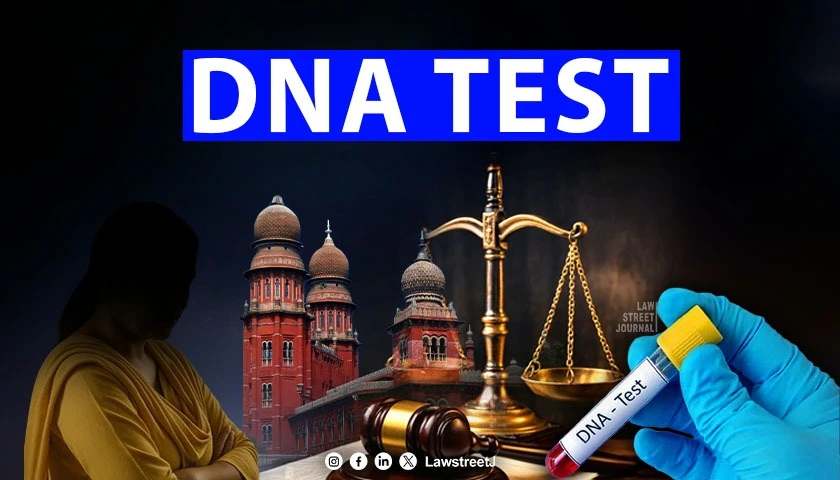
Chennai: The Madras High Court has held that a mother cannot be compelled to undergo a DNA test merely to establish maternity for the purpose of donating her kidney to her son. The Court observed that where the materials on record sufficiently establish the biological relationship on a preponderance of probabilities, insistence on a DNA test would be unjustified.
Justice G.R. Swaminathan of the Madras High Court set aside the decision of the Authorization Committee, Directorate of Medical Education and Research, Chennai, which had refused approval for the kidney donation despite the emergent medical condition of the petitioner’s son requiring transplantation.
The case arose from the refusal of the Authorization Committee constituted under the Transplantation of Human Organs and Tissues Act, 1994, to approve a kidney donation by a mother to her son, who was suffering from renal failure and required an urgent transplant at Apollo Speciality Hospital, Chennai. The Committee rejected the application on the ground that the biological relationship between the donor and recipient had not been satisfactorily established.
The Court expressed its inability to understand why the request of the petitioners had been casually ignored when the donor herself claimed that the recipient was her own biological son. Referring to its earlier order dated 30.05.2024 in WP No. 13918 of 2024, the Court reiterated that the grant of permission by the Authorization Committee under Form-18 is premised on the donation being out of love and affection, in the absence of any financial transaction between donor and recipient, and without any coercion or pressure on the donor.
The Court observed that love and affection are intangible sentiments that cannot be measured by the length of association between the parties and that applicants who assert the absence of commercial consideration cannot be called upon to prove the negative. It further held that unless there is definite material evidencing a financial transaction, permission ought not to be withheld, and that a donor’s statement of altruistic motivation must be taken at face value in the absence of any credible contrary material.
The Court also reiterated its view from an earlier order dated 31.05.2024 in WP No. 13642 of 2024 that even where the donor is a non-relative, a statement that the donation is out of altruism and not for commercial consideration cannot be questioned.
Examining the material on record, the Court noted that the birth certificate of the second petitioner, issued by the Calcutta Municipal Corporation under the Registration of Births and Deaths Act, 1969, recorded the first petitioner as his mother. The Court further observed that the Aadhaar and PAN cards of the petitioners corroborated the familial relationship. Applying the standard of preponderance of probabilities, the Bench held that the documents sufficiently established that the second petitioner was the biological son of the first petitioner and that she could not be compelled to undergo a DNA test merely to prove her maternity.
The Court accordingly set aside the impugned order of the Authorization Committee dated 17.04.2026 and directed the Committee to grant permission to the first petitioner to donate one of her kidneys to the second petitioner forthwith, without any delay, so that the necessary procedures for kidney transplantation could preferably be completed within the following week.
Noting that the meeting of the Authorization Committee was scheduled for the afternoon of 22.05.2026, the Court directed the learned Additional Government Pleader to communicate the order to the Committee at the earliest.
The writ petition was disposed of accordingly with no order as to costs.
Appearances: The petitioners were represented by Mr. Abhinav Parthasarathy, Advocate, while the respondents were represented by Mr. L.S.M. Hasan Fizal, learned Additional Government Pleader.
Case Title: Rita Chaurasiya & Anr. v. The State of Tamil Nadu & Ors., WP No. 20047 of 2026



![TN Medical Council declares change of gender identity of LGBTQIA+ as misconduct [Read Notification]](/secure/uploads/2022/12/lj_5268_5cebb05a-97fb-40fb-8045-25cdf8f4207a.jpg)
![Madras High Court Directs Tamil Nadu Government to Ensure Quota for Transgenders in Local Body Elections [Read Order]](/secure/uploads/2023/08/lj_2507_7a03d113-08b1-4670-b6fb-9058aee481d0.jpg)
![Anti Corruption sleuths acted like "puppets in The Muppet Show", HC notice to ex TN CM in disproportionate assets case [Read Order]](/secure/uploads/2023/09/lj_8675_7b37fc02-1b2d-4f4a-9816-3df20545b37e.jpg)