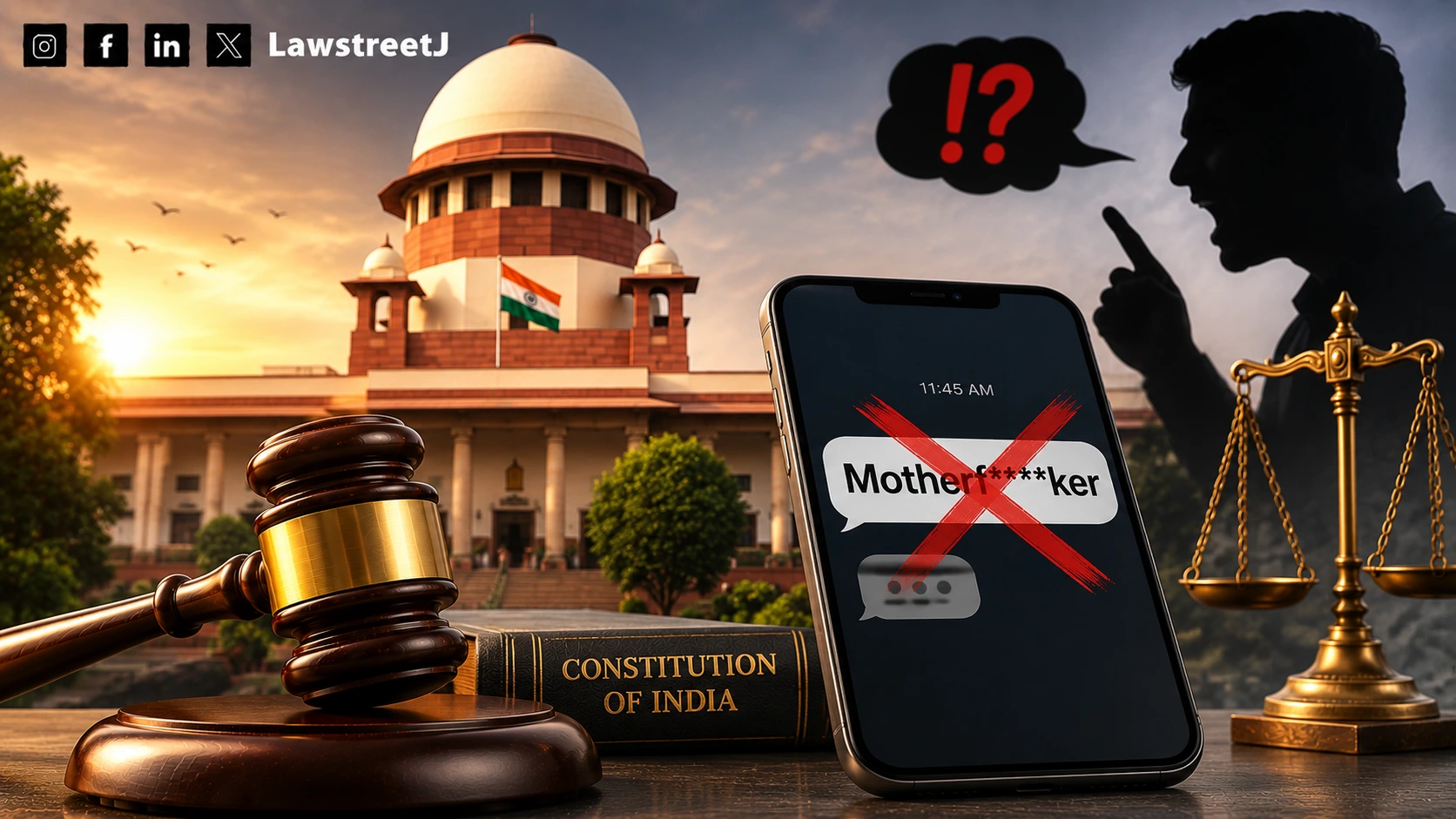
New Delhi: The Supreme Court has set aside a conviction under Section 294(b) of the Indian Penal Code, holding that abusive and vulgar words hurled during an altercation including calling the complainant a "motherf**ker" and "son of a whore" do not amount to obscenity in law, since obscenity requires lascivious content that appeals to prurient interest, which mere profanity does not satisfy.
A Bench of Justices Sanjay Karol and Vipul M. Pancholi was hearing an appeal filed by Mani @ Subramaniyam against a judgment of the Madras High Court, which had acquitted him of charges under the SC/ST (Prevention of Atrocities) Amendment Act, 2015, while confirming his conviction under Sections 294(b), 326 and 506(ii) of the IPC arising out of a land dispute that led to an altercation and assault in 2017.
The prosecution's case was that on 24.08.2017, during a quarrel over a land dispute, the appellant abused the complainant (PW-1) and, upon being confronted, allegedly used obscene words and caste-based slurs, before assaulting him with a billhook, causing a nasal bone fracture and other injuries. The Trial Court had convicted the appellant under provisions of the IPC as well as the SC/ST Act; the High Court, in appeal, acquitted him under the SC/ST Act while confirming the IPC convictions, though it reduced the sentence under Section 326 IPC from five years to one year.
Before the Supreme Court, the appellant, assisted by Mr. Shailesh Madiyal, senior counsel appointed as amicus curiae, challenged the conviction under Sections 294(b), 326 and 506(ii) of the IPC.
Examining Section 294(b) IPC, the Court explained that a conviction requires proof that the offender uttered an obscene word in or near a public place, and that such utterance caused annoyance to others. Surveying its precedents on obscenity under Section 292 IPC, including Ranjit D. Udeshi v. State of Maharashtra, Aveek Sarkar v. State of W.B., and Apoorva Arora v. State (NCT of Delhi), the Court reiterated that a thing is obscene only if it is lascivious, appeals to prurient interest, and tends to deprave and corrupt those exposed to it.
"Legally, obscenity is not synonymous with ‘vulgarity’, ‘abuse’ or ‘profanity’. Use of mere swear words, profanities and vulgar expletives, however distasteful or uncivil they may be, cannot be equated with obscenity," the Court held.
The Court recorded the words attributed to the appellant by PW-1 himself: “Hey Motherfucker! You son of a whore! Are you coming in support of your elder sister's son? Just fuck off, you ‘Kurutha’ Fucker…” It held that, going by the complainant's own version, this language was, at best, abusive or vulgar, and did not satisfy the ingredients of Section 294(b) IPC since there was nothing to show it was lascivious, appealed to prurient interest, or had a tendency to deprave and corrupt, nor was it shown to have caused annoyance to others in a public place. The conviction under Section 294(b) IPC was accordingly set aside.
On Section 506(ii) IPC, the Court held that mere use of threatening words during an altercation, without proof that they were intended to cause alarm or compel the complainant to act or abstain from acting, was insufficient to sustain a charge of criminal intimidation, and set aside this conviction as well.
However, on Section 326 IPC, the Court upheld the conviction, holding that the medical evidence a fractured nasal bone along with lacerations squarely fell within the definition of "grievous hurt" under Section 320 IPC, and was proved to have been caused by a billhook, a dangerous weapon. The testimony of PW-1, corroborated by PW-3 and PW-4 and the medical evidence of PW-2, was found sufficient to sustain this conviction.
Considering the appellant's age of about 70 years, his health condition, and the fact that the incident arose out of animosity over a family land dispute, the Court modified his sentence under Section 326 IPC to imprisonment till the rising of the Court, along with a fine of Rs.50,000 to be paid within two months.
The appeal was allowed accordingly.
Case Title: Mani @ Subramaniyam vs. State rep. by the Deputy Superintendent of Police, Criminal Appeal No. of 2026 (Arising out of SLP(Crl.) No.4516 of 2025)