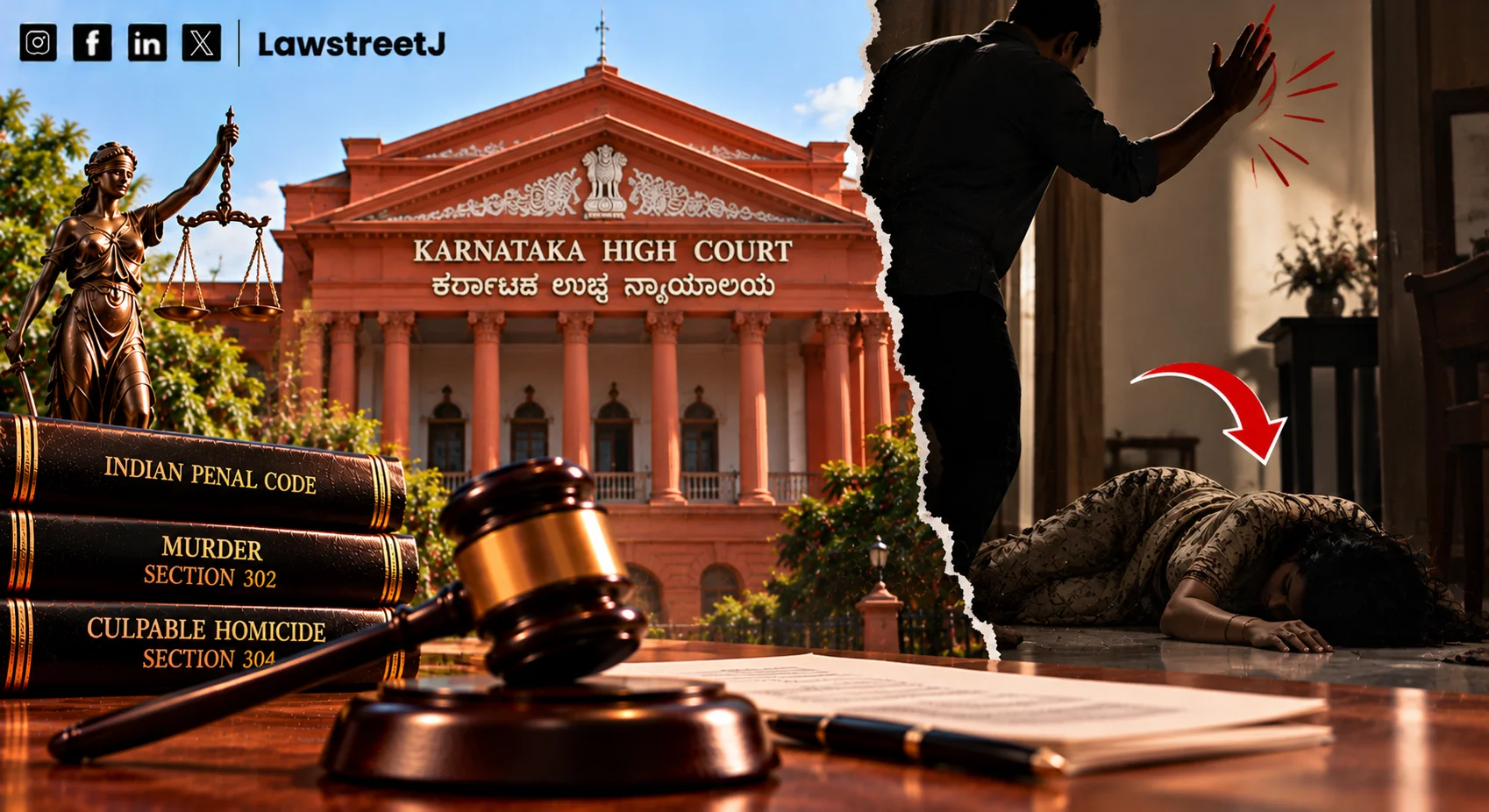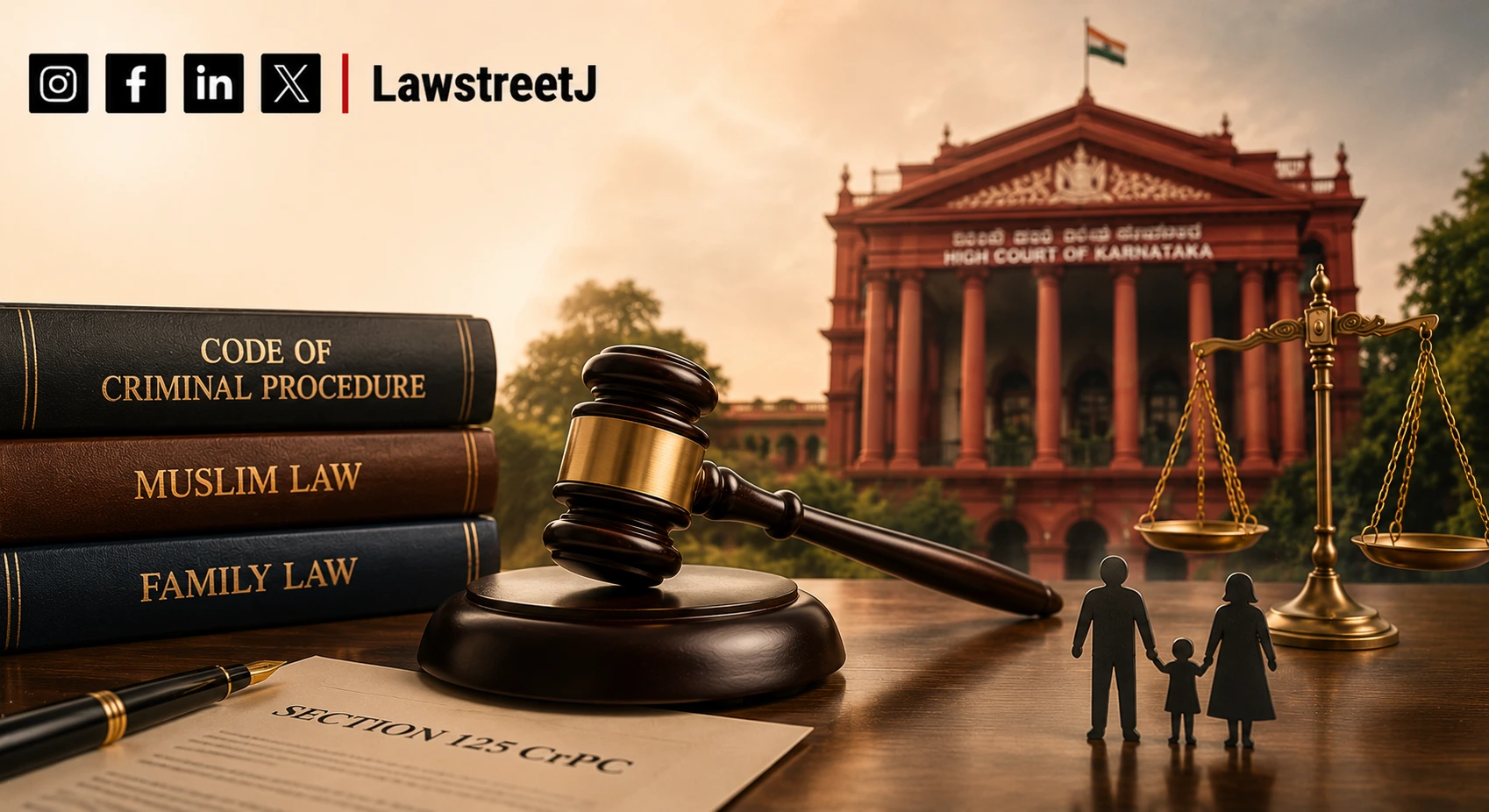
The Karnataka High Court has reiterated that under Mohammedan law and Section 125 of the Code of Criminal Procedure, 1973 (since re-enacted as Section 144 of the Bharatiya Nagarik Suraksha Sanhita, 2023), a Muslim father's obligation to maintain his minor children continues even where they reside with their divorced mother, and that the mother's employment is no defence to this obligation.
Justice Ravi V Hosmani was hearing a petition under Section 482 of the Code of Criminal Procedure filed by the father seeking to set aside concurrent orders of the Sessions Court and the trial court at Bhadravathi directing him to pay maintenance of Rs.2,000 per month each to his two minor children.
The maintenance petition had been filed under Section 125 CrPC on behalf of the children by their mother, who stated that she had married the petitioner in 2008 and that, shortly thereafter, the petitioner and his family began harassing her over dowry demands, neglecting to maintain her and the children despite the petitioner's sufficient income. She stated that this had led to police complaints and a private complaint under Sections 504, 506 and 498A of the Indian Penal Code read with Section 34, and Sections 3 and 4 of the Dowry Prohibition Act, 1961.
The petitioner admitted the relationship but opposed the maintenance claim, contending that it was filed vengefully after the mother's criminal complaint had ended in a 'B' report, that he had not demanded dowry, and that he was working as a daily-wage teacher in an Urdu school while the mother, being a Government school teacher, had sufficient means to maintain the children herself. The trial court, taking into account that the mother earned about Rs.25,000 per month against the petitioner's stated income of Rs.7,000 per month, awarded maintenance of Rs.2,000 per month to each child, a decision the Sessions Court upheld in revision on grounds of territorial jurisdiction and quantum.
Rejecting the petitioner's contention that the claim was filed only to harass him, the Court relied on Padmja Sharma v. Ratan Lal Sharma, reported in (2000) 4 SCC 266, to hold that it is the duty of both parents to maintain their children, and that the mother's employment as a teacher was not, by itself, sufficient ground for the father to neglect this duty. The Court also noted that the petitioner had placed no material, such as a salary certificate, to substantiate his claim of a lower income.
“Thus, both under the personal law and the statutory law (Section 125 CrPC) the obligation of a Muslim father, having sufficient means, to maintain his minor children, unable to maintain themselves, till they attain majority and in case of females till they get married, is absolute, notwithstanding the fact that the minor children are living with the divorced wife.”
Citing this passage from Noor Saba Khatoon v. Mohd. Quasim, reported in (1997) 6 SCC 233, the Court held that the duty of a Muslim father to maintain his son continues till the son attains majority or is able to maintain himself, whichever is earlier, and in the case of a daughter, till her marriage, and that this obligation does not cease merely because the children reside with their mother.
The Court observed that both children were admittedly minors, that both parents were working, and that the petitioner had placed nothing on record to show he was without income or unable to maintain himself. It further noted that the petitioner had admitted not paying maintenance for a substantial period and that the trial court had appropriately weighed the financial status and responsibilities of both parents, along with the children's needs, in fixing the quantum at Rs.2,000 per month each, an amount the Court found neither excessive nor unreasonable.
Finding no grounds to interfere with the concurrent orders of the courts below, the High Court dismissed the petition.
Appearances: For the Petitioner: Sri Harish Kumar M S, Advocate.
Case Title: XXX v. XXX & Anr., Criminal Petition No. 6023 of 2019


![Karnataka High Court: Cabinet Rank Status Not Equivalent to Ministerial Position [Read Order]](/secure/uploads/2023/09/lj_2318_fc1b99b7-aeed-472b-836e-33750bedb394.jpg)


![Woman living in adultery cannot claim maintenance: Karnataka High Court [Read Order]](/secure/uploads/2023/10/lj_3083_Women_living.jpg)