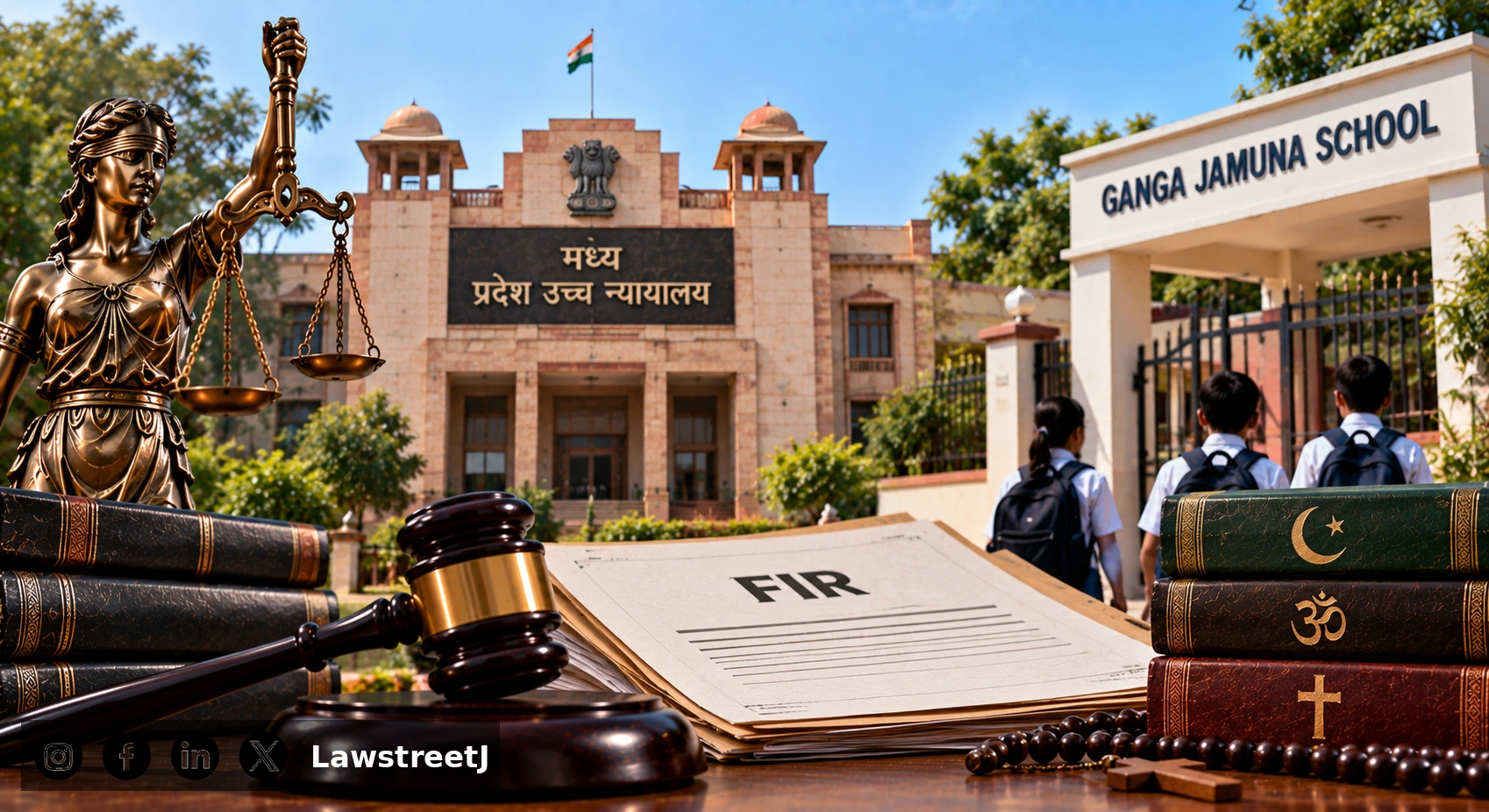
Jabalpur: The Madhya Pradesh High Court at Jabalpur has dismissed three connected petitions seeking quashment of an FIR registered against persons associated with Ganga Jamuna Higher Secondary School, Damoh, over allegations of imposing a compulsory dress code and religious practices on students, holding that the allegations could not be said to be inherently improbable or incapable of constituting the offences alleged, and that the questions raised required appreciation of evidence at trial.
Justice Himanshu Joshi was hearing three connected applications filed under Section 528 of the Bharatiya Nagarik Suraksha Sanhita, 2023, seeking quashment of FIR for offences under Sections 295-A, 120-B and 506 Part-II of the Indian Penal Code, and subsequently under Sections 75 and 87 of the Juvenile Justice (Care and Protection of Children) Act, 2015 and Sections 3 and 5(1) of the Madhya Pradesh Freedom of Religion Act, 2021.
The applicants, contended that they were not members or office bearers of the committee constituted for the relevant period and that there was no material attributing the alleged acts to them. It was further argued that the FIR was lodged by the Investigation Committee/Inspector on behalf of the Collector's Office and not by a converted person or an aggrieved party, and that Section 4 of the Madhya Pradesh Freedom of Religion Act barred investigation in the absence of such a complaint. Reliance was placed on this Court's order in Jerald Almeda and another v. State of Madhya Pradesh, and it was submitted that mere wearing of Hijab could not, by itself, constitute an offence of conversion.
The applicants Anas Athar and Rustam Ali, a teacher and peon at the school respectively, additionally challenged the order taking cognizance and the framing of charges on the ground that no sanction under Section 196 Cr.P.C. had been obtained when cognizance was initially taken, and that subsequent sanction could not cure the initial lack of jurisdiction. It was also submitted that no specific material showed their involvement in any act of conversion, cruelty or criminal conspiracy, and that Sections 75 and 87 of the Juvenile Justice Act were not attracted against them.
The State opposed all three petitions, submitting that the FIR arose from an enquiry conducted by the Collector's Committee following complaints by students concerning compulsory wearing of Hijab, a prohibition on wearing Tilak and Kalawa, compulsory teaching of Urdu, and recitation of prayers, allegedly imposed by threat and coercion. It was submitted that the prosecution sanction under Section 196 Cr.P.C. had subsequently been obtained and placed before the trial court prior to framing of charges, and that an objection regarding sanction could not automatically result in quashing where no failure of justice was shown.
The Court held that while the wearing of Hijab could not, in isolation, constitute an offence under the Freedom of Religion Act, the prosecution case was not founded solely on that allegation but also included alleged prohibition on Tilak and Kalawa, compulsory religious practices, and threat and coercion, matters that depended on appreciation of evidence and could not be resolved by selectively reading the FIR. On the question of sanction, the Court relied on Dharmesh @ Nanu Nitinbhai Shah v. State of Gujarat and connected authorities to hold that subsequent sanction, obtained and placed before the trial court prior to framing of charges, did not vitiate the proceedings. The Court also noted that the trial had substantially progressed, with 32 of 33 prosecution witnesses already examined, which was a relevant circumstance against exercising inherent jurisdiction to terminate the prosecution.
As regards Shailendra Kumar Jain and Abdul Wasim Bari, the Court observed that while documents showing they were not members of the subsequently constituted committee may support their defence, the prosecution had alleged their involvement based on material collected during investigation, and whether they exercised any influence over the school's functioning was a factual question falling within the domain of the trial court. Holding that the allegations, read with the material collected during investigation, were not inherently absurd or improbable, the Court dismissed all three petitions, clarifying that these were matters to be examined at trial.
Appearances:
For the Applicants: Shri Zamir Mohammad Shah, Advocate, Shri Shashank Shekhar, Senior Advocate, with Shri Samresh Katare, Advocate.
For the State: Shri B.D. Singh, Deputy Advocate General.
Case Title: Shailendra Kumar Jain v. The State of Madhya Pradesh, with connected matters Anas Athar and Others v. The State of Madhya Pradesh (M.Cr.C. No.49886 of 2023) and Abdul Wasim Bari v. The State of Madhya Pradesh (M.Cr.C. No.52398 of 2025); Misc. Criminal Case No. 1001 of 2026



![High Court Prohibits Compulsion of Hijab and Islamic Texts on Students of Different Faiths at Ganga Jamuna School [Watch Video]](/secure/uploads/2023/09/lj_5754_f71da9b5-c632-4d0b-94b8-6f36245eb157.jpg)
.jpeg)