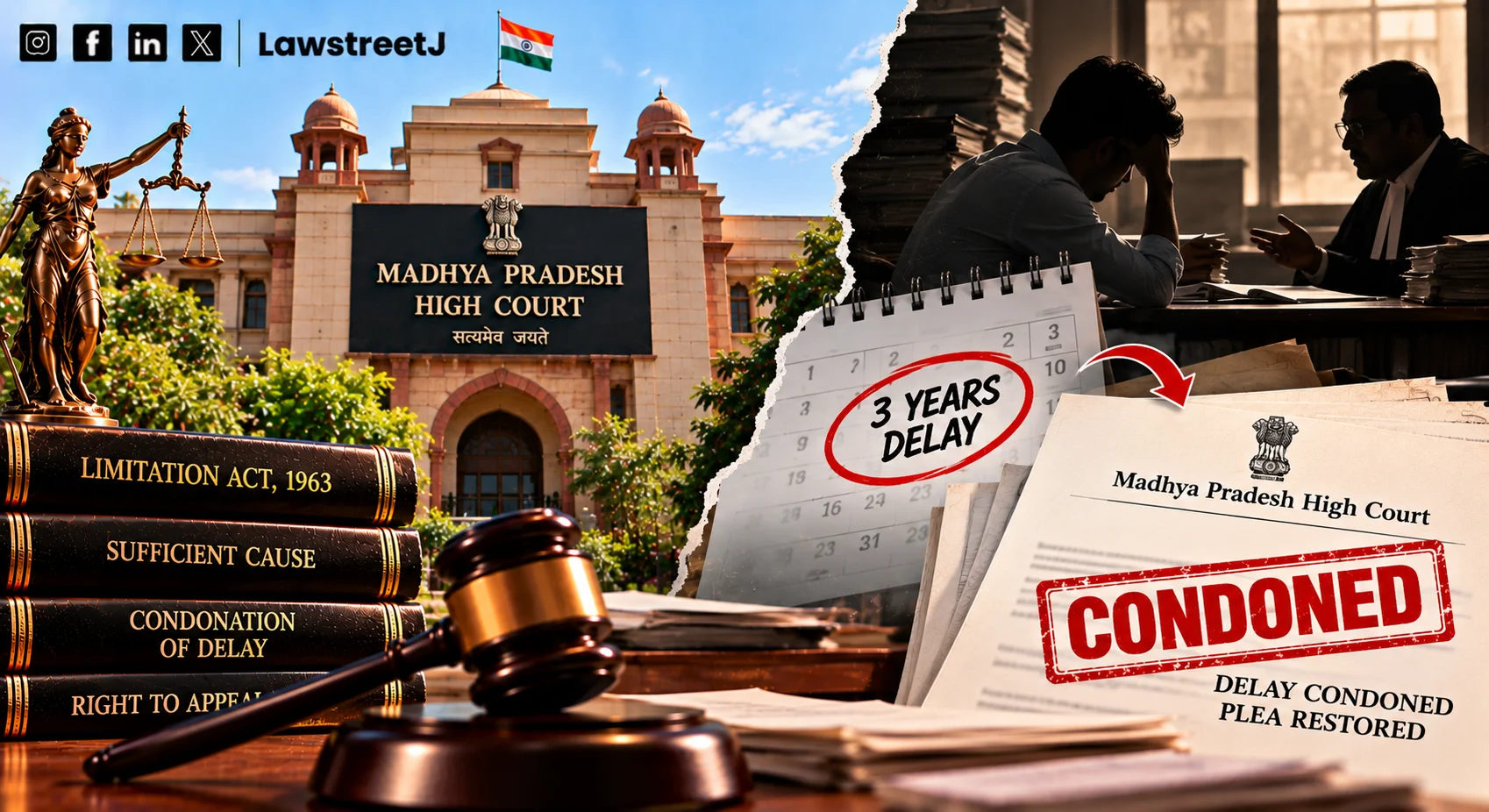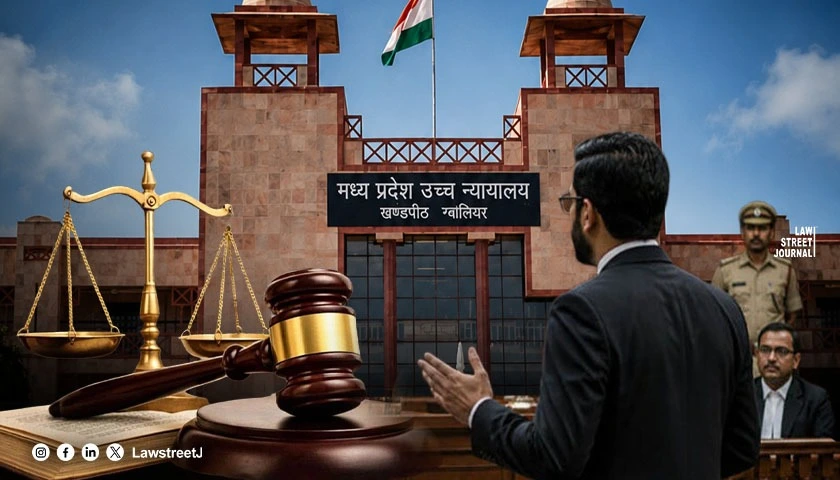
The Madhya Pradesh High Court on June 3, 2026 dismissed a writ appeal filed by an advocate belonging to the Economically Weaker Section (EWS) category who challenged the denial of age relaxation in a recruitment process for the post of Assistant District Public Prosecution Officer (ADPO) conducted by the Madhya Pradesh Public Service Commission (MPPSC).
A Division Bench of Justices Pranay Verma and Jai Kumar Pillai affirmed the order of the learned Single Bench dated May 6, 2026 in W.P. No. 17488/2026, which had dismissed the original writ petition on the ground that the grant of reservation and relaxation is governed by rules already framed by the State Government and that courts cannot direct the State to extend such concessions beyond those rules.
Background
The appellant, Suryakant Tiwari, is a practicing advocate enrolled with the State Bar Council of Madhya Pradesh (Enrolment No. MP-1436/2007) practicing at the Rewa Court. He belongs to the EWS category and holds a valid EWS certificate for the financial year 2025-26.
The MPPSC had previously issued Advertisement No. 03/2021 dated June 7, 2021 for the ADPO eligibility examination. Tiwari participated in that examination but did not qualify. After a gap of five years, the MPPSC issued the impugned Advertisement No. 03/2026 dated March 10, 2026 for the same post. The advertisement prescribed a maximum age limit of 40 years as on the cut-off date of January 1, 2027 and provided age relaxation to SC, ST, and OBC candidates, but not to EWS candidates.
As on the cut-off date, Tiwari was 43 years old, three years beyond the prescribed limit. The online application portal treated him as age-barred and prevented him from submitting his application, prompting him to approach the High Court.
Single Bench’s Dismissal
The learned Single Judge dismissed the writ petition in brief terms, observing that the State Government had already framed rules to determine which categories are entitled to reservation and relaxation, and that there was no occasion for the Court to direct the grant of concessions beyond those rules. Tiwari challenged this order before the Division Bench by way of Writ Appeal No. 1811 of 2026.
Appellant’s Contentions
Before the Division Bench, Tiwari, represented by Advocate Hindesh Pal, raised several contentions. He argued that excluding EWS candidates from age relaxation, while extending it to SC, ST, and OBC candidates, was arbitrary and discriminatory and violated Articles 14 and 16 of the Constitution. He submitted that the State had drawn an irrational classification among similarly situated reserved category candidates without any intelligible differentia.
Tiwari further contended that granting reservation without incidental benefits such as age relaxation rendered the constitutional mandate under Articles 15(6) and 16(6), introduced by the 103rd Constitutional Amendment, wholly illusory and symbolic. He also argued that his exceeding the age limit was a direct consequence of the five-year administrative delay by the respondents in conducting the examination, and that the State could not take advantage of its own inaction.
Reliance was placed on the practice of other State commissions, including the Rajasthan Public Service Commission and Rajasthan Staff Selection Board, which had granted 5 to 10 years of age relaxation to EWS candidates. The appellant also highlighted interim orders of coordinate Benches of the Madhya Pradesh High Court in W.P. No. 38536/2025 and W.P. No. 3294/2026, where similarly situated EWS candidates had been permitted to participate provisionally.
Respondents’ Contentions
The State and the MPPSC, represented by Government Advocate Manas Mani Verma and Advocate Aditya Pachori respectively, defended the advertisement on the ground that the grant of age relaxation and concessions is entirely a matter of statutory rules and state policy. They submitted that the recruitment agency was bound to follow the statutory rules strictly and that courts could not issue a writ of mandamus to direct the State to grant relaxation contrary to the existing rules, as such policy decisions fall within the exclusive domain of the executive.
Analysis and Decision
The Division Bench framed the core issue as whether a writ of mandamus could be issued directing the State to grant age relaxation to EWS candidates on parity with other reserved categories, and whether the impugned advertisement or the Single Bench’s order suffered from any illegality.
The Bench placed reliance on its earlier judgment in W.P. No. 14695/2024, which had crystallized the principles governing the grant of concessions and reservations. In that case, it had been held that reservations and relaxations to Other Backward Classes under Articles 15 and 16 are made under enabling provisions, and that an enabling provision does not automatically create an absolute right to claim such benefits. The judgment had also held that the lists maintained by the State Government and the Central Government for OBC recognition are separate and serve distinct purposes.
Applying those principles, the Division Bench held that the grant of age relaxation and incidental concessions is governed by the specific rules framed by the State Government and that an enabling constitutional provision does not, by itself, vest an absolute right in a candidate to claim age relaxation absent a statutory framework. The Bench found no infirmity in the approach adopted by the respondent authorities or the Single Bench.
The writ appeal was accordingly dismissed, affirming the order of the Single Judge. No order as to costs was made.
Significance
The judgment reinforces the settled position that constitutional provisions enabling reservations and concessions are not self-executing and do not automatically confer enforceable individual rights to specific benefits such as age relaxation. It underscores that the architecture of concessions in public employment remains within the State’s rule-making domain, and that judicial review under Article 226 does not extend to directing the executive to frame or expand such policies.
The ruling is likely to affect other EWS candidates who may have sought age relaxation on parity with SC/ST/OBC categories in various State recruitment processes. At the same time, the decision leaves open a broader constitutional question: whether the omission of age relaxation for EWS candidates, while granting it to other reserved categories, can ever constitute hostile discrimination warranting judicial intervention, a question the Court did not find it necessary to answer on the facts of this case.
Case Details
- Case Title: Suryakant Tiwari v. The State of Madhya Pradesh and Others
- Court: High Court of Madhya Pradesh at Jabalpur
- Bench: Justice Pranay Verma and Justice Jai Kumar Pillai
- Case Number: Writ Appeal No. 1811 of 2026
- Neutral Citation: 2026:MPHC-JBP:40682
- Date of Order: June 3, 2026
- For Appellant: Shri Hindesh Pal, Advocate
- For State: Shri Manas Mani Verma, Government Advocate
- For Respondent No. 2 (MPPSC): Shri Aditya Pachori, Advocate

.jpeg)
![Supporting defamatory WhatsApp posts doesn’t constitute involvement in offence of defamation: MP HC [Read Order]](/secure/uploads/2024/09/lj_6675_WhatsApp_Image_2024-09-16_at_12.24.54_PM.webp)