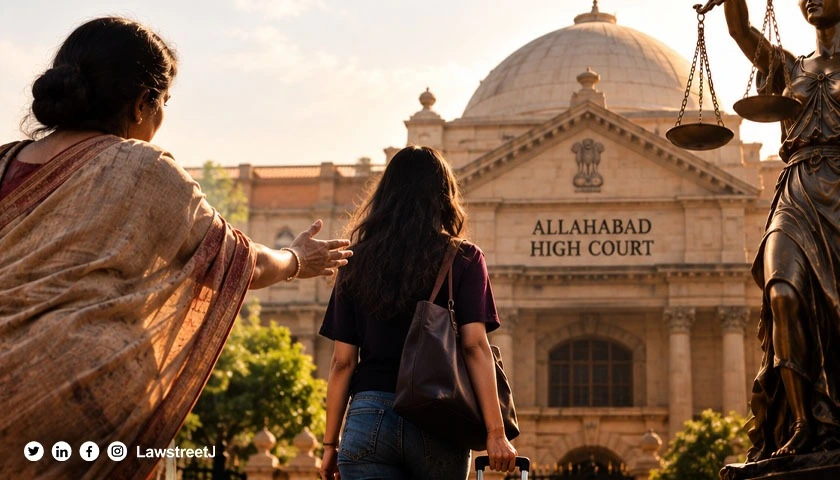


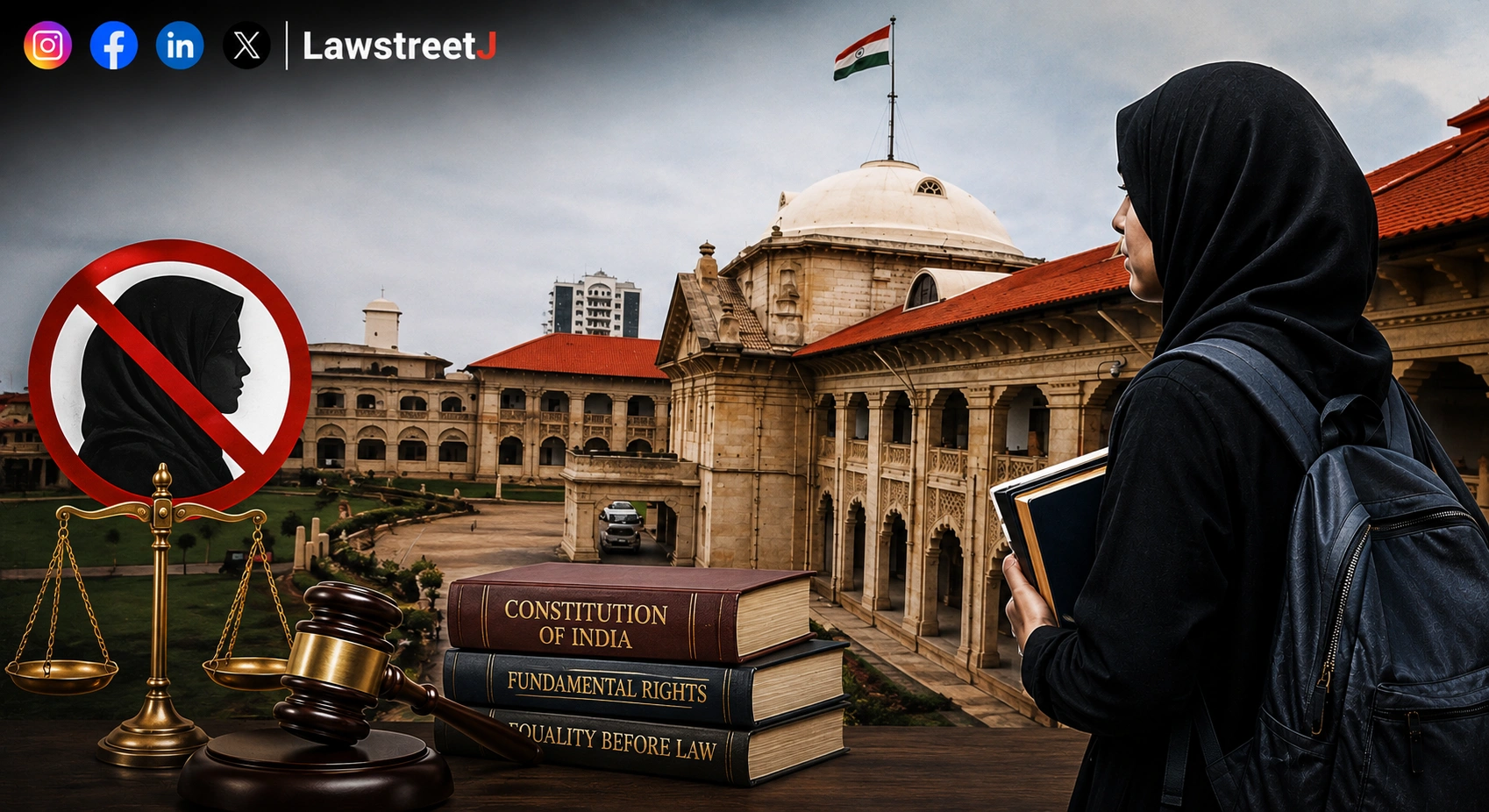
Allahabad: The Allahabad High Court has dismissed a writ petition seeking a mandamus directing a private unaided school to admit a student to Class-XI while permitting her to wear a headscarf in addition to its prescribed uniform, holding that the choice of dress code lies primarily within the domain of the institution and that no material had been placed on record to show that wearing a headscarf is an essential religious practice in Islam.
Background
A Division Bench of Dr. Justice J.J. Munir and Justice Indrajeet Shukla was hearing a writ petition filed by a minor student through her mother, after the School refused her admission to Class-XI on the ground that she insisted on wearing a headscarf with the prescribed uniform.
The petitioner had passed Class-X from the same School and said she had worn a headscarf regularly since Class-VI without any objection from the School, relying on ID cards and group photographs from Classes VIII to X in support. She approached the District Magistrate, who, though conceding he had no jurisdiction over the School, a private institution affiliated to the CBSE, called for a report from the District Inspector of Schools (DIOS). The Assistant DIOS recorded statements of both the petitioner and the School Principal, who stated that the School followed a uniform dress code binding on all students regardless of religion, that other girl students from the petitioner's own community complied with it, and that permitting one student an exemption would affect the School's administration. The DIOS endorsed this report and forwarded it to the District Magistrate.
Arguments
The petitioner contended that she was not violating the School's dress code but only adding a headscarf to it of her own will, that she belonged to the Muslim Shia community and had worn a scarf since childhood as an essential part of her faith, and that the School's refusal violated her fundamental rights to freedom of expression and dignity under Articles 19(1)(a) and 21, as well as her right to practise religion under Article 25. It was argued that there was no justification for the School to introduce this dress-code condition only at the stage of admission to Class-XI.
Counsel appearing for the State respondents submitted that the School, being a private unaided institution, was not subject to State control over its internal administration, including prescription of uniform, and that there was no violation of any fundamental right to religion at stake. Counsel for the CBSE supported this submission, urging that the petitioner was not entitled to the relief sought.
Analysis
The Court held that so long as a dress code is uniform, bona fide, non-discriminatory and intended to maintain discipline and institutional identity, the choice of the prescribed uniform primarily lies within the domain of the School. It observed that the petitioner's earlier, unobjected use of a headscarf in lower classes could not create a vested or enforceable right binding the School to relax its policy for Class-XI, and that prior leniency, whatever its cause, did not estop the School from enforcing its dress code going forward.
Surveying precedent, the Bench referred to its own Division Bench ruling in Pradeep Kumar Srivastava v. Ministry of Human Resource Development, which had upheld a school's prescribed dress code against a public-interest challenge; the Kerala High Court's decision in Fathima Thasneem v. State of Kerala, which held that an institution's right to manage its affairs could prevail over an individual's dress preference; and the Bombay High Court's ruling in Fathema Hussain Sayed v. Bharat Education Society, which found no violation of Article 25 in requiring a student to follow the prescribed dress code. It placed particular reliance on the Full Bench of the Karnataka High Court in Resham v. State of Karnataka, which had held that wearing a hijab is not part of an essential religious practice in Islam and that a uniform dress code promotes a religion-neutral atmosphere among students.
The Court noted that the Supreme Court's decision in Aishat Shifa v. State of Karnataka, arising from an appeal against Resham, had resulted in a split verdict without a final, authoritative ruling, and that a subsequent interim order of the Supreme Court staying a similar dress-code restriction in a Bombay High Court matter was not, by itself, a binding precedent, since interim orders carry no reasons. It held that the consistent, reasoned view of several High Courts remained persuasive authority. The Bench also observed that the petitioner's writ petition contained a bare assertion that wearing a headscarf was an essential religious practice, unsupported by any pleading or religious text establishing that its non-observance would alter the fundamental character of her faith.
Conclusion
Holding that the School had not curtailed the petitioner's freedom of faith but only required conformity to institutional discipline of which a uniform is a part, and that permitting individual departures from the prescribed dress code would defeat its very purpose, the Court found no case made out for the writ sought. The petition was accordingly dismissed, with no order as to costs.
Appearances:
For the Petitioner: Mr. Mohd. Monis, along with Mr. Ejaz Ahmad Khan and Ms. Zeenat Jahan, Advocates.
For Respondent Nos. 1, 4, 5 and 6: Mr. Girijesh Kumar Tripathi, Additional Chief Standing Counsel.
For Respondent Nos. 2 and 3 (CBSE): Mr. Alok Tiwari, Advocate.
Case Title: Sukaina Rizvi vs. State of U.P. and Others, Writ-C No. 31172 of 2026


!["No Loudspeakers For Azan, No Fundamental Right To Create Noise," Says Allahabad HC To Two Mosques [Read Judgment]](/secure/uploads/2020/01/lj_4995_Allahabad_HC_AZAN.jpg)