Patna: The Patna High Court has dismissed a miscellaneous appeal challenging a Family Court decree that declared that no valid marriage existed between the appellant and the respondent, holding that her name being recorded as the respondent's wife in a voter list could not, by itself, establish a valid Hindu marriage where the solemnisation of the marriage was disputed.
A Division Bench of Justices Bibek Chaudhuri and Rana Vikram Singh was hearing a miscellaneous appeal filed by the appellant-wife against the judgment & order dated 26.02.2020 and decree dated 18.03.2020 passed by the Principal Judge, Family Court, Siwan, in Title Suit No. 01 of 2011, whereby the suit filed by the respondent-husband was allowed and it was declared that the appellant was not his legally wedded wife and that no relationship of husband and wife existed between them.
The appellant was first married to the elder brother of the respondent, in 1990, out of which wedlock two children were born, and that after her first husband's death in 1997, she was married to the respondent, his younger brother, in 2002, pursuant to pressure from elders in both families. She claimed she was thereafter tortured for dowry and had earlier succeeded in a maintenance proceeding before the Family Court, an order that was upheld by the High Court in revision. Following the dismissal of that revision, the respondent instituted the Title Suit seeking a declaration that no marriage had ever taken place between them.
The Court noted that Section 7 of the Hindu Marriage Act, 1955 governs the ceremonies required for a valid Hindu marriage, and reproduced the provision in its judgment:
“7. Ceremonies for a Hindu marriage.-(1) A Hindu marriage may be solemnised in accordance with the customary rites and ceremonies of either party thereto. (2) Where such rites and ceremonies include the Saptapadi (that is, the taking of seven steps by the bridegroom and the bride jointly before the sacred fire), the marriage becomes complete and binding when the seventh step is taken.”
Further, the Court observed that the word “solemnised” means to perform the marriage with ceremonies in proper form, and that unless the appropriate rites and ceremonies are performed, a marriage cannot be said to be solemnised in law. It further relied on the Supreme Court's decision in Dolly Rani v. Manish Kumar Chanchal, reported in (2025) 2 SCC 587, extracting the following observations on the sacramental character of Hindu marriage:
“The Hindu marriage is a sacrament and has a sacred character... In Hindu Law, as already noted, marriage is a sacrament or a samskara. It is the foundation for a new family.”
Examining the evidence, the Court found that the appellant, examined as DW-1, had not disclosed the date, place or year of her alleged marriage with the respondent, and that none of the witnesses produced on her behalf spoke of having witnessed the ceremony, or of the performance of saptapadi and sindurdaan, which the Court described as essential rites of a Hindu marriage. It also noted a material contradiction between her witnesses as to the identity of the priest who allegedly performed the ceremony. The Court recorded its findings on this aspect as follows:
“All the witnesses so produced and examined on behalf of Durgawati (appellant) have not stated that when her marriage was solemnized with the respondent and whether the marriage was performed in their presence... The witnesses have also not stated about ‘saptapadi’ and ‘sindurdaan’, which are essentials of a Hindu marriage nor has this been claimed by the appellant in her written statement.”
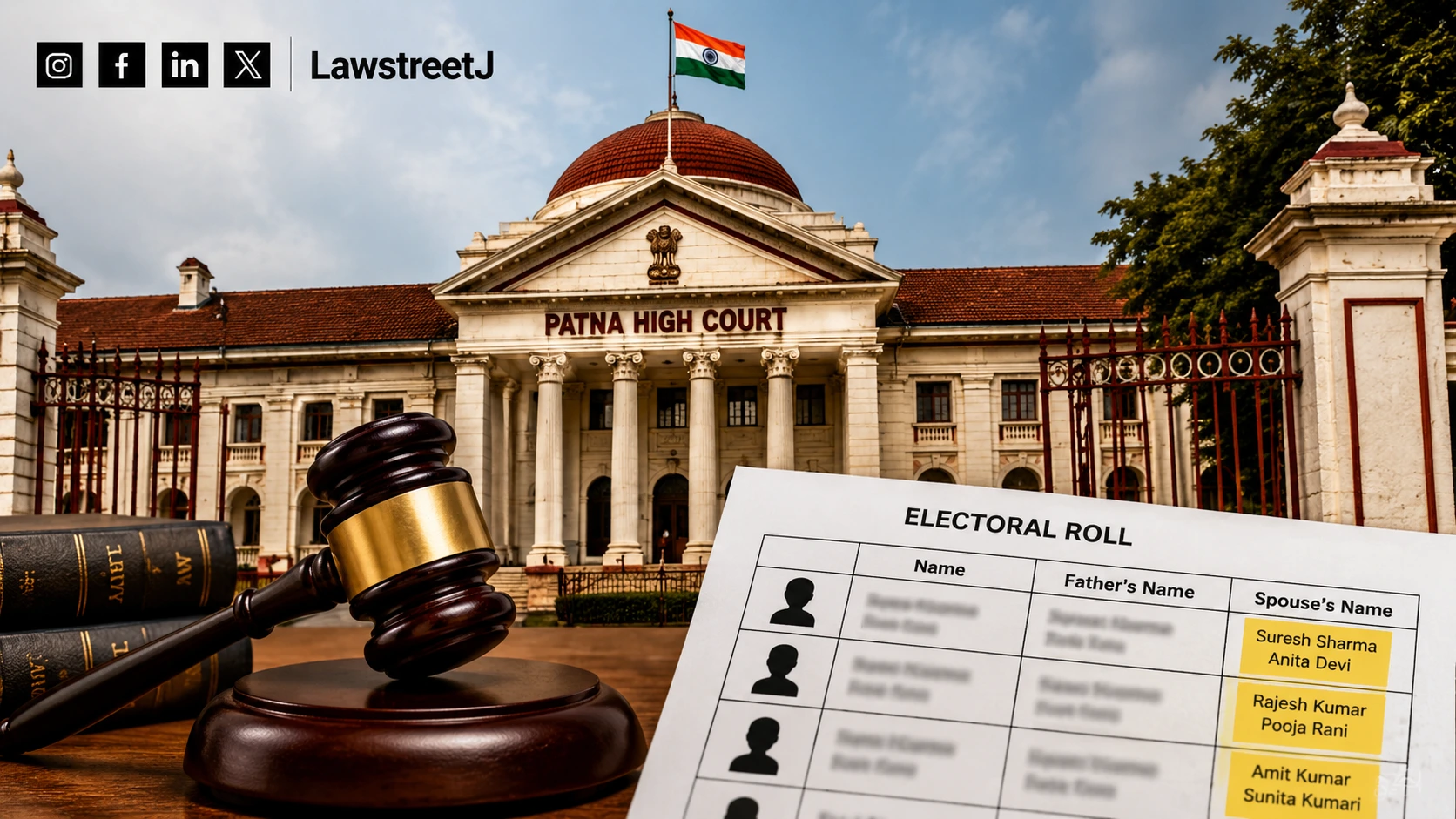
On the documentary evidence, the Court noted that the appellant relied principally on two maintenance orders and certified copies of the voter list for 2004, which showed her as the respondent's wife. However, it found that a subsequent voter list from 2009, produced by the respondent, showed her instead as the wife of Suresh Chaudhary, and held that such entries, being inconsistent, could not by themselves establish a subsisting marriage.
The Court held:
“Even, merely on the basis of names/entries made in the voter-list, one cannot claim validity with respect to solemnization of marriage between the parties. Entries made in the voter-list is not a conclusive proof with respect to any kind of valid or subsisting marriage, save and except the oral evidence, no other corroborative piece of evidence... have not been brought on record nor have been produced on behalf of the appellant in order to substantiate, support and buttress her claim of having a legal and valid marriage with the respondent.”
The Court further clarified that even if the marriage were registered under Section 8 of the Hindu Marriage Act, 1955, or under the Special Marriage Act, 1954, such registration would not by itself confer legitimacy on a marriage that had not, in fact, been solemnised in accordance with Section 7. In contrast, it found that the documents produced by the respondent including the death certificate of Suresh Chaudhary and other records corroborated that the appellant was his legally wedded wife, and that her relationship with the respondent was only that of Bhojayee (sister-in-law) and Devar (brother-in-law).
Holding that the appellant had failed to prove the factum of her marriage with the respondent in accordance with Hindu religious rites and rituals, the Court answered all three issues framed for adjudication whether she was the respondent's legally wedded wife, whether the marriage was solemnised as per Hindu rites, and whether there was evidence establishing a legally valid marriage in the negative, and dismissed the miscellaneous appeal, affirming the judgment, order and decree of the Family Court, Siwan, with no order as to costs.
Appearances:
For the Appellant: Mr. Bijay Shankar Choubey, Adv.; Mr. Bijay Prakash Singh, Adv.
For the Respondent: Mr. Vijay Kumar Mishra, Adv.
Case Title: Durgawati Devi vs. Sachita Chaudhary @ Sachitanand Yadav, Miscellaneous Appeal No. 316 of 2021


![Immediately stop caste-based survey: Patna High Court to Bihar Government [Read Order]](/secure/uploads/2023/05/lj_2614_70fde4fe-1b94-4360-a3d2-e162d6022c46.jpg)

![Supreme Court refuses pre arrest bail to IPS officer accused of creating fake WhatsApp account of HC's CJ [Read Order]](/secure/uploads/2023/11/lj_1575_Fake_WhatsApp_account_of_Patna_HC_Chief.jpg)