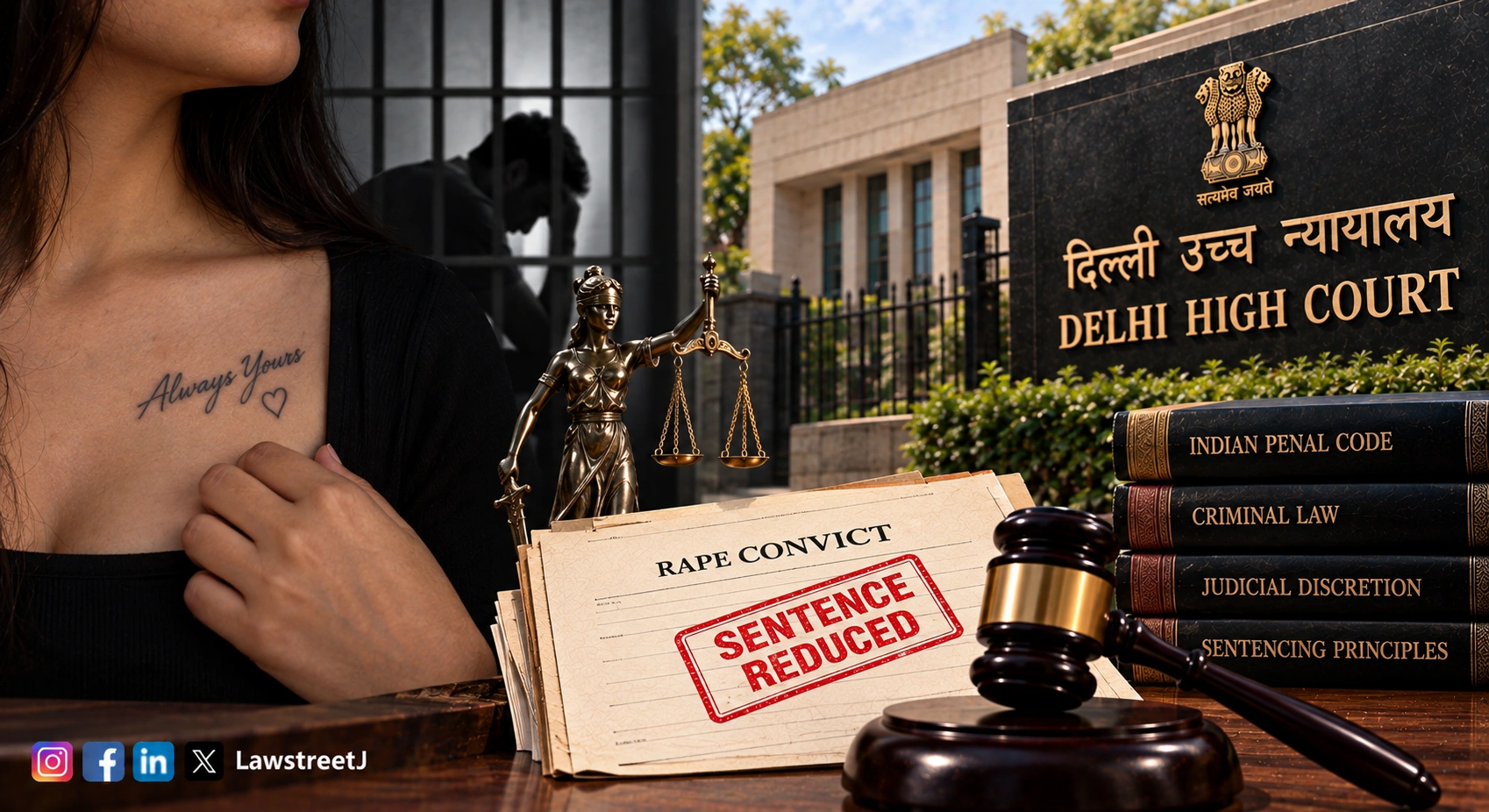
New Delhi: The Delhi High Court has modified the sentence of a man convicted of kidnapping and raping a minor in 2009, holding that the period of incarceration already undergone by him was sufficient punishment, after finding that the case arose from an adolescent relationship and that both the appellant and the prosecutrix were now settled in their respective married lives, with the prosecutrix herself expressing a wish not to pursue the matter further.
Justice Vimal Kumar Yadav was hearing a criminal appeal against a judgment of conviction under Sections 363, 366 and 376 of the Indian Penal Code and the accompanying order on sentence, with counsel for the appellant confining the challenge solely to the question of sentence.
The prosecution case was that the prosecutrix, then about 14 years old, went missing from her home on 15.06.2009, with an FIR under Section 363 IPC registered two days later on 17.06.2009, upon which she returned home. In the intervening period, she had travelled with the appellant to Connaught Place and then to Manali, Himachal Pradesh. While the appellant maintained that the prosecutrix had accompanied him voluntarily, the Court noted that her initial statements to medical authorities and in a statement recorded in her mother's presence on the date of her return were consistent with this version, and that her statement under Section 164 Cr.P.C., recorded only on 26.06.2009 without explanation for the delay, was the point at which she first took a position adverse to the appellant, a position she maintained thereafter, including in her deposition before the trial court.
The Court observed that the prosecutrix could not give a convincing explanation for tattoos of the appellant's name on her chest, or for the appellant's own tattoo of her name, and had not explained why she never raised an alarm despite stating that the appellant used to visit her school, nor why she did not inform her family or school authorities. The Court noted that the only factor weighing against the appellant was the prosecutrix's minority at the relevant time, and recorded that the trial court had itself found special and adequate reasons to impose a sentence below the then-prescribed statutory minimum under the unamended Section 376 IPC.
Counsel for the appellant sought the lightest possible sentence, citing mitigating circumstances including the deep intimacy between the parties, their subsequent marriages to other persons, the tattoos exchanged between them, their young ages at the time (the appellant being 18 and the prosecutrix 14), the prosecutrix's stated unwillingness to pursue the appeal, and the appellant's having already undergone nearly two years and four months of imprisonment (inclusive of remission), besides personal circumstances including the loss of an infant daughter, a subsequent child born through IVF treatment, and seventeen years of pending criminal proceedings.
Reliance was placed on the Supreme Court's observations in State of Uttar Pradesh v. Anurudh & Anr., where the government was urged to consider introducing a ‘Romeo-Juliet’ clause exempting genuine adolescent relationships from prosecution under child protection law, as well as on Illiyas v. State of Kerala and Ravi Kumar v. State, noting that the Delhi, Madras and Bombay High Courts have urged Parliament to consider legislative change in respect of adolescent relationships.
Relying on the Supreme Court's decision in Anversinh @ Kiransinh Fatesinh Zala v. State of Gujarat, the Court noted the absence of any force, coercion, weapon or other malafide in the case, and observed that over seventeen years had elapsed, both parties were now settled in their married lives, and the appellant's antecedents were otherwise clean, with no misuse of power, wealth, status or age. The Court further recorded that the prosecutrix had stated she did not wish to contest the appeal, and that her counsel had not opposed the appellant's plea.
While the State opposed further leniency on the ground that the trial court had already awarded a sentence below the statutory minimum, the Court held that sending the appellant back into custody at this stage, after such a long lapse of time and given the settled family lives of both parties, would serve no purpose and would amount to a travesty of justice.
Accordingly, the Court accepted the appellant's plea and directed that the period of custody already undergone by him be treated as sufficient punishment, with the sentence modified to the period already served, while leaving the fine imposed unaltered. The appeal was disposed of accordingly, with a copy of the judgment directed to be sent to the trial court and the concerned Jail Superintendent for compliance.
Appearances:
For the Appellant: Ms. Saahila Lamba, Adv.
For the Respondent: Mr. Raj Kumar, APP for the State with SI Kanhaiya Lal, PS Geeta Colony; Ms. Astha, Adv. (DHCLSC) with Ms. Megha Singh, Adv. for the prosecutrix.
Case Title: Vakul Kapoor vs. State, CRL.A. 676/2011


![Delhi High Court Sets Aside Arbitral Tribunal's Award Against NHAI in Highway Project Delay Case [Read Judgment]](/secure/uploads/2023/07/lj_9605_23374c2e-392c-4491-a2fe-f2f12fc5272f.jpg)
![Delhi Court Rejects Stay Request in Defamation Case Against Rajasthan CM Ashok Gehlot [Read Order]](/secure/uploads/2023/08/lj_5208_80de1ddc-d76a-4f7f-b180-408e3ae14fb4.jpg)