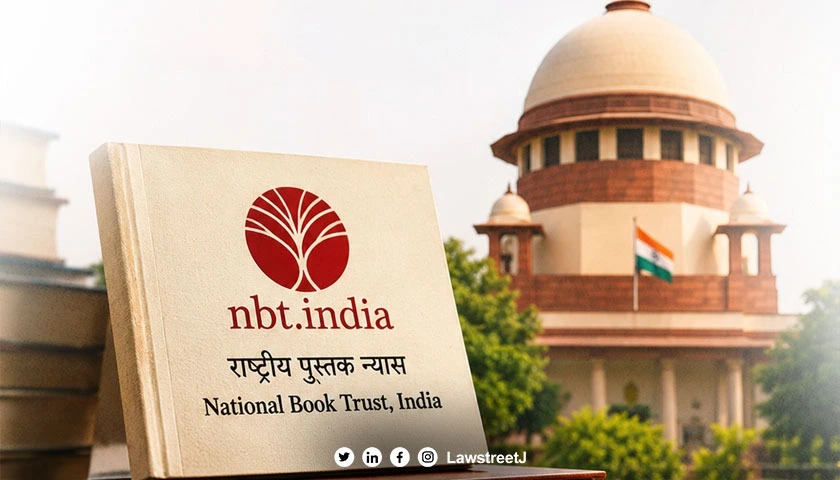
New Delhi: The Supreme Court has held that the National Book Trust, India is a ‘State’ under Article 12 of the Constitution, upholding the 2012 Full Bench judgment of the Delhi High Court and dismissing the Trust’s appeal.
A Bench of Justice Prashant Kumar Mishra and Justice Augustine George Masih delivered the judgment on 6 November 2026 (2026 INSC 1202), holding that the Trust is financially, functionally and administratively dominated by the Government, and that its registration as a society does not take it outside Article 12.
The appeal, Civil Appeal No. 14369 of 2015, was filed by the Chairman of the National Book Trust, India, and another, against A.R. Abdul Gaffar and others. The Court said that the only question for consideration was whether the Trust is a ‘State’ under Article 12. The Delhi High Court’s Full Bench, by its judgment dated 01.06.2012, had held that the Government exercises deep and pervasive control over the Trust, which is in substance an instrumentality or alter ego of the Government and falls within “other authorities”.
The Court recalled the law under Article 12 from Ramana Dayaram Shetty, Ajay Hasia and Pradeep Kumar Biswas, and held that the tests are not a rigid checklist, and that the inquiry is whether, on the cumulative facts, the body is financially, functionally and administratively dominated by, or under the control of, the Government, with control that is particular to the body and pervasive. Merely regulatory control, it said, would not make a body ‘State’.
The Trust argued that it is a society and not a juristic person like a statutory corporation. The Court found no substance in this, noting that Ajay Hasia itself shows that registration as a society does not place a body beyond Article 12, and that the inquiry is directed at the substance of the relationship with the Government and not at the legal form.
On the facts, the Court noted that the Trust was brought into existence by Government of India resolutions dated 15.06.1957 and 28.09.1962, to pursue a national objective of producing and disseminating literature at moderate prices. Under its Rules, the Chairman is appointed by the Government and holds office at its pleasure, the governing body includes representatives of the Ministries of Education, Finance and Information and Broadcasting, and the Government may nominate other members.
The Court held that this was not a case where a Government officer is merely associated with an independent organisation. The Executive Committee, which administers and controls the Trust’s affairs, includes Ministry representatives, with the Finance Ministry’s representative also acting as Financial Adviser, and its other members are Government nominees. The Trust’s rule-making power requires the previous approval of the Government, financial matters go to the Financial Adviser and, in specified cases, to the Ministers, annual reports and accounts go to the Government, and the CAG or its nominee audits the accounts.
The Court held that these features operate cumulatively and cannot be dismissed as ordinary regulatory supervision. It also rejected the Trust’s plea that Government grants form only one source of its income, holding that financial assistance is important but not an exclusive factor, and that earnings from the sale of books do not by themselves displace the pervasive control disclosed by the governing framework.
The Court clarified that it was not holding that publishing books is a sovereign or exclusively governmental function, or that every body with an educational purpose becomes ‘State’, relying on Zee Telefilms. It held that the relevance of the Trust’s functions lies in their character when seen along with its creation and control, noting that its objects include publication and translation of works and making books available at moderate prices. Later material, such as the Trust’s role in the PM-YUVA scheme, was treated only as corroborative.
The Bench said that a society is “not automatically ‘State’ merely because it is associated with the Government”, and that the Court must examine how it is constituted and how far the Government controls its functioning. It also made it clear that the declaration that the Trust is ‘State’ does not make it a department of the Government or its employees civil servants, and has no automatic consequence under Articles 309, 310 or 311, as Article 12 serves a distinct function for the purposes of Part III.
Upholding the Full Bench’s conclusion that the National Book Trust is an ‘other authority’ and a ‘State’ for the purposes of Article 12, the Court dismissed the appeal and placed on record its appreciation of the assistance of Senior Counsel Shri Sanjay Jain, who served as Amicus Curiae, assisted by Ms. Harshita Sukhija.
Case Title: The Chairman, National Book Trust, India and Another v. A.R. Abdul Gaffar and Others, Civil Appeal No. 14369 of 2015