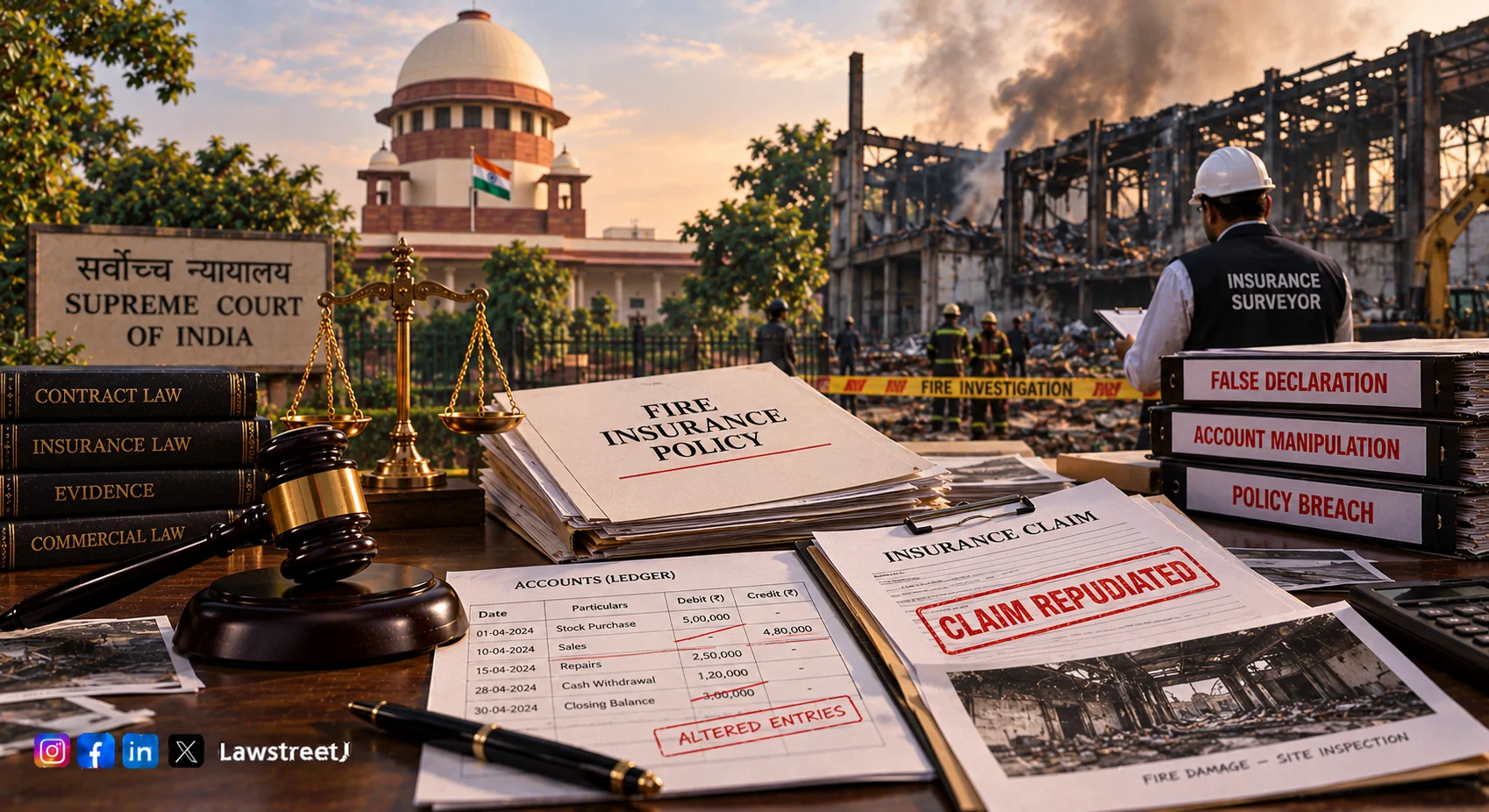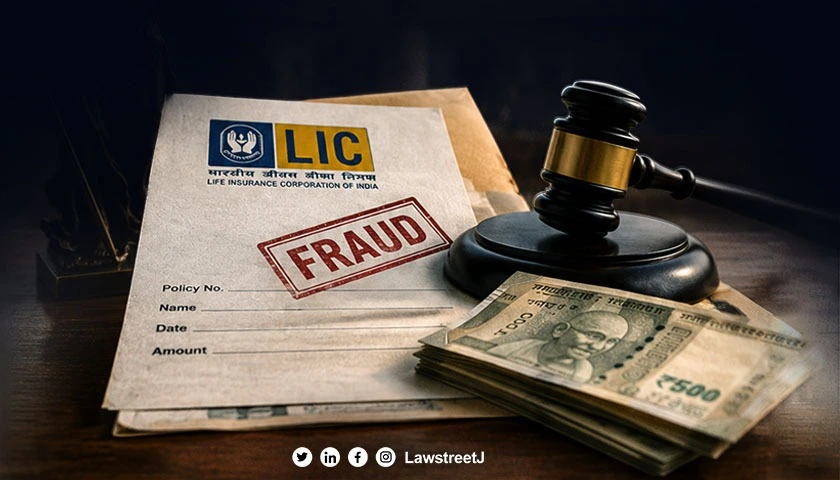
New Delhi: The National Consumer Disputes Redressal Commission has held that the Life Insurance Corporation of India is liable, directly and vicariously, for the fraud of its licensed agent who diverted a company’s advance renewal premiums into fresh policies, since LIC retained the entire premium credited to its account and its branch ignored KYC norms. It allowed a complaint by Goldstar Diamond Pvt. Ltd. and directed LIC to refund Rs 5,30,07,910 with 6% interest from the date of filing.
A Bench of Justice A.P. Sahi, President, and Bharatkumar Pandya, Member, was hearing the complaint of 2013 filed under the Consumer Protection Act, 1986. The company alleged that LIC’s agent, Chetan Desai, had sold it an “Employer-Employee Scheme” in 2005, under which it paid Rs 86.28 lakh for the first two years, and in 2007 persuaded it to pay Rs 7,90,69,030 as advance renewal premiums, by cheques drawn in LIC’s name but handed to him. The company later learnt that the receipts were forged, that the policies were issued on Form 300, which cannot be assigned, instead of Form 340, that many policies had lapsed, and that survival benefit cheques in employees’ names had been kept by him until stale. LIC’s internal reports of 22.06.2012 and 12.11.2012 found large-scale manipulation by the agent and procedural lapses at the branch, including bulk completion of proposals without KYC. His agency was terminated in 2014, and he admitted the manipulation in writing. LIC filed a recovery suit against him and a criminal case is pending.
LIC argued that the company is not a consumer, that the matter involved disputed questions of fact being tried in the criminal case and civil suit, that the agent had no authority to collect premium under Regulation 8 of the LIC Agents Regulations, 1972, relying on Harshad J. Shah, and that the company had colluded with him. The Commission had rejected the first two objections on 15.01.2025, and confirmed this, holding on the basis of National Insurance Co. v. Harsolia Motors and Kozyflx Mattresses v. SBI General Insurance that a company buying insurance is a consumer, and that the facts were not complicated because the receipt of the premium and its retention by LIC were undisputed and LIC itself was in agreement that the agent had cheated both sides.
On the agent’s authority, the Commission noted that he was a licensed agent whose business, since 2005, was to negotiate the acquisition of policies for LIC, and that the company’s cheques were in LIC’s name and credited to its account. Regulation 8(4) says that an agent has no authority to collect money, but the company had acted in good faith, believing it was an advance renewal premium, and had been deceived by the agent into the premium being treated as one for fresh policies. It held that LIC could not absolve itself on the plea that it had not authorised him to act unlawfully, because he represented that he had authority and the company had every reason to believe so. It observed that under Section 182 of the Contract Act the relationship of principal and agent could not be divorced from the transaction.
The Commission held that the agent was acting for LIC and:
“If the agent committed some fraud with the LIC, the Corporation by retaining the amount continues to ratify the said fraud and would therefore be liable directly as well as vicariously for the acts and omissions of the OP-2.”
It also found deficiency by the branch, since LIC’s own reports recorded proposals completed in bulk without KYC, with the employer’s address and records accepted as proof, signature variations, and cheques diverted to third-party deals and loans. It said that the 2009 KYCguidelines exempting small policies up to Rs 10,000 premium did not apply to a scheme with crores in premium, and that no lapse notices were proved to have been sent, since a bulk despatch by ordinary post without any record was no valid explanation. The plea of connivance was rejected as bereft of evidence, since it was not raised in LIC’s own suit or criminal complaint, in which it said that fraud was played upon the company, and it was the company that filed the criminal complaint.
As to relief, the Commission held that the claim of Rs 8,84,97,850 could not be accepted, since only the renewals diverted into fresh policies could be refunded, and the 2005 to 2007 policies were not in dispute. It computed the amount from the three receipts at Rs 1,36,71,800, Rs 2,84,95,110 and Rs 1,08,41,000, totalling Rs 5,30,07,910. It directed refund of that amount with 6% interest per annum from the filing of the complaint on 27.12.2013, payable within three months, failing which the interest rises to 9%, and awarded costs of Rs 1 lakh, declining the claim of Rs 10 crore as compensation.
Appearances:
For the Complainant: Mr. Ashish Mohan, Senior Advocate, with Mr. Vikas Mehta, Mr. Ankit Vashisht, Mr. Prashant Ghelawi, Mr. Vaishnav Kumar and Mr. Madhurendra Kumar, Advocates.
For OPs-1 and 3 (LIC): Ms. Manali Singhal, Senior Advocate, with Mr. Santosh Sachin and Mr. Deepak Singh Rawat, Advocates. OP-2 (the agent) was proceeded ex parte.
Case Title: M/s. Goldstar Diamond Pvt. Ltd. vs. M/s. Life Insurance Corporation of India Ltd. & Ors., NC/CC/454/2013