38.6c New Delhi, India, Saturday, March 21, 2026
Top Stories Supreme Court
Political NEWS Legislative Corner Celebstreet International Videos
Subscribe Contact Us
close
Judiciary

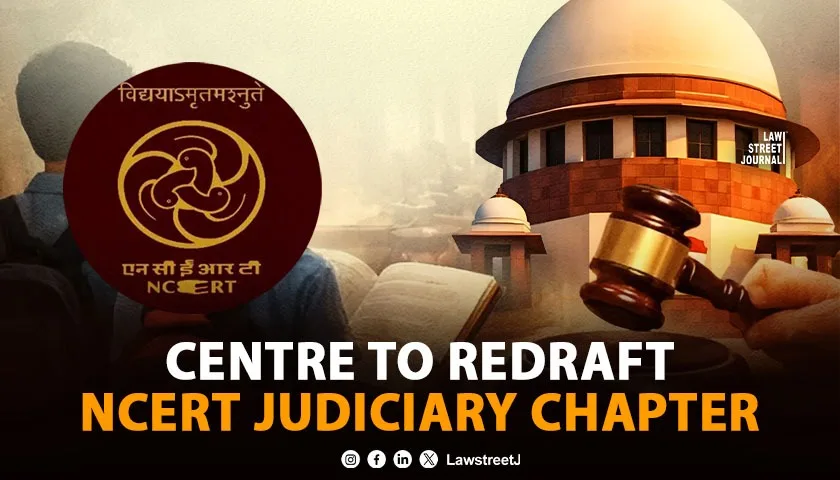
NCERT Textbook Row: Centre Tells Supreme Court High-Level Committee Will Redraft Judiciary Chapter

By Saket Sourav      20 March, 2026 06:46 PM      0 Comments
NCERT Textbook Row Centre Tells Supreme Court High Level Committee Will Redraft Judiciary Chapter

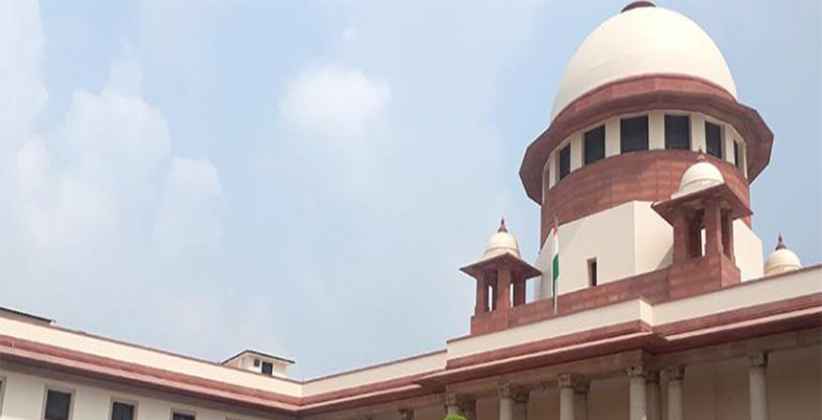
New Delhi: The Central Government on Friday informed the Supreme Court of India that it has constituted a high-level committee comprising eminent legal experts to redraft the controversial chapter on the judiciary in NCERT textbooks. This development follows intense judicial scrutiny and the registration of a suo motu case by the apex court over “offending” content in a Class 8 Social Science textbook.

Solicitor General Tushar Mehta, appearing for the Centre, made the submission before a three-judge Bench comprising Chief Justice of India Surya Kant and Justices Joymalya Bagchi and Vipul M. Pancholi. He informed the Court that the committee will include former Attorney General for India and Senior Advocate K.K. Venugopal, former Supreme Court judge Justice Indu Malhotra, and the Director of the National Judicial Academy and former Supreme Court judge, Justice Aniruddha Bose.

The committee has been tasked with reviewing and redrafting the curriculum relating to legal studies in NCERT textbooks, with particular focus on the chapter titled “The Role of the Judiciary in Our Society” in the book Exploring Society: India and Beyond (Class 8, Vol. 2). The textbook had included a section discussing “corruption in the judiciary,” which the Supreme Court viewed as a matter of serious institutional concern.

The Solicitor General clarified that the revised chapter will not be introduced into the syllabus unless it is thoroughly vetted and approved by this independent committee of domain experts. He further stated that the committee will also include a Vice-Chancellor to provide an academic perspective to the redrafting process.

During earlier proceedings, the Supreme Court had expressed strong dissatisfaction with the manner in which the content was approved. The Bench observed that the approval process appeared “casual” and noted with concern that no eminent jurists were involved in drafting a chapter meant to educate students about the judiciary.

The controversy began in late February when the Court took cognisance of the textbook content following submissions by Senior Advocates Kapil Sibal and Abhishek Manu Singhvi. The Court subsequently imposed a blanket ban on the production, printing, and digital dissemination of the book and ordered the seizure of all copies from schools and libraries.

Chief Justice Surya Kant had earlier remarked that the content appeared to be a “calculated move” and a “deep-rooted conspiracy” to defame the judiciary. He observed that while fair criticism is permissible, a biased narrative should not be presented to young students whose understanding of democratic institutions is still developing.

In response, the National Council of Educational Research and Training issued an unconditional and unqualified apology. NCERT Director Dr. Dinesh Prasad Saklani filed an affidavit stating that the inclusion of the material was an inadvertent error of judgment and confirmed that the book had been withdrawn from circulation.

As part of accountability measures, the Supreme Court directed the Central and State Governments to disassociate themselves from the experts who had drafted the original chapter. The individuals identified—Professor Michel Danino, Suparna Diwakar, and Alok Prasanna Kumar—were barred from participating in future publicly funded academic projects.

The Court observed that these individuals appeared to lack sufficient understanding of the judiciary and questioned their role in preparing educational material for students. NCERT later confirmed that they would not be associated with any of its future activities.

The Bench also expressed concern over irresponsible content circulating on social media regarding the Court’s orders. It directed the Government of India to identify those responsible, stating that appropriate legal action must follow and that such conduct would not be tolerated, even if originating from outside the country.

The Solicitor General assured the Court that the revised content would be introduced only for the 2026–27 academic session after completion of the committee’s review. He added that the government has directed NCERT to review textbooks across all classes to prevent similar issues in the future.

Upon being informed about the constitution of the committee and its members, the Supreme Court expressed satisfaction and disposed of the suo motu proceedings. The Court emphasised that educational material should promote constitutional values and foster respect for institutions among students.

Case title: In Re: Social Science Textbook for Grade 8 (Part 2) Published by NCERT and Ancillary Issues; Dr. Pankaj Pushkar v. Union of India and Anr., Diary No. 13060 of 2026.


Share this article:

About:

Saket is a law graduate from The National Law University and Judicial Academy, Assam. He has a keen ...Read more

Follow:
Linkedin


Leave a feedback about this
Related Posts
View All

Another CBI Officer Investigating Rakesh Asthana Moves SC Against Transfer, Makes Startling Revelations Another CBI Officer Investigating Rakesh Asthana Moves SC Against Transfer, Makes Startling Revelations

After A.K. Bassi, another CBI officer who was investigating corruption allegations against Special Director Rakesh Asthana moved the Supreme Court.

Ayodhya verdict: SC rules in favour of Ram Lalla, Sunni Waqf Board gets alternate land Ayodhya verdict: SC rules in favour of Ram Lalla, Sunni Waqf Board gets alternate land

SC bench led by CJI Ranjan Gogoi has allotted the dispute site to Ram Janmabhoomi Nyas, while directing the government to allot an alternate 5 acre land within Ayodhya to Sunni Waqf Board to build a mosque.

Supreme Court: Money Spent On Judiciary Less Than 1% In All States Except Delhi Supreme Court: Money Spent On Judiciary Less Than 1% In All States Except Delhi

The court guided all states to document their response to the commission's report within four weeks. If any of the states fail to file a response, it will be presumed that they have no objections to the recommendations made by the commission, the court said.

Supreme Court Top Panel Names Chief Justices for Bombay, Orissa and Meghalaya High Courts Supreme Court Top Panel Names Chief Justices for Bombay, Orissa and Meghalaya High Courts

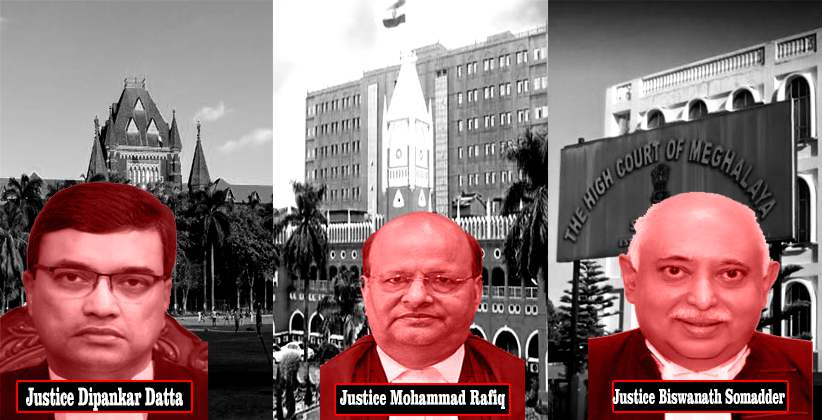
On April 18, 2020, the Supreme Court Collegium recommended new Chief Justices for three High Courts. Justice Dipankar Datta was proposed as Chief Justice of the Bombay High Court, succeeding Justice B.P. Dharmadhikari. Justice Biswanath Somadder was nominated as Chief Justice of Meghalaya High Court, while Justice Mohammad Rafiq was recommended for transfer as Chief Justice of Orissa High Court.

TRENDING NEWS

failure-to-generate-profits-from-movie-does-not-indicate-dishonest-intent-civil-dispute-cannot-be-given-the-colour-of-a-criminal-offence-sc
Trending Judiciary
Failure To Generate Profits From Movie Does Not Indicate Dishonest Intent; Civil Dispute Cannot Be Given the Colour of a Criminal Offence: SC [Read Judgment]

Supreme Court quashes Section 420 IPC case against film producer, says failure to share movie profits shows civil dispute, not cheating.

20 March, 2026 01:37 PM
gujarat-hc-upholds-cat-order-directs-centre-to-appoint-physically-handicapped-candidate-as-postal-sorting-assistant
Trending Judiciary
Gujarat HC Upholds CAT Order, Directs Centre to Appoint Physically Handicapped Candidate as Postal Sorting Assistant [Read Judgment]

Gujarat HC upholds CAT order, directs Centre to appoint physically handicapped candidate as Postal Sorting Assistant, rejecting Union’s plea.

20 March, 2026 02:24 PM

TOP STORIES

sc-cancels-anticipatory-bail-in-scst-atrocities-case-says-police-reconciliation-cannot-bar-fir-for-criminal-acts
Trending Judiciary
SC Cancels Anticipatory Bail in SC/ST Atrocities Case, Says Police Reconciliation Cannot Bar FIR for Criminal Acts [Read Order]

Supreme Court cancels anticipatory bail in SC/ST Act case, holding that police attempts at reconciliation cannot prevent registration of FIR for criminal acts.

16 March, 2026 02:44 PM
telangana-hc-sets-aside-dna-test-order-in-matrimonial-dispute-rules-child-cannot-be-used-as-pawn-to-prove-adultery
Trending Judiciary
Telangana HC Sets Aside DNA Test Order in Matrimonial Dispute; Rules Child Cannot Be Used as Pawn to Prove Adultery [Read Order]

Telangana High Court sets aside DNA test order in matrimonial dispute, holding a child cannot be used as a pawn to prove adultery against the mother.

16 March, 2026 05:35 PM
eviction-suit-over-petrol-pump-property-rejected-by-calcutta-hc-holds-dispute-commercial-in-nature-non-commercial-division-had-no-jurisdiction
Trending Judiciary
Eviction Suit Over Petrol Pump Property Rejected by Calcutta HC; Holds Dispute Commercial in Nature, Non-Commercial Division Had No Jurisdiction [Read Order]

Calcutta High Court rejects eviction suit over petrol pump property, holding the dispute commercial in nature and outside the jurisdiction of the non-commercial division.

16 March, 2026 06:00 PM
child-victims-in-pocso-cases-cannot-be-repeatedly-summoned-for-bail-hearings-or-evidence-delhi-hc
Trending Judiciary
Child Victims in POCSO Cases Cannot Be Repeatedly Summoned for Bail Hearings or Evidence: Delhi HC [Read Judgment]

Delhi High Court rules child victims in POCSO cases cannot be repeatedly summoned for bail hearings or evidence, consolidates safeguards for vulnerable witnesses.

16 March, 2026 06:24 PM

ADVERTISEMENT


Join Group

Signup for Our Newsletter

Get Exclusive access to members only content by email