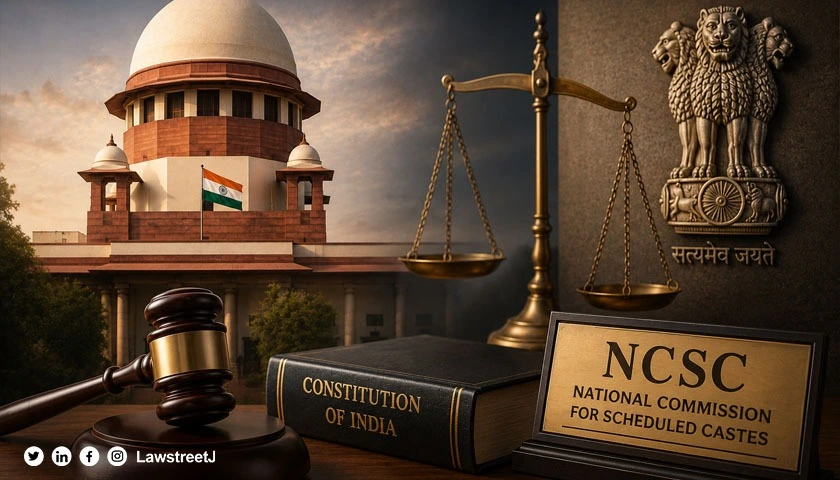
New Delhi: The Supreme Court has held that the National Commission for Scheduled Castes (NCSC), constituted under Article 338 of the Constitution, does not possess adjudicatory powers and cannot issue binding directions in service matters, including a direction to pay arrears within a stipulated period.
A Bench of Justices Sanjay Karol and Augustine George Masih was considering the question of whether the NCSC can pass orders in respect of service matters, and whether such orders are directory or mandatory.
Setting aside the judgment of the Bombay High Court, the Court held that the powers vested in the NCSC under Article 338 are limited to investigation, inquiry and recommendation, and do not extend to adjudication or the issuance of enforceable directions.
The Bench observed that the NCSC's role is confined to recording factual findings and calling upon the concerned Government to act thereupon, and that the powers of a civil court conferred on the Commission under Article 338(8) are procedural in nature, available only for the limited purpose of investigation and inquiry.
“It is therefore clear that while it has powers to requisition documents and receive evidence it does not have the power to make an order in furtherance of that evidence. In other words, NCSC can record a factual finding and then ask the concerned Government, either the Centre or the State to act thereupon.”
Background: Respondent No.3, an employee of the Mumbai Port Authority belonging to the Scheduled Caste, had been promoted to the post of Stenographer Grade-I in terms of an Office Memorandum dated 21st January 2002, which provided consequential seniority to SC/ST employees promoted through reservation. This OM was subsequently quashed by the Bombay High Court, and following a circular dated 27th December 2018 giving effect to that quashing, her seniority was reset and she was demoted from Grade I to Grade II, notionally with effect from 19th April 2007 to 30th November 2016, vide order dated 11th September 2020.
Aggrieved, she approached the NCSC, which, by order dated 23rd October 2024, directed the Mumbai Port Authority to strictly adhere to reservation-in-promotion guidelines, prepare a proper reservation roster, extend promotions in accordance with the rules of reservation, and implement the order along with payment of arrears within 30 days. The Mumbai Port Authority's challenge to this order was dismissed by the Bombay High Court, which held that the directions did not exceed the NCSC's constitutional mandate.
Before the Supreme Court, the Mumbai Port Authority contended that the NCSC lacked the power to issue such directions beyond what is contemplated under Article 338(5) of the Constitution.
The Court undertook a detailed analysis of Article 338, noting that while Sub-article (5)(b) casts a duty on the NCSC to inquire into complaints regarding deprivation of 'rights and safeguards' of Scheduled Castes, the use of the word 'and' indicates that the two are to be read conjunctively as a bundle, and do not confer a separate enforcement power. The Court rejected the NCSC's submission that the term 'safeguards' constitutes an independent enforcement limb of Sub-article (5).
Referring to Sub-clauses (a) and (d) of Article 338(5), the Bench held that the provision of safeguards is a legislative function, and the NCSC's role is confined to monitoring implementation and presenting reports and recommendations to the President or the appropriate Government.
The Court relied on its earlier decision in All India Indian Overseas Bank SC and ST Employees' Welfare Assn. v. Union of India, where it was held that the civil court powers conferred on the NCSC are confined to investigation and inquiry, and do not convert the Commission into a civil court or confer powers such as the grant of injunctions.
“All the procedural powers of a civil court are given to the Commission for the purpose of investigating and inquiring into these matters and that too for that limited purpose only. The powers of a civil court of granting injunctions, temporary or permanent, do not inhere in the Commission nor can such a power be inferred or derived from a reading of clause (8) of Article 338 of the Constitution.”
The Bench also drew upon Collector v. Ajit Jogi and Bhabani Prasad Jena v. Orissa State Commission for Women, both of which held that similarly constituted statutory and constitutional commissions are recommendatory and advisory bodies, and are not vested with adjudicatory powers akin to a court or tribunal.
Holding that the NCSC and its counterparts under Articles 338A and 338B are constitutional bodies with a socially beneficent purpose, but are assigned a role that is recommendatory and advisory rather than adjudicatory, the Court set aside the High Court's judgment and declared the NCSC's direction regarding payment of arrears to be contrary to the provisions of the Constitution and non-est in law.
The appeal was accordingly allowed.
Case Title: Mumbai Port Authority v. National Commission for Scheduled Caste & Ors. (SLP(C) No. 33359 of 2025)