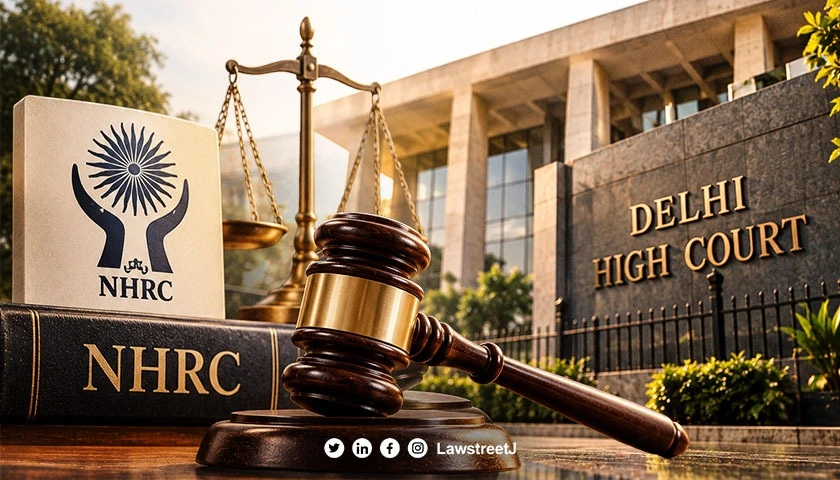
New Delhi: The Delhi High Court has held that it cannot entertain a writ petition challenging an order of the National Human Rights Commission merely because the order was passed at New Delhi, when the complainant, the victims, the incident and the authorities concerned are all in Sukma, Chhattisgarh.
Dismissing the petition for want of territorial jurisdiction and on the principle of forum conveniens, it granted liberty to approach the appropriate forum, including the High Court of Chhattisgarh.
Dr. Justice Swarana Kanta Sharma was hearing a petition by Baman Ram Kawasi, a resident of Village Chitlanar, District Sukma, who alleged that Christian Adivasi families faced a mob on 05.03.2026 demanding that they convert to Hinduism or leave, were assaulted and threatened, and were displaced to makeshift shelters in Sukma town without effective police action. His complaint under the Protection of Human Rights Act, 1993 was disposed of by the NHRC on 09.06.2026 with a direction to the District Magistrate and Superintendent of Police, Sukma, to take appropriate action within eight weeks. He sought that this order be treated as interim, that the complaint remain pending, and that fresh cognizance be taken after a hearing.
The Union argued that the entire cause of action arose in Chhattisgarh, that the NHRC order is to be acted upon at Sukma, and that a petition on the same subject was pending there and not fully disclosed. The petitioner argued that the impugned decision was taken by a statutory authority at New Delhi, forming a material part of the cause of action.
The Court recalled that cause of action means the bundle of material facts essential to the relief, citing State of Goa v. Summit Online Trade Solutions, Alchemist Ltd. v. State Bank of Sikkim and ONGC v. Utpal Kumar Basu. Under Article 226(2) the seat of the authority does not by itself confer jurisdiction, as held in Kusum Ingots & Alloys v. Union of India, and even where a small part of the cause of action arises, the court may decline jurisdiction under forum conveniens. The Full Bench decision in Sterling Agro Industries v. Union of India was also noted for the same position.
Applying this, the Court found that every fact forming the foundation of the grievance pertained to Chhattisgarh, and that the NHRC complaint itself was lodged online with the complainant, victims and place of incident recorded as Sukma. The impugned order adjudicated no right and merely transmitted the complaint to the Sukma authorities. The Court held that the NHRC “has acted merely as a channel, routing the complaint back to the very authorities at Sukma against whom the grievance is directed”, so deciding the reliefs would require examining events, inaction and records located in Chhattisgarh. It also noted that neither the State of Chhattisgarh nor the District Magistrate and Superintendent of Police, Sukma, had been impleaded.
Accepting the petitioner’s case would make every NHRC order, on an incident anywhere in India, challengeable in Delhi. The Court referred to The Indure Pvt. Ltd. v. Government of NCT of Delhi, where a Coordinate Bench said that the decision-maker’s location is “an unchanging constant” and doing so would make the Court a “mini-pan-India Superior Court”, and to its own decision in Rishi Pal v. National Commission for Scheduled Castes. It also relied on Suhas Chakma v. NHRC (W.P.(C) 4731/2021), where a petition against an NHRC closure of a displacement complaint was sent to the appropriate High Court.
The Court concluded that even if the New Delhi order gave rise to some part of the cause of action, it was insufficient to warrant exercise of writ jurisdiction, as the High Court of Chhattisgarh has the most direct and substantial connection with the lis. It declined to record any finding on the alleged concealment of the pending Chhattisgarh proceedings, but added that entertaining the petition would risk parallel adjudication and conflicting orders.
“If the contention of the petitioner were to be accepted, every order of the NHRC, concerning an incident anywhere in the country, would be amenable to challenge before this Court merely because the NHRC has its office at New Delhi.”
The petition was dismissed with liberty to avail remedies before the appropriate forum, including the High Court of Chhattisgarh. The Court clarified that it expressed no opinion on the merits or the respondents’ other objections.
Appearances:
For the Petitioner: Mr. Jaiwant Patnakar and Mr. Philip John, Advocates.
For Respondent No. 1 (Union of India): Mr. Premtosh K. Mishra, CGSC, with Mr. Krish Bhatia and Mr. Vasu Agarwal, Advocates.
Case Title: Baman Ram Kawasi vs. Union of India & Anr., W.P.(C) 13699/2026